Guide and picks
Cooling a nursery
Three constraints the rest of the site does not have: it has to be quiet, it has to be out of reach, and nobody in the room can tell you it is too cold.
By Sawyer V. · Published
The short answer
Put a ceiling fan or a tower fan rated 23 dBA on low in the room, positioned so the air circulates rather than blowing onto the crib, and keep every cord and every clip well away from it. If you need actual cooling rather than air movement, a certified 6,000 BTU window unit at 298 kWh a year runs quietly on a variable-speed compressor. Nothing goes on or near the crib.
Fan & Frost earns a commission when you buy through our links, at no cost to you. It never changes a ranking, and we say so when the right answer is the cheaper unit or nothing at all. Full disclosure · How we pick.

At a glance
The picks, ranked
Tap any row to jump to the full reasoning. Prices are live from Amazon where we have them, and read “check price” where we don’t — never a number we cannot verify today.
| # | Product | Best for | Price |
|---|---|---|---|
| 1 | 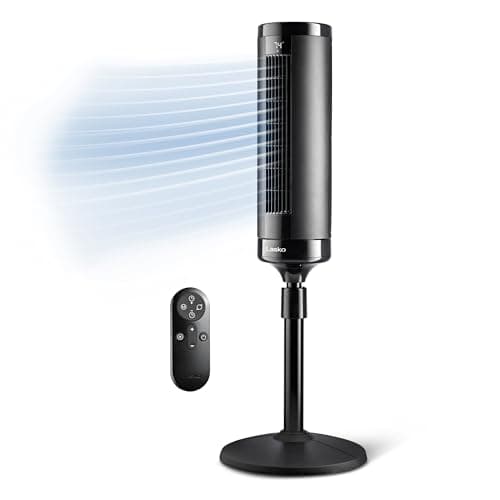 Quietest published figure on the site Lasko EcoQuiet 42" DC Tower Fan 23 dBA on low is the lowest published noise figure of any fan we have data for, and 2.9 W means it runs all night for nothing. | Air movement in a nursery, placed across the room from the crib | |
| 2 | 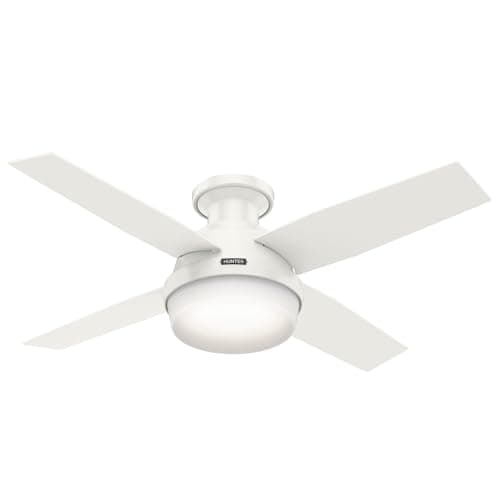 Nothing in the room at all Hunter Martindale 44" Ceiling Fan 10.1 W on high, 1.1 W on low, and it is fixed to the ceiling — no cord, no floor unit, nothing reachable. | A nursery you would rather keep completely clear | |
| 3 | If the room genuinely needs cooling Midea U-Shaped Window Air Conditioner, 6,000 BTU 6,000 BTU, CEER 15.1, 298 kWh a year, and a U-shape that puts the compressor outside a closed window. | A nursery that stays too warm despite shade and airflow | |
| — | 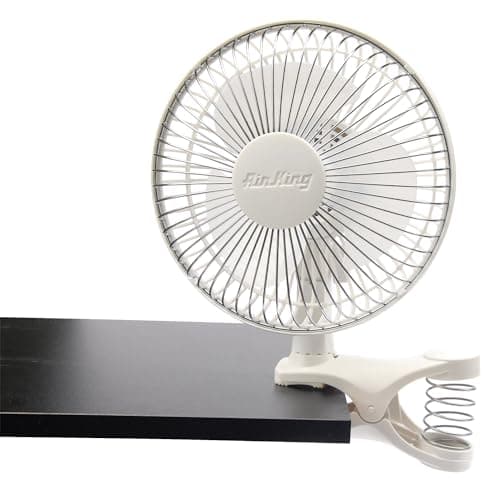 Do not put this anywhere near a crib Air King 6" Commercial Grade Clip-On Fan 34 dBA and 9 W make it look ideal on paper. It clips to things and has a six-foot cord, which makes it exactly wrong here. | A workshop or a desk — genuinely not this room |
Every other room on this site has one question: what gets it coolest for the least money. A nursery has three, and the cooling one comes last.
Constraint one
Quiet, measured rather than claimed
“Whisper quiet” appears on the box of essentially every fan sold. Published dBA figures appear on very few. Here is everything we have an actual number for.
| Product | Low | High |
|---|---|---|
| Lasko EcoQuiet T42710 tower | 23 dBA | 46 dBA |
| Lasko Aria T40733 tower | 31.5 dBA | 48.7 dBA |
| Air King 9145 clip-on | 34 dBA | 37 dBA |
| Lasko Whirlwind A12107 table | 39 dBA | 55 dBA |
| Midea Duo portable AC | 43 dBA | — |
| Whynter ARC-14S portable AC | under 51 dBA | under 56 dBA |
Manufacturer-published figures from each product page. Test conditions are not standardized across brands, so treat these as comparable within a brand and indicative across brands.
Not one window air conditioner in the ENERGY STAR certified dataset publishes a noise rating at all. The dataset records capacity, CEER, annual kWh, dimensions and weight. Acoustics are simply not part of the program. So for window units, the proxy is architecture rather than a number — a U-shape puts the compressor outside a closed window, and a variable-speed compressor modulates instead of cycling.
Constraint two
Placement, which matters more than the product
A baby cannot move away from a draft, cannot pull a blanket up, and cannot tell you the room is too cold. That changes how you aim things.
- Do not aim any fan at the crib. Circulate the room instead — point the fan at a wall, or upward, and let the air mix. You want the room to be evenly tempered, not the cot to be in a breeze.
- Put floor units across the room and behind furniture where possible, so the unit and its cord are physically out of the route a crawling or climbing child takes.
- Nothing goes on, in, or above the crib. No clip fans, no cords draped over a rail, no shelf-mounted anything above the sleep surface.
- Route cords behind furniture and secure them. A trailing lead from a floor fan is the most likely hazard in this whole category, and it is the easiest to eliminate.
- Check the temperature at cot height, not at your head height. Warm air stratifies upward; a thermometer on a high shelf reads a different room from the one the baby is in.
This one is not a DIY job
We are not going to tell you what temperature to keep the room at. Infant sleep guidance is medical advice, it varies by country and it changes, and it should come from your pediatrician or your national health service — not from a site that reviews fans.
What we can tell you is how to hit a target once you have one: measure at cot height rather than at eye level, use a variable-speed machine so you can hold a temperature instead of overshooting it, and size any air conditioner to the room rather than buying capacity you do not need.
Constraint three
Do the free things first
A nursery is usually a small room, often facing the wrong way, and small rooms respond disproportionately to the cheap interventions.
- Block the sun before it gets in. Solar gain through glazing is the largest single heat source in most bedrooms. Blackout blinds get bought for nurseries anyway — fitted close to the glass and closed during the hottest part of the day, they do double duty.
- Turn off what is in the room. A monitor, a nightlight, a humidifier and a white noise machine are each small, and each one is a small heater running continuously in a small space.
- Deal with the door. A closed nursery door with no return path means the room cannot exchange air with the rest of the house. If the door has to stay shut, the room needs its own airflow.
More on the no-cost approaches, which apply to any room but pay off most in a small one.
Say the unwelcome thing
Do not put an evaporative cooler in a nursery.
An evaporative cooler works by adding water vapor to the air. In a small, often closed room that is the wrong direction to push the humidity, and the humidity is not the only issue.
These machines hold standing water — the units on this site carry 6.6 to 15.9 gallons — in a warm tank, feeding a permanently damp pad. That is a maintenance burden with a biological failure mode, in a room where the occupant is breathing whatever comes off it and cannot tell you something smells wrong.
They are excellent machines in a dry garage or on a patio. Here is where they belong. Not here.
In short
The order to work through
Shade and heat sources first, because they are free and a small room responds strongly.
Then airflow — a ceiling fan if you own the place and want nothing in the room, or the 23 dBA tower fan if you do not.
Then, only if the room is genuinely too warm, a correctly sized 6,000 BTU U-shaped window unit.
And at every stage, the placement rules outrank the product choice.
In full
Every pick, and what is wrong with it
Published specifications only, each linked to the page it came from. Where a manufacturer publishes nothing, the row says so — we do not fill blanks in.
1. Quietest published figure on the site
Lasko EcoQuiet 42" DC Tower Fan
Lasko · model T42710
23 dBA on low is the lowest published noise figure of any fan we have data for, and 2.9 W means it runs all night for nothing.
23 dBA on low. Of every fan and air conditioner with a published noise rating across this site, this is the quietest figure, and it is not close.
2.9 W on low — about 0.6¢ for a twelve-hour night. A DC motor with 12 speeds, which matters more here than anywhere else on the site: you can find the setting that moves air without creating a draft, instead of choosing between three that are all slightly wrong.
Place it across the room, aimed at a wall or upward, so the room circulates and nothing blows directly onto the cot. The 8-hour timer covers a night.
The cord is the thing to plan. A tower fan sits on the floor with a lead running to a socket, and that has to be routed and secured somewhere a child cannot reach it.
What’s wrong with it
It is a floor-standing tower at 41.6 inches — it needs a position a toddler cannot reach, and the cord needs managing properly.
Running cost — T42710
| Nameplate power | 2.9 W – 19 W | manufacturer's published figure |
|---|---|---|
| Energy, 8-hour night | 0.15 kWh | 19 ÷ 1000 × 8 |
| Cost per hour | 0.3¢ | at 18.34¢/kWh |
| Cost per 8-hour night | 2.8¢ | on the highest speed |
| Cost per 30 nights | 84¢ | 4.6 kWh |
| Same month, lowest speed | 13¢ | at 2.9 W |
Rate: 18.34¢/kWh, the US average residential price for June 2026 (EIA Electric Power Monthly, Table 5.3). Yours will differ — swap it in: (watts ÷ 1000) × hours × your rate.
| Power | 2.9 W - 19 W (0.06-0.303 A at 120 V) |
|---|---|
| Noise | 23 dBA low, 46 dBA high |
| Speeds | 12 |
| Height | 41.6 in |
| Footprint | 12.8 x 12.8 in |
| Weight | 7.8 lb |
| Timer | 8 hours |
| Air delivery (CFM) | Not published |
| Warranty | 2 years |
Every figure above is from Lasko product page, T42710. Blanks are shown as “not published” rather than filled in.
2. Nothing in the room at all
Hunter Martindale 44" Ceiling Fan
Hunter · model 44in Martindale
10.1 W on high, 1.1 W on low, and it is fixed to the ceiling — no cord, no floor unit, nothing reachable.
The strongest argument for a ceiling fan in a nursery has nothing to do with airflow. There is nothing in the room to trip over, pull down, unplug or climb.
1.1 W on low is 0.2¢ across a twelve-hour night — a rounding error, which means the question of whether to leave it running does not arise.
Run it on low and in the summer direction for gentle circulation. In a small nursery, 44 inches is usually the right span — and check the 18-inch blade-to-wall clearance before you commit.
What’s wrong with it
It is an electrical installation, so it is not an option in most rentals, and no light kit means the room needs other lighting.
Running cost — 44in Martindale
| Nameplate power | 1.1 W – 10.1 W | manufacturer's published figure |
|---|---|---|
| Energy, 8-hour night | 0.08 kWh | 10.1 ÷ 1000 × 8 |
| Cost per hour | 0.2¢ | at 18.34¢/kWh |
| Cost per 8-hour night | 1.5¢ | on the highest speed |
| Cost per 30 nights | 44¢ | 2.4 kWh |
| Same month, lowest speed | 4.8¢ | at 1.1 W |
Rate: 18.34¢/kWh, the US average residential price for June 2026 (EIA Electric Power Monthly, Table 5.3). Yours will differ — swap it in: (watts ÷ 1000) × hours × your rate.
| Blade span | 44 in |
|---|---|
| Efficiency | 304.5 CFM per watt |
| Power, high speed | 10.1 W |
| Power, low speed | 1.1 W |
| Standby power | 0.4 W |
| Type | Indoor, fan only |
| Warranty | 3 years, components |
| ENERGY STAR | Certified |
Every figure above is from ENERGY STAR Certified Ceiling Fans dataset. Blanks are shown as “not published” rather than filled in.
3. If the room genuinely needs cooling
Midea U-Shaped Window Air Conditioner, 6,000 BTU
Midea · model MAW06V1QWT
6,000 BTU, CEER 15.1, 298 kWh a year, and a U-shape that puts the compressor outside a closed window.
When air movement is not enough, this is the least intrusive way to actually lower the temperature.
The U-shape is the reason it is here. The sash closes down through the middle of the unit, so the compressor sits outside a shut window with the glass between it and the room. That is the same principle a mini-split uses, and it takes the loudest component out of the nursery.
298 kWh a year — about $55 for a season — and it is on the ENERGY STAR Most Efficient list. The variable-speed compressor matters: it modulates rather than cycling on and off, so there is no repeated thunk to wake anyone.
Size it properly and do not go bigger. An oversized unit short-cycles, leaves the room clammy, and cycles more often — which is the opposite of what you want here. Sizing guide.
What’s wrong with it
53.1 lb and 22 inches deep — a two-person install, and it occupies the window all season.
Running cost — MAW06V1QWT
| Annual energy use | 298 kWh | ENERGY STAR certified figure |
|---|---|---|
| Annual cost | $55 | 298 × 18.34¢/kWh |
| Per cooling month | $14 | spread over a four-month season |
The annual figure is the certified value from the ENERGY STAR Certified Room Air Conditioners dataset, which models a standard cooling season rather than your actual summer. It is more useful than a nameplate wattage here, because a variable-speed compressor spends most of its life well below nameplate.
Rate: 18.34¢/kWh, the US average residential price for June 2026 (EIA Electric Power Monthly, Table 5.3). Yours will differ — swap it in: (watts ÷ 1000) × hours × your rate.
| Cooling capacity | 6,000 BTU/h |
|---|---|
| CEER | 15.1 |
| Annual energy use | 298 kWh/yr |
| vs federal standard | 37% less energy |
| Dimensions | 13.5 H x 19.2 W x 22.0 D in |
| Weight | 53.1 lb |
| Refrigerant | R-32 |
| Installation | U-shape; sash closes through the middle of the unit |
| Compressor | Variable speed |
| ENERGY STAR | Certified, and on the Most Efficient list |
Every figure above is from ENERGY STAR Certified Room Air Conditioners dataset. Blanks are shown as “not published” rather than filled in.
Skip this one
Air King 6" Commercial Grade Clip-On Fan
Air King · model 9145
34 dBA and 9 W make it look ideal on paper. It clips to things and has a six-foot cord, which makes it exactly wrong here.
This gets recommended for nurseries constantly and it should not be. The specs invite it — 34 dBA on low, 9 W, 2.22 lb, 190 CFM — and everything about the specs is beside the point.
It is designed to clip onto things. Clipped to a crib rail, a shelf above a cot, or a changing table, it is an object that can be pulled down into the space below it. And it has a six-foot cord that has to reach a socket from wherever it is clipped, which means a cord running through or near the sleep space.
No noise rating makes that acceptable. Cords and anything detachable stay well clear of a crib — nothing on it, nothing above it, nothing within reach of it.
It is a good product. Use it somewhere else.
What’s wrong with it
A clip mount near a crib is a fall hazard and the cord is a strangulation hazard. Neither is acceptable regardless of how quiet it is.
Running cost — 9145
| Nameplate power | 9 W – 12 W | manufacturer's published figure |
|---|---|---|
| Energy, 8-hour night | 0.10 kWh | 12 ÷ 1000 × 8 |
| Cost per hour | 0.2¢ | at 18.34¢/kWh |
| Cost per 8-hour night | 1.8¢ | on the highest speed |
| Cost per 30 nights | 53¢ | 2.9 kWh |
| Same month, lowest speed | 40¢ | at 9 W |
Rate: 18.34¢/kWh, the US average residential price for June 2026 (EIA Electric Power Monthly, Table 5.3). Yours will differ — swap it in: (watts ÷ 1000) × hours × your rate.
| Power | 9 W - 12 W (0.1-0.2 A at 120 V) |
|---|---|
| Air delivery | Up to 190 CFM |
| Noise | 34 dBA low, 37 dBA high |
| Speeds | 2 |
| Mounting | Spring-loaded clip, non-marking |
| Dimensions | 10.38 H x 6.25 L x 8.13 W in |
| Weight | 2.22 lb |
| Cord | 6 ft, 3-conductor |
| Listing | ETL listed, OSHA compliant |
| Warranty | 1 year |
Every figure above is from Air King product page, 9145 (via Lasko). Blanks are shown as “not published” rather than filled in.
We are not linking a buy button for this one. If you want to look at it anyway, it is easy enough to find — but we would rather send you to something that fits your room.
Questions people actually ask
Frequently asked
What is the quietest fan for a nursery?
Of the fans with a published figure, the Lasko EcoQuiet T42710 at 23 dBA on low is the quietest we have data for. Its DC motor also gives 12 speeds, so you can find a setting that circulates air without creating a draft rather than choosing between three.
Should a fan blow directly on a baby?
No. Aim it at a wall or upward so the room circulates and the air mixes evenly. A baby cannot move out of a draft, pull up a blanket, or tell you they are cold, so you want an evenly tempered room rather than airflow over the cot.
Are clip-on fans safe in a nursery?
Not near a crib. A clip mount is an object that can be pulled down into the space below it, and the cord has to run from wherever it is clipped to a socket. Nothing goes on, above, or within reach of the sleep surface, however quiet it is.
What size air conditioner for a nursery?
Size it to the room and resist going bigger. An oversized unit short-cycles, leaves the room clammy, and cycles on and off more often — which is exactly what you do not want in a room someone is sleeping in. Sizing guide.
How quiet are window air conditioners?
Nobody publishes a figure. Not one window unit in the ENERGY STAR certified dataset carries a noise rating — the program records capacity, efficiency, energy use and dimensions only. Judge by architecture instead: a U-shape puts the compressor outside a closed window, and a variable-speed compressor modulates rather than cycling.
Can you use an evaporative cooler in a nursery?
We would not. It adds humidity to a small, often closed room, and it holds several gallons of standing water feeding a permanently damp pad — a maintenance burden with a biological failure mode, in a room whose occupant cannot tell you something smells wrong.
Sources
Where these numbers came from
- ENERGY STAR Certified Room Air Conditioners dataset — CEER, annual kWh, and the absence of any noise field
- ENERGY STAR Certified Ceiling Fans dataset — CFM per watt and wattage by speed
- Lasko T42710 EcoQuiet product page — 23 dBA low, 2.9 W low, 12 speeds
- EIA Electric Power Monthly, Table 5.3 — electricity rate
Read next
Where to go from here
Back to Room Cooling, or read how we pick.