Guide and picks
Cooling a home office
A home office has a heat source no other room has, and a noise constraint no other room has. They pull in opposite directions.
By Sawyer V. · Published
The short answer
Deal with the equipment heat first — essentially all the power your computer and monitors draw ends up as heat in the room. Then pick on noise: the Air King 9145 clip-on is 34 to 37 dBA, a three-decibel spread that means it sounds the same at any speed, which is what a microphone wants. For real cooling, a certified 6,000 to 8,000 BTU window unit is quieter than any portable and half the running cost.
Fan & Frost earns a commission when you buy through our links, at no cost to you. It never changes a ranking, and we say so when the right answer is the cheaper unit or nothing at all. Full disclosure · How we pick.

At a glance
The picks, ranked
Tap any row to jump to the full reasoning. Prices are live from Amazon where we have them, and read “check price” where we don’t — never a number we cannot verify today.
| # | Product | Best for | Price |
|---|---|---|---|
| 1 | 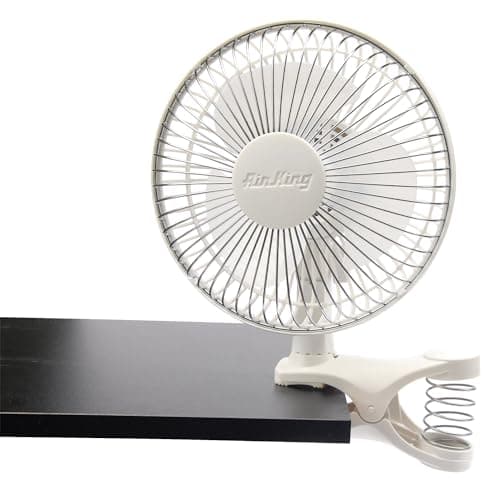 Best fan for a desk you take calls at Air King 6" Commercial Grade Clip-On Fan 34 dBA low, 37 dBA high — a three-decibel spread, so it sounds the same whatever speed it is on. | Personal airflow that does not change pitch when you change speed | |
| 2 | Best for the whole room, with scheduling Lasko Aria 40" Smart Wi-Fi Tower Fan 460 CFM at 31.5 dBA on low, and app or voice scheduling so it can pre-cool the room before your first meeting. | Cooling the office before you sit down in it | |
| 3 | 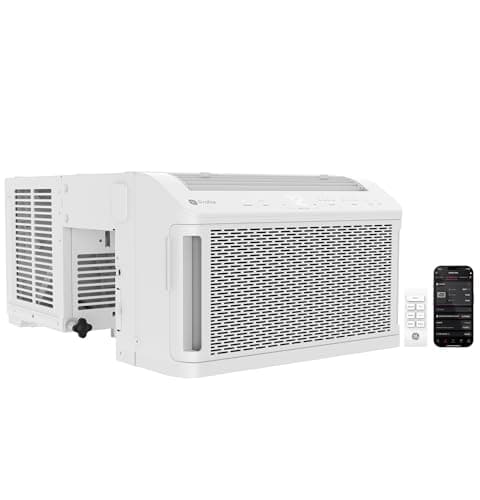 Best actual cooling GE Profile ClearView Window Air Conditioner, 8,000 BTU CEER 16, 375 kWh a year, and a variable-speed compressor that modulates instead of cycling on and off through your meetings. | An office that is genuinely too hot, not just stuffy | |
| — | The one that will ruin your calls Whynter ARC-14S Dual Hose Portable Air Conditioner 1,300 W and under 51 dBA on low, with a compressor sitting three feet from your microphone. | A room with no usable window — and nothing else |
A home office is usually the smallest room in the house, frequently the one that was a box room, and it is the only room with a heat source that runs for eight hours a day at your elbow.
Start here
Your desk is a heater
This is the part most cooling advice for offices skips, and it is where the largest, cheapest wins are.
Essentially all the electrical power drawn by a computer, a monitor or a router ends up as heat in the room. Energy is conserved. A little leaves as light and sound, and the rest is thermal. A desk drawing 300 watts is a 300-watt heater running while you work.
For scale, using the certified figures from elsewhere on this site: the most efficient 44-inch ceiling fan we have data for draws 10.1 W. A gaming desktop under load can draw thirty times that, continuously, in a room with the door shut.
Which suggests some things worth doing before you buy anything:
- Check what is actually on. A desktop left running overnight, a second machine you no longer use, a laptop charging at full rate all day, a monitor that never sleeps — each is a continuous thermal load.
- Move what you can out of the room. A network switch, a NAS, a printer, a UPS. None of them need to be next to you, and each takes its heat with it.
- Let the machine idle properly. Power management is the only fix here that costs nothing and reduces heat directly at source.
None of this replaces cooling in a genuinely hot room. All of it reduces how much cooling you need.
The constraint
The noise problem is specific
Every room has a noise preference. An office you take calls in has a requirement, and it is a slightly unusual one.
Steady noise is far less of a problem than changing noise. Noise suppression on a call adapts to a constant background and removes it well. What defeats it is change — a compressor kicking in, a fan stepping up a speed, a machine cycling.
Which reframes the specification you should be reading.
| Product | Low | High | Spread |
|---|---|---|---|
| Air King 9145 clip-on | 34 dBA | 37 dBA | 3 dB |
| Lasko Aria T40733 tower | 31.5 dBA | 48.7 dBA | 17.2 dB |
| Lasko EcoQuiet T42710 tower | 23 dBA | 46 dBA | 23 dB |
| Lasko Whirlwind A12107 table | 39 dBA | 55 dBA | 16 dB |
Manufacturer-published figures. Test conditions are not standardized across brands.
The EcoQuiet has the quietest low setting on the site by a distance, and it is the right answer for a bedroom. For an office, the Air King’s three-decibel spread is arguably more valuable: you can change speed mid-meeting and nothing about the call changes.
And for air conditioners, remember that no window unit in the ENERGY STAR certified dataset publishes a noise rating at all. You are choosing on architecture: variable-speed compressor over single-speed, and half the machine outside rather than all of it inside.
This one is not a DIY job
Position the fan behind the microphone, not in front of it. A fan pointed at your face is also pointed at your mic, and moving air across a microphone element produces low-frequency noise that no amount of software suppression handles cleanly.
Put it to the side or behind you, aimed across rather than at you. You still get air movement over your skin, which is what actually makes you feel cooler, without the airflow crossing the capsule.
A clip-on fan makes this easy because it mounts off the desk entirely — a shelf edge or the top of a monitor puts it above and behind the microphone line.
The room
A small room with the door shut
Home offices are frequently the smallest bedroom, and small rooms have a specific behavior: they heat quickly, and they respond quickly.
Shade the window. Solar gain through glazing is usually the largest single heat input, larger than the computer. A west-facing office is unworkable by mid-afternoon for exactly this reason, and a blind fitted close to the glass and closed before the sun arrives is free.
Open the door if you can. A closed door in a small room with a continuous heat source means the heat has nowhere to go. If the door has to stay shut for calls, that is precisely the situation that justifies buying cooling.
Time the ventilation. If the outdoor air is cooler in the morning, ventilate then and shut everything before the afternoon. More on the free interventions.
Say the unwelcome thing
Do not buy a portable air conditioner for a room you take calls in.
It is the standard recommendation for offices and it is the wrong one. A portable puts the entire refrigeration system — compressor included — on the floor beside your desk. A window unit puts half of it outside the building.
The efficiency case is just as poor. A portable pulls room air across the condenser and blows it out the hose, so the room goes slightly negative and pulls hot outdoor air in through every gap to replace it. That is why DOE-rated SACC capacity comes in so far below the marketing BTU figure — 9,500 against 14,000 on the unit above.
If the window will take a unit, use a window unit. If it genuinely will not, choose the portable carefully and expect to hear it.
In short
What to actually do
Reduce the heat you are making. Free, and in a small room it is often decisive.
Shade the glass. Also free, and usually larger than the equipment load.
Then personal airflow — a clip-on fan mounted behind the microphone line, at 9 to 12 W.
Then room airflow — a scheduled tower fan that runs before you sit down.
Then, if the room is genuinely hot, a certified window unit with a modulating compressor.
In full
Every pick, and what is wrong with it
Published specifications only, each linked to the page it came from. Where a manufacturer publishes nothing, the row says so — we do not fill blanks in.
1. Best fan for a desk you take calls at
Air King 6" Commercial Grade Clip-On Fan
Air King · model 9145
34 dBA low, 37 dBA high — a three-decibel spread, so it sounds the same whatever speed it is on.
The specification that makes this the desk pick is the one nobody markets: 34 dBA on low against 37 dBA on high.
Three decibels between the extremes. Compare that with the Lasko A12107’s 39 to 55 dBA — a 16-decibel range. A fan whose noise floor barely moves is a fan you can turn up mid-call without anyone noticing, and without your noise suppression suddenly having a different signal to work against.
9 to 12 W — about 1.8¢ for an eight-hour working day — and up to 190 CFM from 2.22 lb. ETL listed and OSHA compliant, which is a commercial-grade specification on a desk product.
The clip mount is the real advantage in an office. It goes on a shelf edge, a monitor arm, or the back of the desk — and takes up no desk surface at all.
What’s wrong with it
190 CFM is personal airflow only. It will not do anything for the room, and 6 inches of blade is a desk-scale product.
Running cost — 9145
| Nameplate power | 9 W – 12 W | manufacturer's published figure |
|---|---|---|
| Energy, 8-hour night | 0.10 kWh | 12 ÷ 1000 × 8 |
| Cost per hour | 0.2¢ | at 18.34¢/kWh |
| Cost per 8-hour night | 1.8¢ | on the highest speed |
| Cost per 30 nights | 53¢ | 2.9 kWh |
| Same month, lowest speed | 40¢ | at 9 W |
Rate: 18.34¢/kWh, the US average residential price for June 2026 (EIA Electric Power Monthly, Table 5.3). Yours will differ — swap it in: (watts ÷ 1000) × hours × your rate.
| Power | 9 W - 12 W (0.1-0.2 A at 120 V) |
|---|---|
| Air delivery | Up to 190 CFM |
| Noise | 34 dBA low, 37 dBA high |
| Speeds | 2 |
| Mounting | Spring-loaded clip, non-marking |
| Dimensions | 10.38 H x 6.25 L x 8.13 W in |
| Weight | 2.22 lb |
| Cord | 6 ft, 3-conductor |
| Listing | ETL listed, OSHA compliant |
| Warranty | 1 year |
Every figure above is from Air King product page, 9145 (via Lasko). Blanks are shown as “not published” rather than filled in.
2. Best for the whole room, with scheduling
Lasko Aria 40" Smart Wi-Fi Tower Fan
Lasko · model T40733
460 CFM at 31.5 dBA on low, and app or voice scheduling so it can pre-cool the room before your first meeting.
31.5 dBA on low while moving 460 CFM is a genuinely good combination, and it is enough air to work the whole room rather than just your seat.
The scheduling is the reason it is here rather than in a general fan roundup. A home office is occupied on a predictable timetable, so a fan that starts twenty minutes before you sit down is solving the problem at the right moment. Alexa, Google Assistant, or the Aria app.
41 to 52 W — about 7.6¢ for a working day at full power, less if you leave it low.
Note the honest limit: 48.7 dBA on high is audible, and it will be on a call. Run it high between meetings and drop it to low when the camera goes on.
What’s wrong with it
48.7 dBA on high is audible on a call, and the remote is not included — you are relying on the app or a smart speaker.
Running cost — T40733
| Nameplate power | 41 W – 52 W | manufacturer's published figure |
|---|---|---|
| Energy, 8-hour night | 0.42 kWh | 52 ÷ 1000 × 8 |
| Cost per hour | 1.0¢ | at 18.34¢/kWh |
| Cost per 8-hour night | 7.6¢ | on the highest speed |
| Cost per 30 nights | $2.29 | 12.5 kWh |
| Same month, lowest speed | $1.80 | at 41 W |
Rate: 18.34¢/kWh, the US average residential price for June 2026 (EIA Electric Power Monthly, Table 5.3). Yours will differ — swap it in: (watts ÷ 1000) × hours × your rate.
| Power | 41 W - 52 W (0.3-0.44 A at 120 V) |
|---|---|
| Air delivery | 460 CFM |
| Noise | 31.5 dBA low, 48.7 dBA high |
| Speeds | 5 |
| Smart control | Aria for Home app (iOS/Android), Amazon Alexa, Google Assistant |
| Height | 39.58 in |
| Footprint | 11.2 x 11.2 in |
| Weight | 9.5 lb |
| Timer | 9 hours |
| Oscillation | 90 degrees |
| Remote | Not included |
| Warranty | 2 years |
Every figure above is from Lasko product page, T40733. Blanks are shown as “not published” rather than filled in.
3. Best actual cooling
GE Profile ClearView Window Air Conditioner, 8,000 BTU
GE Profile · model PWJV08W
CEER 16, 375 kWh a year, and a variable-speed compressor that modulates instead of cycling on and off through your meetings.
When airflow is not enough — and in a west-facing office with three screens it often is not — this is the efficient answer.
375 kWh a year, about $69 for a season. CEER 16 is the top of the 8,000 BTU class and it is on the ENERGY STAR Most Efficient list.
The variable-speed compressor is the office-specific argument. A single-speed unit cycles hard on, hard off, and each transition is an event your microphone hears. A modulating compressor holds a steady level, which is far easier to ignore and far easier for noise suppression to handle.
At 15.3 inches deep and 46.2 lb it is also the easiest certified unit in its class to install. Installation guide.
What’s wrong with it
46.2 lb, occupies the window for the season, and no window unit publishes a noise rating so you are buying on architecture.
Running cost — PWJV08W
| Annual energy use | 375 kWh | ENERGY STAR certified figure |
|---|---|---|
| Annual cost | $69 | 375 × 18.34¢/kWh |
| Per cooling month | $17 | spread over a four-month season |
The annual figure is the certified value from the ENERGY STAR Certified Room Air Conditioners dataset, which models a standard cooling season rather than your actual summer. It is more useful than a nameplate wattage here, because a variable-speed compressor spends most of its life well below nameplate.
Rate: 18.34¢/kWh, the US average residential price for June 2026 (EIA Electric Power Monthly, Table 5.3). Yours will differ — swap it in: (watts ÷ 1000) × hours × your rate.
| Cooling capacity | 8,000 BTU/h |
|---|---|
| CEER | 16 |
| Annual energy use | 375 kWh/yr |
| vs federal standard | 47% less energy |
| Dimensions | 12.6 H x 18.6 W x 15.3 D in |
| Weight | 46.2 lb |
| Refrigerant | R-32 |
| Installation | Does not straddle the windowsill |
| Compressor | Variable speed |
| ENERGY STAR | Certified, and on the Most Efficient list |
Every figure above is from ENERGY STAR Certified Room Air Conditioners dataset. Blanks are shown as “not published” rather than filled in.
Skip this one
Whynter ARC-14S Dual Hose Portable Air Conditioner
Whynter · model ARC-14S
1,300 W and under 51 dBA on low, with a compressor sitting three feet from your microphone.
Portable air conditioners are the default recommendation for offices because they need no installation. For a room you take calls in they are the worst choice available.
The compressor is in the room. Not in a window frame, not outside on a pad — in the room, a few feet from your microphone, cycling. Under 51 dBA on low is the manufacturer’s own figure, and it is measured from a distance, not from your chair.
The efficiency case is no better. 1,300 W, and a 14,000 BTU headline that is DOE-rated at 9,500 BTU SACC — a 32 percent haircut once duct heat and infiltration are counted. Why that gap exists.
Buy one only if the window genuinely cannot take a unit. That case is covered here.
What’s wrong with it
The entire machine — compressor included — is inside the room with you. A window unit puts half of it outside. That is the whole difference.
Running cost — ARC-14S
| Nameplate power | 1300 W | manufacturer's published figure |
|---|---|---|
| Energy, 8-hour night | 10.40 kWh | 1300 ÷ 1000 × 8 |
| Cost per hour | 24¢ | at 18.34¢/kWh |
| Cost per 8-hour night | $1.91 | on the highest speed |
| Cost per 30 nights | $57 | 312.0 kWh |
Rate: 18.34¢/kWh, the US average residential price for June 2026 (EIA Electric Power Monthly, Table 5.3). Yours will differ — swap it in: (watts ÷ 1000) × hours × your rate.
| Marketing capacity | 14,000 BTU (ASHRAE-128) |
|---|---|
| DOE-rated capacity | 9,500 BTU SACC |
| Hoses | Dual |
| Power | 1,300 W / 11.6 A at 115 V |
| Noise | Under 51 dBA low, under 56 dBA high |
| Dehumidification | 71 pints/day |
| Refrigerant | R-32 |
| Dimensions | 16 W x 19 D x 35.5 H in |
| Weight | 73 lb |
| Manufacturer coverage claim | 500 sq ft |
| Warranty | 1 year unit, 3 years compressor |
Every figure above is from Whynter product page, ARC-14S. Blanks are shown as “not published” rather than filled in.
We are not linking a buy button for this one. If you want to look at it anyway, it is easy enough to find — but we would rather send you to something that fits your room.
Questions people actually ask
Frequently asked
Does a computer make a room hotter?
Yes, and by essentially its full power draw. Almost all the electrical energy a computer, monitor or router consumes ends up as heat in the room — a desk drawing 300 watts is a 300-watt heater running while you work.
What is the quietest fan for a home office?
For calls specifically, the Air King 9145 at 34 to 37 dBA — a three-decibel spread means it sounds the same at any speed. For the lowest absolute figure, the Lasko EcoQuiet T42710 at 23 dBA on low, though it rises to 46 dBA at full speed.
Where should a fan go on a desk for video calls?
Behind or beside you, aimed across rather than at you — never in front of the microphone. Air moving across a mic element produces low-frequency noise that software suppression handles poorly. A clip-on fan mounted on a shelf edge sits above the microphone line entirely.
Is a portable air conditioner good for a home office?
It is the worst option for a room you take calls in, because the compressor sits inside the room a few feet from your microphone. A window unit puts half the machine outside, runs on far less power, and a variable-speed model modulates instead of cycling audibly.
Why is my home office hotter than the rest of the house?
Usually three things at once: it is the smallest room, it has a continuous 100 to 400 watt heat source at the desk, and the door is shut. Small rooms with a constant load and no air exchange heat up quickly and stay hot.
Do window air conditioners have noise ratings?
Not in the certified data. No window unit in the ENERGY STAR dataset publishes a noise figure — the program records capacity, CEER, annual kWh and dimensions only. Choose on architecture: a variable-speed compressor that modulates rather than cycling.
Sources
Where these numbers came from
Read next
Where to go from here
Back to Room Cooling, or read how we pick.