Guide and picks
BTU vs SACC: why the box says 14,000 and the label says 9,500
Portable air conditioners carry two capacity numbers that can differ by a third. Neither is a lie, exactly. But only one of them tells you what will happen in your room.
By Sawyer V. · Published
The short answer
The number on the box is measured by an older standard that ignores heat leaking back through the exhaust duct and hot outside air infiltrating to replace what the unit blew out. SACC — Seasonally Adjusted Cooling Capacity, the DOE-rated figure — subtracts both. It is always lower, the gap varies enormously by unit, and it is the number to size your room from.
Fan & Frost earns a commission when you buy through our links, at no cost to you. It never changes a ranking, and we say so when the right answer is the cheaper unit or nothing at all. Full disclosure · How we pick.
At a glance
The picks, ranked
Tap any row to jump to the full reasoning. Prices are live from Amazon where we have them, and read “check price” where we don’t — never a number we cannot verify today.
| # | Product | Best for | Price |
|---|---|---|---|
| 1 | 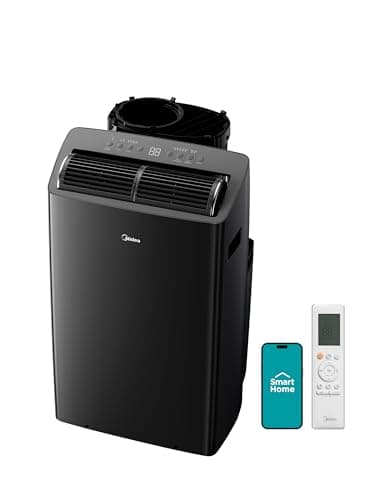 The smallest haircut we found Midea Duo Smart Inverter Portable Air Conditioner 14,000 BTU on the box and 12,000 SACC — a 14.3% reduction, the smallest of any unit we checked. | A portable that has to serve 450-550 sq ft honestly | |
| 2 | The largest haircut, and the most transparent Whynter ARC-14S Dual Hose Portable Air Conditioner 9,500 SACC against a 14,000 BTU headline — but it labels both figures with their standards, which most do not. | A room of about 400 sq ft, sized honestly | |
| 3 | The unit with no haircut at all GE Profile ClearView Window Air Conditioner, 8,000 BTU A window unit's labeled capacity is its capacity — there is no SACC correction because there is no duct. | Anyone with a sash window who wants the number to mean something |
Go to a portable air conditioner listing and you will often find two capacity figures within a few lines of each other. A Whynter ARC-14S is sold as a 14,000 BTU unit, and its own specification page states 9,500 BTU SACC. A Midea Duo MAP14S1TBL is also sold as 14,000 BTU, and Midea states 12,000 BTU SACC.
Same headline number. A 2,500 BTU difference in what actually reaches the room. If you sized a room from the box, you would think you were choosing between two equivalent machines.
The mechanism
What SACC actually measures
A portable air conditioner has a problem a window unit does not. A window unit sits in the wall of the room: cold side in, hot side out, and the heat it rejects lands outside. A portable sits inside the room and pushes its waste heat out through a duct. Two things follow, and the DOE test procedure is built to capture both.
First, the duct is hot and it is in your room. A flexible hose full of exhaust air runs across the floor, radiating heat back into the space the machine is trying to cool. Some of the cooling is spent on the duct.
Second, and much worse for single-hose units: air leaves the room and something has to replace it. A single-hose portable draws the air it needs to cool its condenser from the room, then blows that air outside. The room is now at slightly negative pressure, so outside air — the hot air you are trying to escape — infiltrates through gaps around doors, windows and floors to make up the difference. You are, in effect, paying to pull the outdoors in.
The DOE test procedure at 10 CFR part 430, subpart B, appendix CC subtracts both effects from the measured cooling capacity to give adjusted cooling capacity (ACC), then takes a weighted average of ACC measured at two representative operating conditions to give SACC. That procedure has been in force since 1 June 2016.
The number on the box, by contrast, typically comes from ASHRAE Standard 128, which measures cooling capacity without accounting for duct losses or infiltration at all. Whynter labels its two figures exactly that way on its own page: “14,000 BTU (ASHRAE-128 Standard)” and “9,500 BTU (DOE 2017 Standard)”.
A note on what we are not telling you. The precise weighting factors and test temperatures inside that weighted average are specified in appendix CC, and we could not confirm them against the primary regulation text when writing this page — two secondary sources gave conflicting figures. So we have described the mechanism and cited the standard, and we are publishing no weighting number. You do not need it to make the decision below, and a number we cannot verify is worth less than an honest gap.
The evidence
How big the gap gets, from the manufacturers’ own pages
This is the part almost nobody publishes: the haircut is not a fixed ratio. It depends on how the machine is built. Both rows below are the manufacturer’s own published pair of numbers, not our estimate.
| Unit | On the box | DOE SACC | Reduction |
|---|---|---|---|
| Midea Duo MAP14S1TBL (dual hose) | 14,000 | 12,000 | 14.3% |
| Whynter ARC-14S (dual hose) | 14,000 | 9,500 | 32.1% |
Two units, same headline capacity, and one delivers 26% more cooling than the other by their own published figures. If a reviewer ranks “14,000 BTU portables” and never mentions SACC, they have put two materially different machines in the same bucket.
And note that both of those are dual-hose units — the better configuration. Single-hose units carry the full infiltration penalty on top of duct losses.
What it means for you
Which number to size from
SACC. Always SACC. Run the ENERGY STAR sizing table against the SACC figure, not the box figure:
| Room area (sq ft) | Capacity needed (BTU/h) |
|---|---|
| 100 up to 150 | 5,000 |
| 150 up to 250 | 6,000 |
| 250 up to 300 | 7,000 |
| 300 up to 350 | 8,000 |
| 350 up to 400 | 9,000 |
| 400 up to 450 | 10,000 |
| 450 up to 550 | 12,000 |
| 550 up to 700 | 14,000 |
Source: ENERGY STAR, Room Air Conditioners. ENERGY STAR notes the capacities “are calculated based on an 8-foot ceiling.” The full chart, with the adjustments.
Do the substitution for the ARC-14S. Its SACC is 9,500 BTU, which sits between the table’s 9,000 BTU row (350–400 sq ft) and its 10,000 BTU row (400–450 sq ft). So it is honestly a roughly 400 square foot machine.
Whynter’s own product page claims coverage of 500 sq ft.
Those two published numbers do not agree, and the gap between them is exactly the SACC haircut being quietly left out of the coverage claim. We are not accusing anyone of lying: 14,000 BTU under ASHRAE-128 would indeed serve about 550 sq ft on that table. But 14,000 BTU is not what arrives in your room, and the same page says so 20 lines further down.
Say the unwelcome thing
Don't try to 'correct' the box number with a rule of thumb.
The temptation is to hear “SACC is lower” and apply a mental discount — knock 20% off whatever the box says and move on. The table above is the reason that fails: the real reductions here are 14% and 32% for units with identical headline figures. A fixed discount would have sized one room correctly and the other by nearly 2,500 BTU.
Look up the actual SACC. It is on the spec sheet, on the yellow EnergyGuide label, and increasingly in the retail listing.
Related
Why there is no ENERGY STAR sticker to fall back on
For window air conditioners you can sidestep marketing entirely and read the certified data: ENERGY STAR publishes tested CEER and modeled annual kWh for every certified unit, and our window AC rankings are built on it.
No such program exists for portable air conditioners. The ENERGY STAR certified room air conditioner dataset returns window and through-the-wall units only; a portable AC cannot carry an ENERGY STAR label because there is no specification for it to meet. Portables are covered by the DOE test procedure — which is what gives you SACC — but there is no efficiency certification on top.
That absence is itself a buying signal, and it is one reason a window unit beats a portable whenever a window unit will physically fit.
Practical
How to check any unit in about a minute
- Look for two capacity numbers. If a listing shows only one, it is almost certainly the ASHRAE figure. Find the spec sheet or the EnergyGuide label.
- Count the hoses. One hose means the infiltration penalty applies in full. Two means the condenser draws its air from outside and the penalty is much smaller.
- Take the SACC figure to the sizing table and read off the room area it honestly serves.
- Compare that with the coverage claim in the listing. If the listing claims meaningfully more, you now know why.
- Then check what it costs to run — the ARC-14S draws 1,300 W, and we work that through to a monthly figure here.
If, having done that, the honest SACC figure is too small for your room, the answer is not a bigger portable. It is a window unit, where the capacity on the label is the capacity in the room.
In full
Every pick, and what is wrong with it
Published specifications only, each linked to the page it came from. Where a manufacturer publishes nothing, the row says so — we do not fill blanks in.
1. The smallest haircut we found
Midea Duo Smart Inverter Portable Air Conditioner
Midea · model MAP14S1TBL
14,000 BTU on the box and 12,000 SACC — a 14.3% reduction, the smallest of any unit we checked.
12,000 BTU SACC maps to roughly 450–550 sq ft on the ENERGY STAR table — which, unusually, is close to Midea’s own 550 sq ft coverage claim. Most manufacturers base that claim on the box figure instead.
Dual hose, so the condenser draws its air from outside rather than from your room, and 43 dBA published.
What’s wrong with it
Midea publishes no wattage for it, so its running cost cannot be calculated. At 74.96 lb it is also the heaviest portable here.
Running cost
Midea does not publish a wattage for the MAP14S1TBL, so we cannot calculate what it costs to run. We are not going to estimate one. If Midea publishes a nameplate figure, this block will show the arithmetic.
| Marketing capacity | 14,000 BTU |
|---|---|
| DOE-rated capacity | 12,000 BTU SACC |
| Hoses | Dual |
| Noise | 43 dBA |
| Speeds | 3 |
| Refrigerant | R-32 |
| Dimensions | 19.52 W x 16.73 D x 32.48 H in |
| Weight | 74.96 lb |
| Manufacturer coverage claim | 550 sq ft |
| Power | Not published (115 V stated, no wattage) |
| Warranty | 1 year |
Every figure above is from Midea product page, MAP14S1TBL. Blanks are shown as “not published” rather than filled in.
2. The largest haircut, and the most transparent
Whynter ARC-14S Dual Hose Portable Air Conditioner
Whynter · model ARC-14S
9,500 SACC against a 14,000 BTU headline — but it labels both figures with their standards, which most do not.
This is the unit that makes the point. Whynter labels both numbers explicitly — “14,000 BTU (ASHRAE-128)” and “9,500 BTU (DOE 2017)” — which is more disclosure than most of the category offers, and it is the reason we can show you a 32% reduction at all.
Sized honestly at 350–400 sq ft it is capable: dual hose, R-32, 71 pints a day of dehumidification, and a 3-year compressor warranty. Sized from the box figure it will disappoint.
What’s wrong with it
Its own page claims 500 sq ft coverage, which its 9,500 SACC does not support. And 1,300 W is a real running cost.
Running cost — ARC-14S
| Nameplate power | 1300 W | manufacturer's published figure |
|---|---|---|
| Energy, 8-hour night | 10.40 kWh | 1300 ÷ 1000 × 8 |
| Cost per hour | 24¢ | at 18.34¢/kWh |
| Cost per 8-hour night | $1.91 | on the highest speed |
| Cost per 30 nights | $57 | 312.0 kWh |
Rate: 18.34¢/kWh, the US average residential price for June 2026 (EIA Electric Power Monthly, Table 5.3). Yours will differ — swap it in: (watts ÷ 1000) × hours × your rate.
| Marketing capacity | 14,000 BTU (ASHRAE-128) |
|---|---|
| DOE-rated capacity | 9,500 BTU SACC |
| Hoses | Dual |
| Power | 1,300 W / 11.6 A at 115 V |
| Noise | Under 51 dBA low, under 56 dBA high |
| Dehumidification | 71 pints/day |
| Refrigerant | R-32 |
| Dimensions | 16 W x 19 D x 35.5 H in |
| Weight | 73 lb |
| Manufacturer coverage claim | 500 sq ft |
| Warranty | 1 year unit, 3 years compressor |
Every figure above is from Whynter product page, ARC-14S. Blanks are shown as “not published” rather than filled in.
3. The unit with no haircut at all
GE Profile ClearView Window Air Conditioner, 8,000 BTU
GE Profile · model PWJV08W
A window unit's labeled capacity is its capacity — there is no SACC correction because there is no duct.
The cleanest way to avoid the BTU-versus-SACC problem is to buy a machine that does not have it. A window unit sits in the wall with its hot side outside, so there is no duct to leak heat back and no infiltration to account for.
It is also certified: CEER 16, 375 kWh a year (about $69 at 18.34¢/kWh), and on the ENERGY STAR Most Efficient list — a tested figure no portable can offer, because no certification program for portables exists.
What’s wrong with it
It needs a vertical sash window and occupies it for the season, which is exactly the constraint that pushes people toward portables in the first place.
Running cost — PWJV08W
| Annual energy use | 375 kWh | ENERGY STAR certified figure |
|---|---|---|
| Annual cost | $69 | 375 × 18.34¢/kWh |
| Per cooling month | $17 | spread over a four-month season |
The annual figure is the certified value from the ENERGY STAR Certified Room Air Conditioners dataset, which models a standard cooling season rather than your actual summer. It is more useful than a nameplate wattage here, because a variable-speed compressor spends most of its life well below nameplate.
Rate: 18.34¢/kWh, the US average residential price for June 2026 (EIA Electric Power Monthly, Table 5.3). Yours will differ — swap it in: (watts ÷ 1000) × hours × your rate.
| Cooling capacity | 8,000 BTU/h |
|---|---|
| CEER | 16 |
| Annual energy use | 375 kWh/yr |
| vs federal standard | 47% less energy |
| Dimensions | 12.6 H x 18.6 W x 15.3 D in |
| Weight | 46.2 lb |
| Refrigerant | R-32 |
| Installation | Does not straddle the windowsill |
| Support bracket | Required |
| Compressor | Variable speed |
| ENERGY STAR | Certified, and on the Most Efficient list |
Every figure above is from ENERGY STAR Certified Room Air Conditioners dataset. Blanks are shown as “not published” rather than filled in.
Questions people actually ask
Frequently asked
What does SACC stand for?
Seasonally Adjusted Cooling Capacity. It is the DOE-rated cooling capacity for portable air conditioners, defined by the test procedure at 10 CFR part 430, subpart B, appendix CC, in force since June 2016.
Is the BTU number on the box a lie?
No, it is a measurement under a different standard — usually ASHRAE 128, which does not account for exhaust duct heat or infiltration air. It is a real figure that describes the refrigeration circuit rather than the room. SACC describes the room.
How much lower is SACC than the box BTU?
It varies far more than people expect. Two units both sold as 14,000 BTU are DOE-rated at 12,000 and 9,500 by their own manufacturers — a 14 percent reduction versus a 32 percent one. There is no reliable rule of thumb, which is why you have to look up the actual figure.
Do window air conditioners have a SACC rating?
No. SACC exists because a portable's duct and infiltration losses need accounting for, and a window unit has neither — it sits in the wall of the room with its hot side outside. Window units are rated by cooling capacity and CEER, both of which ENERGY STAR certifies and publishes.
Does a dual-hose portable have a better SACC?
Structurally it should, because the condenser draws outside air instead of room air and the infiltration penalty largely disappears. But configuration is not the only factor: both units in our table are dual-hose and one still loses 32 percent. Check the published figure rather than inferring it from the hose count.
Which number do retailers advertise?
Usually the higher ASHRAE figure in the product title, with SACC further down the specification list — and DOE labeling requirements mean SACC generally appears somewhere. If you can only find one number, assume it is the box figure.
Sources
Where these numbers came from
- eCFR — 10 CFR part 430, subpart B, appendix CC (DOE portable AC test procedure)
- DOE — Portable Air Conditioner Test Procedure final rule (PDF)
- Federal Register — Test Procedure for Portable Air Conditioners (2023)
- Whynter ARC-14S specifications — 14,000 BTU ASHRAE / 9,500 BTU SACC
- Midea Duo MAP14S1TBL specifications — 14,000 BTU / 12,000 BTU SACC
- ENERGY STAR — Room Air Conditioners sizing guidance
- ENERGY STAR Certified Room Air Conditioners dataset (no portable category)
Read next
Where to go from here
Back to Guides & Calculators, or read how we pick.