The picks
Best evaporative coolers for large spaces
In a big space the coverage claims fail hardest, and the two specifications that actually predict performance are the ones people ignore.
By Sawyer V. · Published
The short answer
Size on published CFM and tank capacity, not on square-footage claims. The Hessaire MC37M moves 3,100 CFM on 250 W with a continuous water hookup, and the Honeywell CO60PM moves 2,697 CFM on 220 W with a 15.9 gallon tank and a 30-foot throw. Coverage claims are unusable: across Honeywell’s range, every stated square footage equals the CFM divided by 1.64.
Fan & Frost earns a commission when you buy through our links, at no cost to you. It never changes a ranking, and we say so when the right answer is the cheaper unit or nothing at all. Full disclosure · How we pick.
At a glance
The picks, ranked
Tap any row to jump to the full reasoning. Prices are live from Amazon where we have them, and read “check price” where we don’t — never a number we cannot verify today.
| # | Product | Best for | Price |
|---|---|---|---|
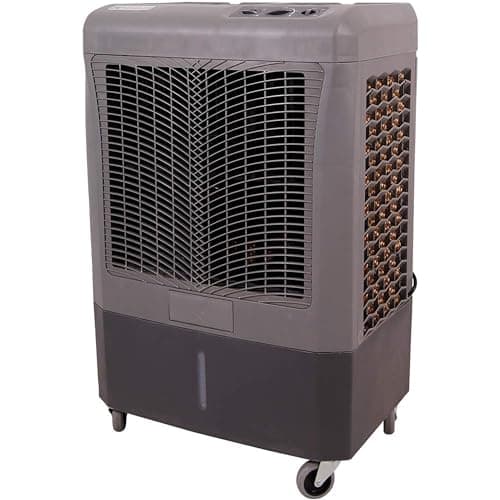
| 1 | Most air per watt Hessaire MC37M Mobile Evaporative Cooler 3,100 CFM on 250 W — the best air-per-watt of any evaporative cooler we hold data for, with continuous hookup. | A workshop, garage or barn running all day on a hose | |
| 2 | Longest throw and largest tank Honeywell CO60PM Indoor/Outdoor Evaporative Cooler 2,697 CFM on 220 W with a 30-foot air throw, a 15.9 gallon tank, and triple-sided honeycomb media. | A large space where reach matters as much as volume | |
| 3 | 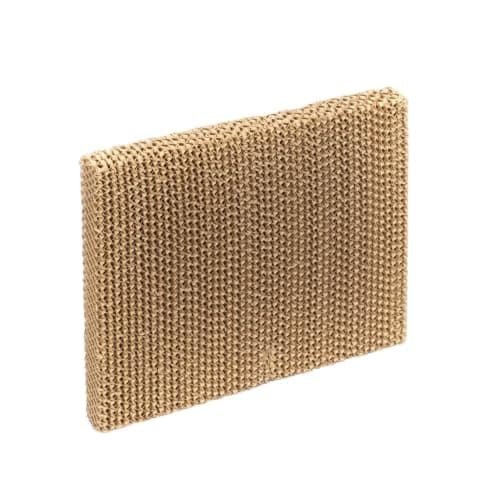 Budget for this before you start Hessaire CP370 Media Pad Set 21 x 23 inch media pads for the 3,100 CFM Hessaire chassis — the consumable a large-space cooler goes through. | Keeping a hard-working cooler working | |
| — | Too small for this job Honeywell CL25AE Indoor Evaporative Cooler 764 CFM on 235 W. Nearly the same power as a 3,100 CFM machine, for a quarter of the air. | A single room — not a large space |
Large spaces are where evaporative cooling is at its most convincing — a workshop, a garage, a barn, a covered patio — and also where the marketing figures fail most badly.
The finding
Coverage claims are a formula, not a measurement
Every evaporative cooler carries a “cools up to X square feet” figure, and in a large space it is exactly the number people want to size against.
We checked the arithmetic across Honeywell’s range, which spans a roughly thirteenfold difference in airflow. Every published coverage claim equals the CFM divided by 1.64.
| Unit | CFM | Claim | CFM ÷ 1.64 |
|---|---|---|---|
| Honeywell CL25AE | 764 | 466 sq ft | 466 |
| Honeywell CO60PM | 2,697 | 1,643 sq ft | 1,644 |
Manufacturer product pages. The division is our arithmetic.
A formula applied to airflow cannot know your ceiling height, your insulation, your climate, how many doors are open or how many people are in the room. It is a marketing figure with the shape of a specification.
In a large space those unknowns dominate, so the claim is least reliable exactly where people most want to use it.
Size on this instead
Three specifications that actually predict performance
- CFM. How much air the machine moves. In a large space this is the primary number, and 3,100 against 764 is a four-fold difference that no amount of placement makes up.
- Throw distance. How far that air travels before it dissipates. Volume without reach leaves the far end of a workshop untouched. Honeywell publishes 30 feet for the CO60PM; most competitors publish nothing.
- Tank capacity and hookup. A large machine evaporates a lot of water, and a cooler you have to refill twice a day is a cooler that ends up unused. Continuous hookup changes this from a chore to a non-issue.
Air changes per hour is the honest way to size ventilation, and it applies loosely here too: volume in cubic feet times the changes you want, divided by 60, gives a CFM figure to aim at.
This one is not a DIY job
A large space needs an air path, not just a big machine. Evaporative cooling adds moisture, and in a closed volume the humidity climbs until the air can no longer absorb more — at which point the cooling stops regardless of CFM.
In a workshop or garage that usually means a door or window open on the far side from the cooler, so there is a route: dry air in, humidified air out.
This is also why these machines suit large and semi-open spaces so well. A barn, a covered patio or a workshop with the roller door up has the air exchange built in.
Continuous hookup is worth it above about 2,000 CFM. Not just for convenience — a float valve holds the water level steady, which avoids the concentration cycle that scales up pumps and distributors.
Placement
Where to put it in a big room
- Aim along the longest axis. You are trying to set the whole volume moving, and the longest run gives the air column the most distance to work with.
- Put it near the intake, not the exhaust. The cooler should be drawing the driest available air, which is the air coming in from outside.
- Do not aim it at the exit. Blowing cooled air straight out of an open door is a common and expensive placement error.
- Raise it if you can. Cooled air is denser and sinks, so launching it above head height covers more of the occupied zone than launching it at floor level.
Maintenance
A hard-working cooler needs more attention
Everything in the maintenance routine scales with use, and a large-space machine runs long hours.
Run the fan without the pump for the last ten to fifteen minutes of each session. Drying the media before it sits addresses both mineral scale and biological growth, and it is the single highest-value habit in the category.
Check the pad wets evenly across its whole face regularly. A distributor scaling shut is the commonest cause of a large cooler quietly losing most of its effect.
The full cleaning procedure, and the seasonal shutdown.
Say the unwelcome thing
Do not size a large space from the square-footage claim.
It is the figure printed largest on the box and the least useful one available.
Across Honeywell’s range, spanning a thirteenfold airflow difference, every coverage claim is exactly the CFM divided by 1.64. It is arithmetic on a number you already have, not a measurement of anything.
In a large space that matters more, because the variables the formula ignores — ceiling height, insulation, open doors, solar gain, how many people are working — are exactly the ones that dominate in a workshop or a barn.
Size on CFM, throw distance and tank capacity, then make sure the space has an air path. 3,100 CFM on 250 W is a real number; 1,900 square feet is a division.
In full
Every pick, and what is wrong with it
Published specifications only, each linked to the page it came from. Where a manufacturer publishes nothing, the row says so — we do not fill blanks in.
1. Most air per watt
Hessaire MC37M Mobile Evaporative Cooler
Hessaire · model MC37M
3,100 CFM on 250 W — the best air-per-watt of any evaporative cooler we hold data for, with continuous hookup.
3,100 CFM on 250 W works out to about 12.4 CFM per watt, the highest in this category — and in a large space, air-per-watt matters because the machine runs for hours.
37¢ for an eight-hour day of electricity.
The 10.3 gallon tank with continuous hookup is what makes all-day use realistic. A float valve also keeps the water level constant, which avoids the concentrate-and-refill cycle that precipitates minerals onto the pump and distributor.
Note what Hessaire declines to publish: no coverage claim and no noise rating. We treat the missing coverage claim as a point in their favor.
What’s wrong with it
No published noise rating and no published coverage claim, and 40 lb makes it a machine you place rather than move.
Running cost — MC37M
| Nameplate power | 250 W | manufacturer's published figure |
|---|---|---|
| Energy, 8-hour night | 2.00 kWh | 250 ÷ 1000 × 8 |
| Cost per hour | 4.6¢ | at 18.34¢/kWh |
| Cost per 8-hour night | 37¢ | on the highest speed |
| Cost per 30 nights | $11 | 60.0 kWh |
Rate: 18.34¢/kWh, the US average residential price for June 2026 (EIA Electric Power Monthly, Table 5.3). Yours will differ — swap it in: (watts ÷ 1000) × hours × your rate.
| Air delivery | 3,100 CFM |
|---|---|
| Power | 250 W / 2.4 A |
| Water tank | 10.3 gallons, continuous hookup capable |
| Dimensions | 24 L x 16 W x 38 H in |
| Weight | 40 lb |
| Pads | Industrial-grade cooling pads |
| Coverage claim | Not published on the product page |
Every figure above is from Hessaire product page, MC37M. Blanks are shown as “not published” rather than filled in.
2. Longest throw and largest tank
Honeywell CO60PM Indoor/Outdoor Evaporative Cooler
Honeywell · model CO60PM
2,697 CFM on 220 W with a 30-foot air throw, a 15.9 gallon tank, and triple-sided honeycomb media.
30-foot air throw is the specification that matters in a big space and that most competitors do not state. Volume alone does not help if the air stops ten feet from the machine.
2,697 CFM on 220 W — about 32¢ for an eight-hour day — which is slightly less power than the Hessaire for slightly less air.
Triple-sided honeycomb media gives three faces of rigid, rinsable pad rather than one, which means more media area and easier maintenance. Why media architecture matters.
61 to 65 dBA is loud. In an open workshop that is fine; anywhere people are talking it is not.
What’s wrong with it
61 to 65 dBA competes with conversation, and 15.9 gallons is over 130 lb of water when full.
Running cost — CO60PM
| Nameplate power | 220 W | manufacturer's published figure |
|---|---|---|
| Energy, 8-hour night | 1.76 kWh | 220 ÷ 1000 × 8 |
| Cost per hour | 4.0¢ | at 18.34¢/kWh |
| Cost per 8-hour night | 32¢ | on the highest speed |
| Cost per 30 nights | $9.68 | 52.8 kWh |
Rate: 18.34¢/kWh, the US average residential price for June 2026 (EIA Electric Power Monthly, Table 5.3). Yours will differ — swap it in: (watts ÷ 1000) × hours × your rate.
| Air delivery | 2,697 CFM |
|---|---|
| Power | 220 W |
| Water tank | 15.9 gallons, continuous hookup |
| Air throw | 30 ft |
| Noise | 61-65 dBA |
| Speeds | 3, with oscillation |
| Pads | Triple-sided honeycomb |
| Dimensions | 27.6 W x 18.3 D x 40 H in |
| Weight | 39.2 lb |
| Manufacturer coverage claim | 1,643 sq ft |
| Warranty | 1 year |
Every figure above is from Honeywell Air Comfort product page, CO60PM. Blanks are shown as “not published” rather than filled in.
3. Budget for this before you start
Hessaire CP370 Media Pad Set
Hessaire · model CP370
21 x 23 inch media pads for the 3,100 CFM Hessaire chassis — the consumable a large-space cooler goes through.
A cooler running all day in a large space evaporates a great deal of water, and everything dissolved in that water stays in the pad.
So media is the real recurring cost of a large installation, more than the water and often more than the electricity in hard water areas.
21 by 23 inches, fitting the MC37, M150 and MFC3600. Measure yours before ordering — a pad that is close but not exact leaves a bypass gap, and air goes around it.
No published replacement interval, so it is judged by inspection: what to look for.
What’s wrong with it
Hessaire publishes no replacement interval, so there is no guidance on how often this cost recurs.
Running cost
Hessaire does not publish a wattage for the CP370, so we cannot calculate what it costs to run. We are not going to estimate one. If Hessaire publishes a nameplate figure, this block will show the arithmetic.
| Fits | MC37, M150 and MFC3600 (3,100 CFM) coolers |
|---|---|
| Pad size | 21 x 23 in |
| Type | Replacement media pad set |
| Replacement interval | Not published by the manufacturer |
Every figure above is from Hessaire parts page, CP370 media pad set. Blanks are shown as “not published” rather than filled in.
Skip this one
Honeywell CL25AE Indoor Evaporative Cooler
Honeywell · model CL25AE
764 CFM on 235 W. Nearly the same power as a 3,100 CFM machine, for a quarter of the air.
Included to show what undersizing costs, because it is the common mistake here.
764 CFM on 235 W against 3,100 CFM on 250 W. Almost identical power, four times the air on the larger machine.
That is not a criticism of the small unit — in a single room it is the right size, and 52 to 60 dBA makes it the quietest in the category.
But in a workshop it draws nearly the same electricity while achieving a fraction of the effect. Where it belongs.
What’s wrong with it
In a large space it will run continuously and never win, which is the classic undersizing failure.
Running cost — CL25AE
| Nameplate power | 235 W | manufacturer's published figure |
|---|---|---|
| Energy, 8-hour night | 1.88 kWh | 235 ÷ 1000 × 8 |
| Cost per hour | 4.3¢ | at 18.34¢/kWh |
| Cost per 8-hour night | 34¢ | on the highest speed |
| Cost per 30 nights | $10 | 56.4 kWh |
Rate: 18.34¢/kWh, the US average residential price for June 2026 (EIA Electric Power Monthly, Table 5.3). Yours will differ — swap it in: (watts ÷ 1000) × hours × your rate.
| Air delivery | 764 CFM |
|---|---|
| Power | 235 W |
| Water tank | 6.6 gallons |
| Air throw | 33 ft |
| Noise | 52-60 dBA |
| Speeds | 3, oscillating louvers |
| Timer | Up to 7.5 hours |
| Dimensions | 18.9 x 14.6 x 33.3 in |
| Weight | 25.4 lb |
| Manufacturer coverage claim | 466 sq ft |
| Warranty | 1 year |
Every figure above is from Honeywell Air Comfort product page, CL25AE. Blanks are shown as “not published” rather than filled in.
We are not linking a buy button for this one. If you want to look at it anyway, it is easy enough to find — but we would rather send you to something that fits your room.
Questions people actually ask
Frequently asked
What size evaporative cooler do I need for a large space?
Size on published CFM rather than the square-footage claim. Take the volume in cubic feet, multiply by the air changes per hour you want and divide by 60 to get a CFM target — then check the throw distance reaches the far end.
Are evaporative cooler coverage claims accurate?
They are not measurements. Across Honeywell's range, spanning a thirteenfold airflow difference, every published coverage claim equals the CFM divided by 1.64 — a formula applied to a number you already have.
What is the most powerful evaporative cooler?
Of the units we hold data for, the Hessaire MC37M at 3,100 CFM on 250 W, which is also the best air-per-watt in the category. The Honeywell CO60PM moves 2,697 CFM on 220 W with a longer published throw.
Do large evaporative coolers need a water hookup?
Above about 2,000 CFM it is worth having. Not only for convenience — a float valve keeps the water level constant, avoiding the concentrate-and-refill cycle that precipitates minerals onto the pump and distributor.
Where should I place an evaporative cooler in a workshop?
Aim it along the longest axis, position it near where fresh air enters rather than where it leaves, do not point it at an open door, and raise it above head height if you can since cooled air sinks.
Does a large space need more ventilation for an evaporative cooler?
It needs an air path regardless of size. Evaporative cooling adds moisture, and in a closed volume humidity climbs until the air cannot absorb more and the cooling stops — so a door or window open on the far side is required. The humidity limit.
Sources
Where these numbers came from
- Hessaire MC37M product page — 3,100 CFM, 250 W, 10.3 gal tank, continuous hookup
- Honeywell CO60PM product page — 2,697 CFM, 220 W, 30 ft throw, 15.9 gal tank, 1,643 sq ft claim
- Honeywell CL25AE product page — 764 CFM, 235 W, 466 sq ft claim
- Hessaire CP370 media pad set — 21 x 23 in, no published replacement interval
Read next
Where to go from here
Back to Evaporative Coolers, or read how we pick.