The picks
Best air circulators
A circulator is not a fan aimed at you. It is a fan aimed at the far wall, and the specification that matters is one almost nobody publishes.
By Sawyer V. · Published
The short answer
A circulator throws a coherent column of air across a room so it hits a surface, spreads and returns — setting the whole volume turning over rather than blowing at one person. Vornado publishes 70 feet for the 630 and 75 feet for the 683, with a five-year warranty. The category’s weakness is data: Vornado publishes no wattage, no CFM and no dBA, so nothing can be compared numerically.
Fan & Frost earns a commission when you buy through our links, at no cost to you. It never changes a ranking, and we say so when the right answer is the cheaper unit or nothing at all. Full disclosure · How we pick.
At a glance
The picks, ranked
Tap any row to jump to the full reasoning. Prices are live from Amazon where we have them, and read “check price” where we don’t — never a number we cannot verify today.
| # | Product | Best for | Price |
|---|---|---|---|
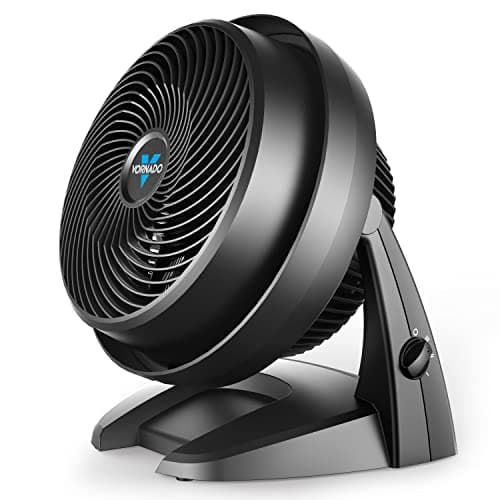
| 1 | Best overall Vornado 630 Medium Air Circulator Vornado states it moves air up to 70 feet, with a five-year warranty — five times the category norm. | A normal room you want mixed rather than blown at | |
| 2 | 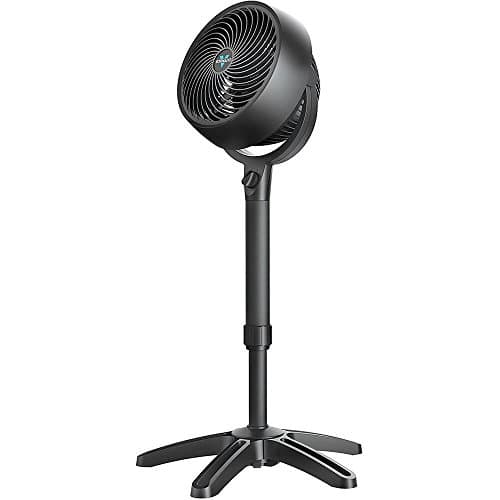 Most throw, at the right height Vornado 683 Medium Pedestal Air Circulator 75 feet of stated air movement on an adjustable 32 to 38 inch pedestal, also with five years. | A larger room, or one with furniture in the way | |
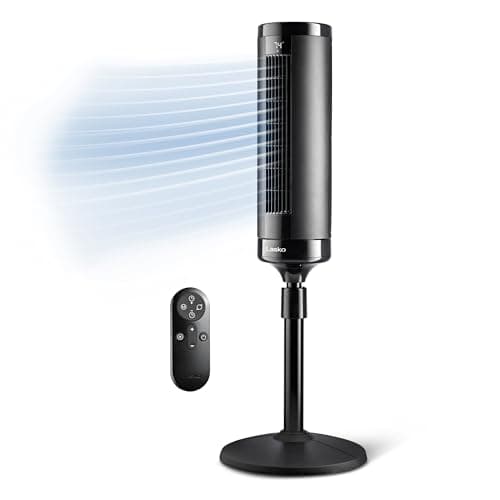
| 3 |  The one that publishes its airflow Lasko Wind Curve 42" Tower Fan 720 CFM published — the highest airflow figure of any fan on this site, at pedestal height. | A large room where you want a number rather than a claim | |
| — |  The wrong shape for this job Lasko EcoQuiet 42" DC Tower Fan 2.9 W on low at 23 dBA, and the only fan here with a full published specification. It also does not circulate a room. | Personal cooling — not room circulation |
“Air circulator” sounds like marketing for a fan, and it describes a genuinely different design doing a genuinely different job.
The difference
Column, not spray
A conventional fan pushes air outward in a broadening cone. It slows and spreads quickly, which is exactly right for cooling a person a few feet away.
A circulator uses a deep shroud around a shaped blade to organize the output into a narrow, coherent column that holds together over distance. Aimed at a far wall, it strikes the surface, spreads along it, and returns along the floor and ceiling — setting up a circulation pattern that turns the whole room over.
The distinction is the same one as between a floodlight and a spotlight. Same energy, organized differently, useful for different things.
| Circulator | Conventional fan | |
|---|---|---|
| Output shape | Narrow coherent column | Broadening cone |
| Aimed at | The far wall | A person |
| Effect | Whole room mixed | Airflow on whoever is in front |
| Oscillation | Usually none — it breaks the column | Common and useful |
| Best for | Stuffy corners, uneven rooms, stratification | Feeling cooler |
| Works with nobody there | Yes — it is mixing air | No — nothing to cool |
The last row is the one that matters most. A conventional fan in an empty room achieves nothing — it cools people, and there are none. A circulator is doing something to the air itself, so it still has a job when the room is empty.
The problem
Nobody publishes the numbers
This is the category with the worst published data on the site, and it is worth being direct about it.
Vornado publishes no wattage, no CFM, no dimensions and no weight for either circulator here. What they publish is a throw distance — 70 and 75 feet — which is their own claim under unstated conditions.
Lasko publishes CFM but no wattage or dBA for the pedestal fan.
And there is no certification program for portable fans at all, so nothing in this category is independently tested. The contrast with ceiling fans is stark: certified CFM per watt, wattage at two speeds, span and warranty, for all 1,398 records.
The practical consequence: you cannot compare circulators on efficiency, because the numerator and denominator are both missing. What you can compare is stated throw, warranty length and design.
This one is not a DIY job
Aim it at the far wall, not at yourself. This is the single most common mistake with a circulator, and it turns an expensive fan into an ordinary one.
Point it at the wall furthest from where people sit, at a slight upward angle. Done right, you should feel a gentle general movement everywhere in the room rather than a breeze anywhere specific.
Do not oscillate it. A sweeping head never sustains flow in one direction long enough for a circulation pattern to establish, which is why these are usually sold without the function.
Give it a clear run. Furniture, curtains and an open door in the wrong place absorb the column before it arrives.
When it wins
Four jobs a circulator does better
- A stuffy corner. Rooms develop dead zones where air simply does not move. A column aimed past the problem area drags it into the circulation.
- Helping an air conditioner reach further. A room the cooled air never quite gets to is a circulation problem, not a capacity one — and adding capacity is the expensive way to fix it. Common upstairs.
- Stratification in a tall room. Warm air collects at the ceiling, and a circulator aimed upward brings it back down. Sunrooms are the extreme case.
- Damp corners in a basement or garage. Still air is where moisture accumulates, and keeping the volume moving is a genuine preventative. The basement case.
When it does not
And when a normal fan is better
If you are hot and sitting still, a circulator aimed past you does far less than a cheap fan aimed at you. Felt cooling depends on air speed at your skin, and a circulator is deliberately organizing its output somewhere else.
If you want it quiet, the published figures are not there. A DC tower fan at 23 dBA is the only fan on this page with a stated noise rating.
If you want to know what it costs to run, the same problem applies.
Say the unwelcome thing
Do not buy a circulator to cool yourself.
It is the most common mismatch in this category, and it is caused by the marketing rather than the product.
A circulator is engineered to project air a long way and mix a room. Pointed at a person from three feet, that focused column is a narrow jet rather than the broad coverage a tower or pedestal fan gives you — and people find it less comfortable, not more.
Worse, the marketing encourages exactly that use, and then the conclusion is that the fan is disappointing.
Buy a circulator to move a room. Buy a tower fan or a desk fan to move air across yourself — and get published wattage and dBA with it.
In full
Every pick, and what is wrong with it
Published specifications only, each linked to the page it came from. Where a manufacturer publishes nothing, the row says so — we do not fill blanks in.
1. Best overall
Vornado 630 Medium Air Circulator
Vornado · model 630
Vornado states it moves air up to 70 feet, with a five-year warranty — five times the category norm.
70 feet is the manufacturer’s claim, and throw is the specification a circulator lives or dies on. The deep shrouded housing is what produces a column that survives the trip rather than a spray that dissipates in a few feet.
Five years on the warranty, against one to two for most of this category. A warranty is a manufacturer’s own estimate of failure rate with money behind it — the closest thing to a durability figure anyone here publishes.
Three speeds, and deliberately no oscillation. A sweeping head breaks the column up before it can establish a circulation pattern.
The honest gaps: no wattage, no CFM, no dimensions, no weight, no dBA. The 70-foot figure is Vornado’s own.
What’s wrong with it
No published wattage, CFM, dimensions or weight. On a site that runs on numbers, that is a real gap.
Running cost
Vornado does not publish a wattage for the 630, so we cannot calculate what it costs to run. We are not going to estimate one. If Vornado publishes a nameplate figure, this block will show the arithmetic.
| Power | Not published |
|---|---|
| Airflow reach | Moves air up to 70 ft |
| Speeds | 3 |
| Air delivery (CFM) | Not published |
| Dimensions | Not published |
| Weight | Not published |
| Warranty | 5 years |
Every figure above is from Vornado product page, 630. Blanks are shown as “not published” rather than filled in.
2. Most throw, at the right height
Vornado 683 Medium Pedestal Air Circulator
Vornado · model 683
75 feet of stated air movement on an adjustable 32 to 38 inch pedestal, also with five years.
75 feet, and more usefully, the head sits at 32 to 38 inches rather than on a table or the floor.
Height matters more for circulation than it does for personal cooling. A column launched at floor level hits sofa bases, rug edges and table legs within a few feet; one launched at chest height has a clear run at the far wall.
Same deep-shroud design, same five-year warranty, same three speeds, same absence of oscillation.
And the same published-data gap. If running cost matters to you, a DC tower fan at 2.9 W is the only fan on this page whose consumption you can actually know.
What’s wrong with it
Same data problem — no wattage, no CFM, no dBA — plus a pedestal takes floor space a table unit does not.
Running cost
Vornado does not publish a wattage for the 683, so we cannot calculate what it costs to run. We are not going to estimate one. If Vornado publishes a nameplate figure, this block will show the arithmetic.
| Power | Not published |
|---|---|
| Airflow reach | Moves air up to 75 ft |
| Speeds | 3 |
| Height | 32 - 38 in, adjustable |
| Air delivery (CFM) | Not published |
| Warranty | 5 years |
Every figure above is from Vornado product page, 683. Blanks are shown as “not published” rather than filled in.
3. The one that publishes its airflow
Lasko Wind Curve 42" Tower Fan
Lasko · model 2554
720 CFM published — the highest airflow figure of any fan on this site, at pedestal height.
Not a circulator in the strict sense, and worth including because it fills the gap the category leaves.
720 CFM published, the highest airflow figure we hold. Circulation depends on moving enough air far enough, and volume is half of that even without a shroud.
The trade is coherence. A conventional fan produces a wider, less organized output, so more of it dissipates before reaching the far wall. In a normal room that is fine; across a large one a shrouded design keeps more of the column together.
The gaps here too: no published wattage and no dBA. Full pedestal comparison.
What’s wrong with it
It is a conventional pedestal fan rather than a shrouded circulator, so it produces more spread and less throw.
Running cost — 2554
| Nameplate power | 37 W – 49 W | manufacturer's published figure |
|---|---|---|
| Energy, 8-hour night | 0.39 kWh | 49 ÷ 1000 × 8 |
| Cost per hour | 0.9¢ | at 18.34¢/kWh |
| Cost per 8-hour night | 7.2¢ | on the highest speed |
| Cost per 30 nights | $2.16 | 11.8 kWh |
| Same month, lowest speed | $1.63 | at 37 W |
Rate: 18.34¢/kWh, the US average residential price for June 2026 (EIA Electric Power Monthly, Table 5.3). Yours will differ — swap it in: (watts ÷ 1000) × hours × your rate.
| Power | 37 W - 49 W (0.4 A at 120 V) |
|---|---|
| Air delivery | 720 CFM |
| Speeds | 3 |
| Height | 42.5 in |
| Footprint | 13 x 13 in |
| Weight | 10.62 lb |
| Timer | 7.5-hour auto-off |
| Noise | Not published |
| Warranty | 1 year |
Every figure above is from Lasko product page, 2554. Blanks are shown as “not published” rather than filled in.
Skip this one
Lasko EcoQuiet 42" DC Tower Fan
Lasko · model T42710
2.9 W on low at 23 dBA, and the only fan here with a full published specification. It also does not circulate a room.
The best-documented fan on this page and the least suited to it, which makes the point about what a circulator is for.
A tower fan produces a tall, wide, slow sheet of air — excellent for covering a seated person from close range, and it dissipates within a few feet. There is no column to hit a far wall.
2.9 W on low, 23 dBA, twelve speeds, all published — and about 0.4¢ for an eight-hour night.
If your problem is that you are hot, this is the better buy. If your problem is a stuffy corner or an uneven room, it will not fix it. The two jobs, and their placements.
What’s wrong with it
A tower fan produces a wide vertical sheet of air at low velocity, which is the opposite of a coherent column.
Running cost — T42710
| Nameplate power | 2.9 W – 19 W | manufacturer's published figure |
|---|---|---|
| Energy, 8-hour night | 0.15 kWh | 19 ÷ 1000 × 8 |
| Cost per hour | 0.3¢ | at 18.34¢/kWh |
| Cost per 8-hour night | 2.8¢ | on the highest speed |
| Cost per 30 nights | 84¢ | 4.6 kWh |
| Same month, lowest speed | 13¢ | at 2.9 W |
Rate: 18.34¢/kWh, the US average residential price for June 2026 (EIA Electric Power Monthly, Table 5.3). Yours will differ — swap it in: (watts ÷ 1000) × hours × your rate.
| Power | 2.9 W - 19 W (0.06-0.303 A at 120 V) |
|---|---|
| Noise | 23 dBA low, 46 dBA high |
| Speeds | 12 |
| Height | 41.6 in |
| Footprint | 12.8 x 12.8 in |
| Weight | 7.8 lb |
| Timer | 8 hours |
| Air delivery (CFM) | Not published |
| Warranty | 2 years |
Every figure above is from Lasko product page, T42710. Blanks are shown as “not published” rather than filled in.
We are not linking a buy button for this one. If you want to look at it anyway, it is easy enough to find — but we would rather send you to something that fits your room.
Questions people actually ask
Frequently asked
What is the difference between an air circulator and a fan?
A circulator uses a deep shroud to organize its output into a narrow coherent column that holds together over distance, so it can hit a far wall and set the whole room turning over. A conventional fan produces a broadening cone that dissipates within a few feet.
Where should I point an air circulator?
At the wall furthest from where people sit, at a slight upward angle — not at yourself. Done correctly you feel a gentle general movement everywhere rather than a breeze anywhere specific.
Should an air circulator oscillate?
No, and most are sold without the function. A sweeping head never sustains flow in one direction long enough for a circulation pattern to establish, which defeats the entire design.
How much power does an air circulator use?
Vornado does not publish wattage, CFM, dimensions or weight for either model here — only a stated throw distance. There is no certification program for portable fans, so nothing in this category is independently tested.
Is an air circulator better than a normal fan?
For mixing a room, yes. For cooling a person sitting still, no — felt cooling depends on air speed at your skin, and a circulator deliberately organizes its output toward the far wall instead. How fans actually cool you.
Does a circulator work in an empty room?
Yes, unlike a conventional fan. It is acting on the air itself — mixing stratified layers, clearing dead corners, helping cooled air reach further — rather than relying on someone's skin to be there.
Sources
Where these numbers came from
- Vornado 630 product page — 70 ft air movement, 3 speeds, 5-year warranty, no published wattage or CFM
- Vornado 683 product page — 75 ft air movement, 32-38 in adjustable, 5-year warranty
- Lasko 2554 product page — 720 CFM published, no wattage or dBA
- EIA Electric Power Monthly, Table 5.3 — electricity rate
Read next
Where to go from here
Back to Fans, or read how we pick.