The picks
The most powerful box fans, by published CFM
One manufacturer in this category publishes CFM. That single fact decides the whole question, and it is not the fan most people buy.
By Sawyer V. · Published
The short answer
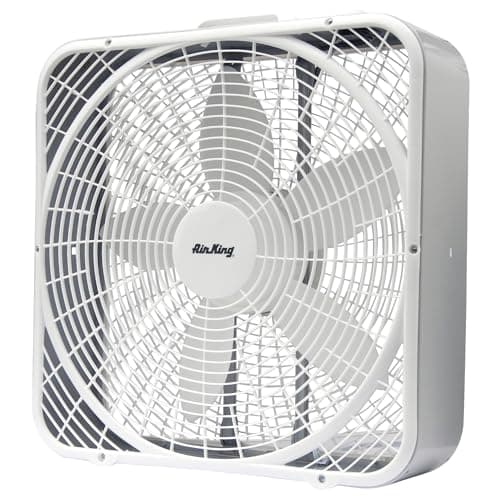
The Air King 9723, at 2,163 CFM on 105 W — the highest airflow figure any box fan manufacturer publishes, and the only one traceable to a specification sheet rather than a retail listing. That is 20.6 CFM per watt. If you need more air than that, stop looking at box fans: a 20-inch whole-house window fan publishes 3,560 CFM and costs about the same to run per unit of air.
Fan & Frost earns a commission when you buy through our links, at no cost to you. It never changes a ranking, and we say so when the right answer is the cheaper unit or nothing at all. Full disclosure · How we pick.
At a glance
The picks, ranked
Tap any row to jump to the full reasoning. Prices are live from Amazon where we have them, and read “check price” where we don’t — never a number we cannot verify today.
| # | Product | Best for | Price |
|---|---|---|---|
| 1 | Best overall Air King 9723 20" Commercial Grade Box Fan 2,163 CFM on 105 W, published by the manufacturer with the blade speed and amperage to go with it. Nothing else in the category is even stated. | A garage, a workshop, a job site, or any room where you want the most air a box fan can legitimately claim | |
| 2 | 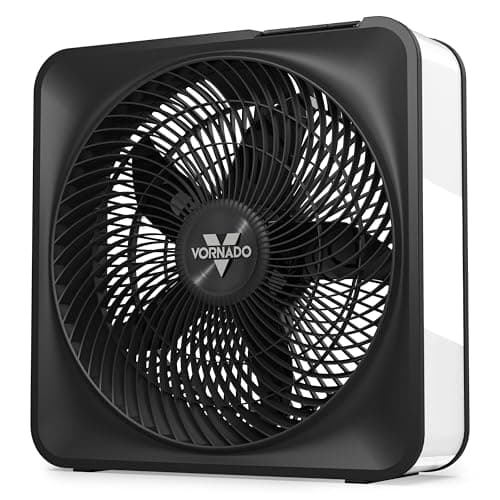 Most force, if not most volume Vornado Model 80 High-Velocity Box Fan 120 W into a 16.15-inch blade inside a 20-inch shroud — a tighter, faster column of air than a full-width blade produces, and five speeds to meter it. | Throwing air across a long room rather than filling a small one | |
| 3 | 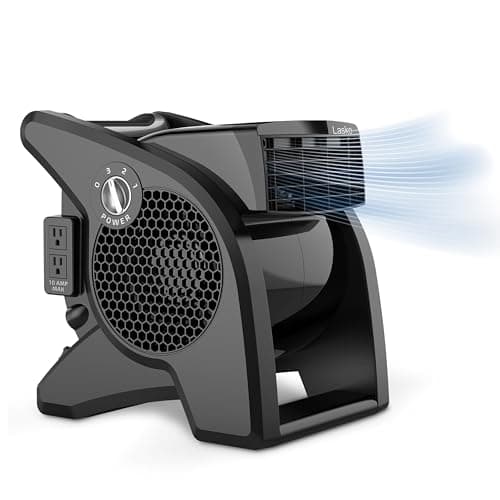 If you want brute force and do not care about the format Lasko Max Performance 15" Air Mover 178 W into a 15-inch pivoting utility blade — 70 per cent more power than the strongest box fan here, in a frame built to be pointed at something. | Drying a floor, airing out a basement, or pushing air down a corridor | |
| 4 | 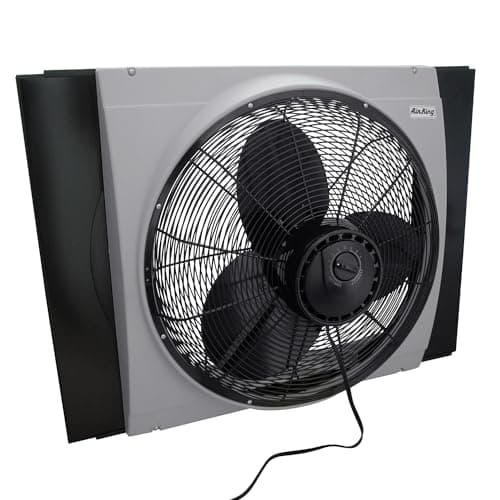 More air than any box fan, by 65 per cent Air King 20" Whole House Window Fan 3,560 CFM on 170 W — 20.9 CFM per watt, and 1,400 CFM more than the strongest box fan publishes. Same blade size, different job. | A window, when the actual goal is to change the air in the whole house | |
| — | 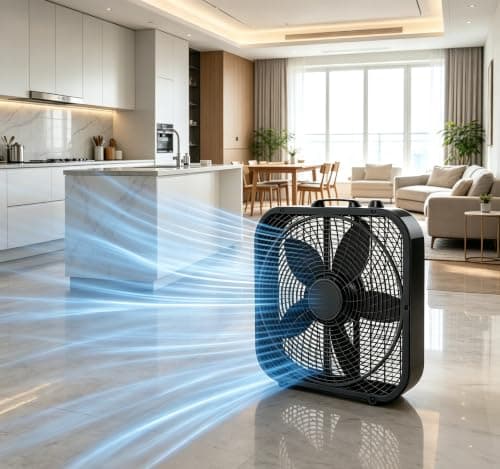 The one to skip if power is the point Lasko B20301 20" Weather-Resistant Box Fan The cheapest box fan here, and the only one whose manufacturer publishes no wattage, no CFM and no blade speed. You cannot buy power you cannot measure. | Nothing on this page |
Search for the most powerful box fan and you will find airflow figures everywhere: 2,295 CFM, 2,400 CFM, 3,000 CFM. Almost none of them appear on the manufacturer’s own specification page, and there is no mandatory test procedure for portable fan airflow in the United States, so they are not comparable with each other even when they are real.
There is exactly one 20-inch box fan whose maker publishes a full airflow table, and that is the fan this page is built on.
The comparison
What each manufacturer actually publishes
| Fan | CFM, high | Watts, high | CFM per watt | 8 hrs |
|---|---|---|---|---|
| Air King 9723 box fan | 2,163 | 105 W | 20.6 | 15¢ |
| Vornado Model 80 box fan | Not published | 120 W | — | 18¢ |
| Lasko B20801 box fan | Not published | 102 W | — | 15¢ |
| Lasko U15720 air mover | Not published | 178 W | — | 26¢ |
| Air King 9166F window fan | 3,560 | 170 W | 20.9 | 25¢ |
Airflow and wattage from each manufacturer’s own specification page. CFM per watt and costs are our arithmetic at 18.34¢/kWh.
The ceiling
Why 2,163 CFM is roughly where a box fan stops
A box fan is a 20-inch blade on a shaded-pole or PSC motor in a frame under five inches deep. All three of those cap the output.
- Blade diameter is fixed by the window. The format exists to sit in a double-hung sash, which is why it is 20 inches and why it has been 20 inches for fifty years.
- Depth is fixed by the sash closing on it. Under five inches leaves no room for a deep shroud, and shroud depth is what converts blade speed into static pressure.
- The motor is fixed by the price. 1/25 HP is what a box fan budget buys. The air mover on this page gets 178 W into a smaller blade precisely because it is not trying to be a $40 object.
Beyond that ceiling the categories change shape: high-velocity floor fans trade width for pressure, whole-house window fans trade portability for scale, and a whole-house fan moves an order of magnitude more air than any of them.
This one is not a DIY job
Two box fans beat one powerful box fan almost every time. One in a window blowing out and one in a window on the opposite side blowing in creates directed flow through the building. A single fan, however powerful, mostly stirs the room it is standing in.
Cost
What the extra power costs
Almost nothing, which is the pleasant part of this category. The spread between the weakest and strongest fan here is $3.35 over a month of eight-hour runs. Even the air mover at 178 W costs $7.83 a month running all night, against $57 for a portable air conditioner.
That is the real argument for buying the fan with the published number rather than the cheapest one: the running cost difference is noise, so you may as well buy the air. The full wattage table is here.
Say the unwelcome thing
Do not buy on a listing's CFM figure.
There is no mandatory airflow test procedure for portable fans in the United States. A manufacturer that publishes CFM on its own specification sheet has at least committed to a figure; a number that appears only in a retail listing has committed to nothing, and the same chassis is routinely listed at different figures by different sellers.
If two fans both publish CFM, compare them. If only one does, that is the comparison.
In full
Every pick, and what is wrong with it
Published specifications only, each linked to the page it came from. Where a manufacturer publishes nothing, the row says so — we do not fill blanks in.
1. Best overall
Air King 9723 20" Commercial Grade Box Fan
Air King · model 9723
2,163 CFM on 105 W, published by the manufacturer with the blade speed and amperage to go with it. Nothing else in the category is even stated.
2,163 / 1,900 / 1,463 CFM on 105 / 87 / 65 W. That is the whole case. It is the only complete airflow-and-power table published for a box fan by the company that makes it, and every other figure in this article is measured against it.
The efficiency that falls out of those numbers is 20.6 CFM per watt on high and 22.5 on low — our arithmetic on Air King’s published figures. Low is the better deal, which is true of almost every fan and almost never acted on.
1,220 RPM on high through a 20-inch blade, driven by a 1/25 HP permanently lubricated motor in a steel body. The motor rating is the specification that separates a fan intended to run all day in a shop from one intended to run evenings in a bedroom.
Running cost is unremarkable because fans are cheap: 15¢ for an eight-hour shift on high at 18.34¢/kWh, $4.62 for thirty of them.
What you are buying over a supermarket box fan is a published number and a motor built for duty cycles. What you are not buying is quiet: no dBA figure is published, and a steel commercial fan at 1,220 RPM is not a bedroom object.
What’s wrong with it
Air King publishes no noise figure, it is a steel commercial fan rather than a living-room object, and at 11.4 lb it is heavier than the plastic alternatives.
Running cost — 9723
| Nameplate power | 65 W – 105 W | manufacturer's published figure |
|---|---|---|
| Energy, 8-hour night | 0.84 kWh | 105 ÷ 1000 × 8 |
| Cost per hour | 1.9¢ | at 18.34¢/kWh |
| Cost per 8-hour night | 15¢ | on the highest speed |
| Cost per 30 nights | $4.62 | 25.2 kWh |
| Same month, lowest speed | $2.86 | at 65 W |
Rate: 18.34¢/kWh, the US average residential price for June 2026 (EIA Electric Power Monthly, Table 5.3). Yours will differ — swap it in: (watts ÷ 1000) × hours × your rate.
| Air delivery | 2,163 / 1,900 / 1,463 CFM (high / medium / low) |
|---|---|
| Power | 105 / 87 / 65 W (0.94 / 0.72 / 0.56 A) |
| Efficiency | 20.6 CFM per watt on high, 22.5 on low (our arithmetic) |
| Blade speed | 1,220 / 1,075 / 855 RPM |
| Blade | 20 in |
| Speeds | 3 |
| Motor | 1/25 HP, 120 V, 1 phase |
| Dimensions | 21.38 W x 6.38 D x 22.5 H in |
| Weight | 11.4 lb |
| Oscillation | No |
| Noise | Not published |
Every figure above is from Air King commercial box fan product page, model 9723. Blanks are shown as “not published” rather than filled in.
2. Most force, if not most volume
Vornado Model 80 High-Velocity Box Fan
Vornado · model 80
120 W into a 16.15-inch blade inside a 20-inch shroud — a tighter, faster column of air than a full-width blade produces, and five speeds to meter it.
There are two different things people mean by a powerful fan. Volume is how much air moves; reach is how far it goes before it dissipates. They are not the same, and a wide slow blade is good at the first while a smaller fast blade in a shroud is good at the second.
16.15 inches of blade inside a 19.99-inch frame is the design decision. The extra shroud depth lets Vornado run the blade faster and column the output rather than letting it spread, which is the same principle behind its air circulators.
120 / 90 / 70 W is published across three of the five speeds. On high that is 18¢ per eight hours, the most of any fan here and still less than a light bulb used to cost to run.
Where this one earns its price is the two settings below a conventional low, the removable grille (a blade you can actually clean stays a blade that moves its rated air), and five years of warranty.
The gap is the one that matters on this page: Vornado publishes no CFM. We are not going to estimate it and we are not going to repeat a retailer’s figure.
What’s wrong with it
Vornado publishes no CFM at all, so its airflow cannot be compared with the Air King's. It also draws the most power of any box fan here for air you cannot quantify.
Running cost — 80
| Nameplate power | 70 W – 120 W | manufacturer's published figure |
|---|---|---|
| Energy, 8-hour night | 0.96 kWh | 120 ÷ 1000 × 8 |
| Cost per hour | 2.2¢ | at 18.34¢/kWh |
| Cost per 8-hour night | 18¢ | on the highest speed |
| Cost per 30 nights | $5.28 | 28.8 kWh |
| Same month, lowest speed | $3.08 | at 70 W |
Rate: 18.34¢/kWh, the US average residential price for June 2026 (EIA Electric Power Monthly, Table 5.3). Yours will differ — swap it in: (watts ÷ 1000) × hours × your rate.
| Power | 120 / 90 / 70 W (three of the five settings published) |
|---|---|
| Speeds | 5 |
| Blade diameter | 16.15 in |
| Supply | 120 V, 60 Hz |
| Dimensions | 19.99 W x 6.41 D x 20.19 H in |
| Weight | 12.96 lb |
| Cord | 6 ft, 2-pin polarized |
| Grille | Removable, for cleaning |
| Air delivery (CFM) | Not published |
| Noise | Not published |
| Warranty | 5 years |
Every figure above is from Vornado product page, Model 80 High-Velocity Box Fan. Blanks are shown as “not published” rather than filled in.
3. If you want brute force and do not care about the format
Lasko Max Performance 15" Air Mover
Lasko · model U15720
178 W into a 15-inch pivoting utility blade — 70 per cent more power than the strongest box fan here, in a frame built to be pointed at something.
An air mover is what you buy when a box fan is not enough and you have stopped caring what it looks like.
160 W to 178 W across three speeds — 1.35 to 1.53 A at 120 V, the highest current draw of any fan on this site. That power goes into a 15-inch blade in a drum housing that pivots, so the entire output can be aimed at a wall, a floor or a doorway.
Two 120 V pass-through outlets and a 9.5 ft cord are the tell that this is a trade tool: you daisy-chain them down a corridor off one socket.
It costs 26¢ for an eight-hour run on high, which is still small, and $7.83 over a month if you genuinely leave it going.
Buy it for a flood, a repaint or a garage. Do not buy it to cool a living room.
What’s wrong with it
Lasko publishes no CFM for it either, it is the loudest object in this article by some distance, and 178 W is three times the running cost of a box fan on low.
Running cost — U15720
| Nameplate power | 160 W – 178 W | manufacturer's published figure |
|---|---|---|
| Energy, 8-hour night | 1.42 kWh | 178 ÷ 1000 × 8 |
| Cost per hour | 3.3¢ | at 18.34¢/kWh |
| Cost per 8-hour night | 26¢ | on the highest speed |
| Cost per 30 nights | $7.83 | 42.7 kWh |
| Same month, lowest speed | $7.04 | at 160 W |
Rate: 18.34¢/kWh, the US average residential price for June 2026 (EIA Electric Power Monthly, Table 5.3). Yours will differ — swap it in: (watts ÷ 1000) × hours × your rate.
| Power | 160 W - 178 W (1.35-1.53 A at 120 V) |
|---|---|
| Speeds | 3 |
| Dimensions | 14.5 H x 14.0 D x 11.5 W in |
| Weight | 12.55 lb |
| Extras | Two 120 V accessory outlets, 9.5 ft cord, pivoting head |
| Air delivery (CFM) | Not published |
| Warranty | 1 year |
Every figure above is from Lasko product page, U15720. Blanks are shown as “not published” rather than filled in.
4. More air than any box fan, by 65 per cent
Air King 20" Whole House Window Fan
Air King · model 9166F
3,560 CFM on 170 W — 20.9 CFM per watt, and 1,400 CFM more than the strongest box fan publishes. Same blade size, different job.
If the reason you want a powerful box fan is that you want to change the air in a building rather than stir the air in a room, this is the fan that does it, and the gap is not close.
3,560 / 3,120 / 2,510 CFM on 170 / 145 / 115 W. Its low setting moves more air than the strongest box fan on high, and it does it on 115 W against 105. Efficiency works out at 20.9 CFM per watt, almost exactly the same as the box fan — you are not buying efficiency, you are buying scale.
64 / 57 / 50 dB published, which is the other thing: Air King will tell you how loud this one is and will not tell you how loud its box fan is.
Storm Guard lets the window close behind the fan, so the opening is sealed rather than propped. The constraint is fit: measure the opening before you buy. The window fan category in full.
What’s wrong with it
It needs a window 27 to 38 inches wide and 26.25 inches high, weighs 36.6 lb, and cannot stand on a floor. This is installed equipment, not a portable fan.
Running cost — 9166F
| Nameplate power | 115 W – 170 W | manufacturer's published figure |
|---|---|---|
| Energy, 8-hour night | 1.36 kWh | 170 ÷ 1000 × 8 |
| Cost per hour | 3.1¢ | at 18.34¢/kWh |
| Cost per 8-hour night | 25¢ | on the highest speed |
| Cost per 30 nights | $7.48 | 40.8 kWh |
| Same month, lowest speed | $5.06 | at 115 W |
Rate: 18.34¢/kWh, the US average residential price for June 2026 (EIA Electric Power Monthly, Table 5.3). Yours will differ — swap it in: (watts ÷ 1000) × hours × your rate.
| Air delivery | 3,560 / 3,120 / 2,510 CFM (high / medium / low) |
|---|---|
| Power | 170 / 145 / 115 W (1.4 / 1.2 / 1.0 A) |
| Efficiency | 20.9 CFM per watt on high, 21.8 on low (our arithmetic) |
| Noise | 64 / 57 / 50 dB (high / medium / low) |
| Blade | 20 in |
| Speeds | 3 |
| Window required | 27 - 38 in wide x 26.25 in high |
| Dimensions | 26.75 W x 11.25 D x 26.25 H in |
| Weight | 36.6 lb |
| Storm Guard | Window can close behind the fan |
| Mounting | Hardware included |
| ENERGY STAR | No program exists for window fans |
Every figure above is from Air King whole house window fan product page, models 9155 and 9166F. Blanks are shown as “not published” rather than filled in.
Skip this one
Lasko B20301 20" Weather-Resistant Box Fan
Lasko · model B20301
The cheapest box fan here, and the only one whose manufacturer publishes no wattage, no CFM and no blade speed. You cannot buy power you cannot measure.
This is a perfectly reasonable box fan and the wrong answer to this question.
7.25 lb against 11.4 for the Air King and 12.96 for the Vornado. Weight in a fan is motor and blade, and a fan that weighs 40 per cent less than its rivals has less of both.
Lasko publishes no wattage, no CFM and no RPM for it — only “less than 2¢ per hour”, which is a running-cost claim rather than a performance one.
Buy it as a cheap second fan for a spare room. What box fans actually cost.
What’s wrong with it
Nothing is published at all. 7.25 lb of fan has a small motor and a light blade, and both of those are the opposite of what this page is about.
Running cost
Lasko does not publish a wattage for the B20301, so we cannot calculate what it costs to run. We are not going to estimate one. If Lasko publishes a nameplate figure, this block will show the arithmetic.
| Power | Not published (Lasko states "less than 2 cents per hour") |
|---|---|
| Speeds | 3 |
| Blade | 20 in |
| Motor | Weather-resistant, for indoor window use |
| Dimensions | 20.5 W x 4.38 D x 21.75 H in |
| Weight | 7.25 lb |
| Cord | 6 ft |
| Safety | Blue Plug fused plug |
| Air delivery (CFM) | Not published |
| Noise | Not published |
| Warranty | 2 years |
Every figure above is from Lasko product page, B20301. Blanks are shown as “not published” rather than filled in.
We are not linking a buy button for this one. If you want to look at it anyway, it is easy enough to find — but we would rather send you to something that fits your room.
Questions people actually ask
Frequently asked
What is the most powerful box fan?
The Air King 9723, at 2,163 CFM on 105 W. It is the only 20-inch box fan whose manufacturer publishes a full airflow table — 2,163 / 1,900 / 1,463 CFM across its three speeds — so it is the only airflow figure in the category that can be checked against a specification sheet.
How many CFM is a box fan?
Most manufacturers do not say. The one published figure for a 20-inch box fan is 2,163 CFM on high, 1,463 CFM on low. Lasko and Vornado publish wattage for their box fans but no airflow at all, and listing figures of 2,295 or 2,400 CFM do not appear on either company's specification pages.
What is the highest CFM box fan you can buy?
2,163 CFM is the highest published figure. If you need more air than that, the format to move to is a whole-house window fan: a 20-inch one publishes 3,560 CFM on 170 W, which is 65 per cent more air for 62 per cent more power. Window fans compared.
Does a higher-wattage fan move more air?
Not reliably. The 178 W air mover on this page drives a 15-inch blade and the 105 W box fan drives a 20-inch one, so the box fan almost certainly moves more total air while the air mover moves it harder. Watts tell you what the motor consumes, not what the blade delivers.
Is a box fan or a high-velocity fan more powerful?
They are powerful in different ways. A box fan moves a large volume of air gently across a wide area; a high-velocity fan drives a smaller volume much harder in one direction. For cooling a room, volume wins. For drying a floor or pushing air down a corridor, velocity wins. High-velocity fans.
What does the most powerful box fan cost to run?
About 15¢ for an eight-hour run on high at 18.34¢/kWh, or $4.62 over thirty of them. The entire spread between the weakest and strongest fan on this page is under $3.85 a month.
Sources
Where these numbers came from
- Air King commercial box fan specifications, model 9723 — 2,163/1,900/1,463 CFM on 105/87/65 W
- Vornado Model 80 High-Velocity Box Fan — 120/90/70 W, 16.15 in blade
- Lasko B20801 Power Plus box fan — 73-102 W
- Lasko U15720 Max Performance air mover — 160-178 W, 1.35-1.53 A
- Air King whole house window fan, 9166F — 3,560/3,120/2,510 CFM on 170/145/115 W
- EIA Electric Power Monthly, Table 5.3 — electricity rate
Read next
Where to go from here
Back to Fans, or read how we pick.