The picks
The best smart fans, and whether the app is worth it
Wi-Fi does not make a fan cool better. It makes it start before you get home and stop without you waking up — which is worth something, and worth knowing the price of.
By Sawyer V. · Published
The short answer
The Lasko Aria T40733: 460 CFM on 41–52 W, 31.5 dBA on low, five speeds, a 9-hour timer, and Alexa plus Google Assistant. Smart control is worth it for scheduling and voice, not for cooling — and if you only want quiet and cheap, a 12-speed DC tower beats it on both.
Fan & Frost earns a commission when you buy through our links, at no cost to you. It never changes a ranking, and we say so when the right answer is the cheaper unit or nothing at all. Full disclosure · How we pick.
At a glance
The picks, ranked
Tap any row to jump to the full reasoning. Prices are live from Amazon where we have them, and read “check price” where we don’t — never a number we cannot verify today.
| # | Product | Best for | Price |
|---|---|---|---|
| 1 | Best overall Lasko Aria 40" Smart Wi-Fi Tower Fan The only fan here that publishes CFM, wattage and dBA together — 460 CFM, 41-52 W, 31.5 dBA low — and adds app and voice control on top. | A bedroom or living room you want on a schedule | |
| 2 | 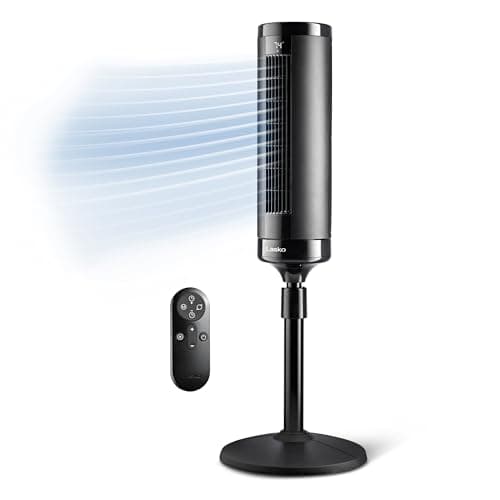 Cheaper and quieter, without the app Lasko EcoQuiet 42" DC Tower Fan 23 dBA and 2.9 W on low, with twelve speeds — it beats the smart fan on every specification except connectivity. | Anyone whose real requirement is a quiet bedroom fan | |
| 3 | 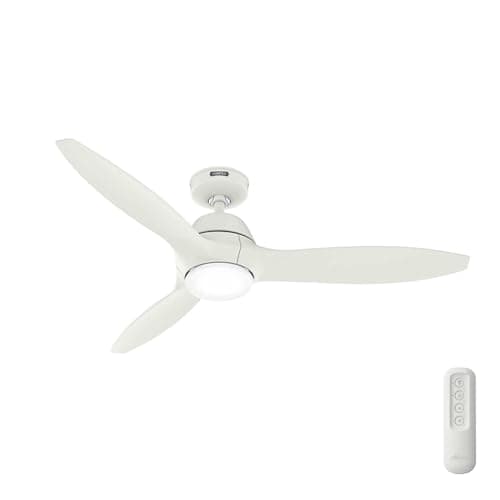 The smart option worth wiring in Hunter Skyway 52" Ceiling Fan with Light Kit 363.8 CFM per watt certified at 16.3 W, and a wall switch or smart relay makes any ceiling fan schedulable. | A room you own, where the fan can be permanent | |
| — | 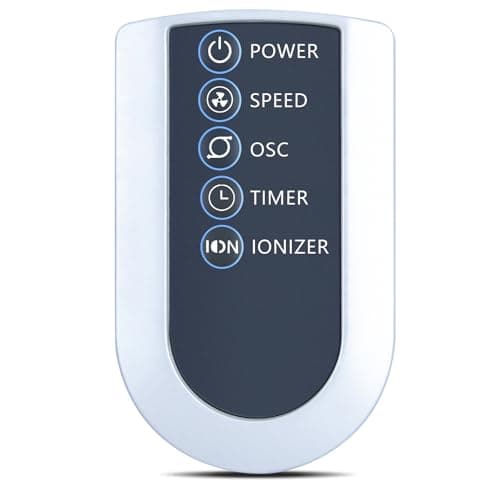 The one to skip if connectivity is the point Lasko Wind Curve 42" Tower Fan 720 CFM and 49 W with no smart control at all — more air than the smart fan, and no way to schedule it. | A living room where nobody needs a schedule |
“Smart fan” describes a connectivity feature, not a cooling one. No app moves more air. So the question worth answering is narrow: what does the connectivity genuinely do, and what does it cost?
What it buys
Three things Wi-Fi genuinely adds
- Scheduling. The real one. A fan that starts at 9pm has moved the room’s stale air before you get into it, and a schedule that stops it at 3am means nobody wakes to switch it off. The Aria’s 9-hour timer covers a night; the app covers the rest.
- Voice at 2am. Sounds trivial until the alternative is standing up in a hot room. Alexa and Google Assistant both work with the Aria.
- Control from another room. Useful when the fan is in a nursery or a room you are not in — and the reason a nursery fan is one of the few places the feature really earns itself.
What it does not add is cooling, quiet or efficiency. On all three the Aria is beaten by a DC tower fan that costs less.
The comparison
Smart against not-smart
| Aria T40733 (smart) | EcoQuiet T42710 (DC) | |
|---|---|---|
| Power | 41 – 52 W | 2.9 – 19 W |
| Air delivery | 460 CFM | Not published |
| Noise | 31.5 / 48.7 dBA | 23 / 46 dBA |
| Speeds | 5 | 12 |
| Timer | 9 hours | 8 hours |
| App / voice | Yes — Alexa, Google | No |
| Remote | Not included | Included |
| Weight | 9.5 lb | 7.8 lb |
| 30 nights on low | $1.80 | 13¢ |
| Warranty | 2 years | 2 years |
Specifications from Lasko’s product pages; costs are our arithmetic at 18.34¢/kWh.
The row that decides it for most people is the running cost. On its lowest speed the smart fan draws 41 W where the DC tower draws 2.9 W. Over a summer that is a real gap, and it is the price of the AC motor rather than of the Wi-Fi.
There is a smart fan that avoids the trade entirely, and it is a ceiling fan on a smart switch — certified efficiency plus scheduling, for less power than either tower.
The hidden cost
Standby draw, which nobody publishes for tower fans
A connected device is never fully off. It holds a Wi-Fi association and listens for commands 8,760 hours a year.
For ceiling fans this is measured and public: the certified dataset lists standby draw separately, and it runs from 0.3 W to 1.2 W — which works out to 48¢ to $1.93 a year doing nothing. Small, but it never stops.
For smart tower fans, no manufacturer publishes it. Lasko states the Aria’s running wattage but not its standby, so we cannot tell you what it costs switched off. Given a Wi-Fi radio is typically thirstier than a ceiling fan’s receiver, assume it is at the higher end of that range rather than the lower — but we are not going to put a number on something nobody published.
Say the unwelcome thing
Do not buy connectivity to solve a noise problem.
A common path to this page is a fan that is too loud at night, and an app looks like the answer because you can turn it down without getting up.
It is not the answer. The Aria is 31.5 dBA on low against 23 dBA for a non-smart DC tower, and it has five speeds against twelve — so it is both louder and harder to dial into the setting that is just enough.
If the problem is noise, buy on published dBA and speed count. The quiet-fan page ranks on exactly that.
Before you buy
Four things worth checking
- Does it include a remote? The Aria does not. When the Wi-Fi drops — and it will — the app is not a control method, and without a remote you are walking to the fan.
- Which assistants, specifically. Alexa and Google Assistant are the common pair. If your household runs on something else, check before buying.
- 2.4 GHz only? Most home appliances are, and a combined-band router can make setup unexpectedly annoying.
- Does it still work as a fan? Anything that requires an account and a working cloud service to change speed is a fan with a dependency. Physical controls on the unit are not optional.
And the question underneath all of it: would a blind closed during the day and a 19 W fan solve this without an app at all? For a lot of rooms, yes.
In full
Every pick, and what is wrong with it
Published specifications only, each linked to the page it came from. Where a manufacturer publishes nothing, the row says so — we do not fill blanks in.
1. Best overall
Lasko Aria 40" Smart Wi-Fi Tower Fan
Lasko · model T40733
The only fan here that publishes CFM, wattage and dBA together — 460 CFM, 41-52 W, 31.5 dBA low — and adds app and voice control on top.
460 CFM published, which is a genuinely useful number and rare in this category. Combined with 41–52 W that gives roughly 8.8 CFM per watt — respectable for a tower, though a long way short of a ceiling fan's certified 366.
31.5 dBA on low, 48.7 on high, both published. That is quiet enough to sleep beside, if not as quiet as the 23 dBA EcoQuiet DC tower.
What the smart part actually buys you is scheduling. A fan that starts an hour before bedtime has already moved the day’s stale air by the time you get in, and a 9-hour timer plus an app schedule means it stops in the small hours without anyone waking to switch it off. Voice control through Alexa or Google Assistant matters most at 2am, when the alternative is getting up.
About $2.29 for a month of eight-hour nights at full power, or $1.80 on its lowest setting. 9.5 lb, 39.58 inches, 90-degree oscillation, 2-year warranty.
What’s wrong with it
No remote is included, so if the Wi-Fi drops or the app is down you are walking to the fan. 41 W on its lowest speed is also 14× a DC tower fan's 2.9 W.
Running cost — T40733
| Nameplate power | 41 W – 52 W | manufacturer's published figure |
|---|---|---|
| Energy, 8-hour night | 0.42 kWh | 52 ÷ 1000 × 8 |
| Cost per hour | 1.0¢ | at 18.34¢/kWh |
| Cost per 8-hour night | 7.6¢ | on the highest speed |
| Cost per 30 nights | $2.29 | 12.5 kWh |
| Same month, lowest speed | $1.80 | at 41 W |
Rate: 18.34¢/kWh, the US average residential price for June 2026 (EIA Electric Power Monthly, Table 5.3). Yours will differ — swap it in: (watts ÷ 1000) × hours × your rate.
| Power | 41 W - 52 W (0.3-0.44 A at 120 V) |
|---|---|
| Air delivery | 460 CFM |
| Noise | 31.5 dBA low, 48.7 dBA high |
| Speeds | 5 |
| Smart control | Aria for Home app (iOS/Android), Amazon Alexa, Google Assistant |
| Height | 39.58 in |
| Footprint | 11.2 x 11.2 in |
| Weight | 9.5 lb |
| Timer | 9 hours |
| Oscillation | 90 degrees |
| Remote | Not included |
| Warranty | 2 years |
Every figure above is from Lasko product page, T40733. Blanks are shown as “not published” rather than filled in.
2. Cheaper and quieter, without the app
Lasko EcoQuiet 42" DC Tower Fan
Lasko · model T42710
23 dBA and 2.9 W on low, with twelve speeds — it beats the smart fan on every specification except connectivity.
Worth putting directly beside the smart fan, because the comparison is stark on the numbers that describe cooling.
2.9–19 W against 41–52 W. On low that is 13¢ a month against $1.80 — roughly fourteen times cheaper to run. And 23 dBA against 31.5, which on a logarithmic scale is a substantial difference at bedside.
Twelve speeds rather than five also matters more at close range: you can sit exactly on the setting that is just enough.
Buy the smart fan if you want scheduling and voice. Buy this if what you actually wanted was a quiet, cheap bedroom fan and the app was incidental. The quiet comparison is here.
What’s wrong with it
No app, no voice control and no scheduling beyond its 8-hour timer. If you genuinely want the fan running before you get home, this cannot do it.
Running cost — T42710
| Nameplate power | 2.9 W – 19 W | manufacturer's published figure |
|---|---|---|
| Energy, 8-hour night | 0.15 kWh | 19 ÷ 1000 × 8 |
| Cost per hour | 0.3¢ | at 18.34¢/kWh |
| Cost per 8-hour night | 2.8¢ | on the highest speed |
| Cost per 30 nights | 84¢ | 4.6 kWh |
| Same month, lowest speed | 13¢ | at 2.9 W |
Rate: 18.34¢/kWh, the US average residential price for June 2026 (EIA Electric Power Monthly, Table 5.3). Yours will differ — swap it in: (watts ÷ 1000) × hours × your rate.
| Power | 2.9 W - 19 W (0.06-0.303 A at 120 V) |
|---|---|
| Noise | 23 dBA low, 46 dBA high |
| Speeds | 12 |
| Height | 41.6 in |
| Footprint | 12.8 x 12.8 in |
| Weight | 7.8 lb |
| Timer | 8 hours |
| Air delivery (CFM) | Not published |
| Warranty | 2 years |
Every figure above is from Lasko product page, T42710. Blanks are shown as “not published” rather than filled in.
3. The smart option worth wiring in
Hunter Skyway 52" Ceiling Fan with Light Kit
Hunter · model 52" Skyway (damp-rated)
363.8 CFM per watt certified at 16.3 W, and a wall switch or smart relay makes any ceiling fan schedulable.
The overlooked route to a “smart fan” is to make a far more efficient fan smart, rather than buying connectivity attached to a mediocre one.
16.3 W on high at a certified 363.8 CFM per watt — about 72¢ for a month of nights, against $2.29 for the smart tower moving far less air. A compatible smart switch adds scheduling and voice to that.
The certified data also tells you what the tower fans will not: standby draw is 0.4 W, so you know what the always-on part costs. The full certified ranking is here.
What’s wrong with it
It is a wired installation with a light kit, and it is damp-rated rather than wet-rated. Smart control means adding a compatible switch or relay rather than buying connectivity in the box.
Running cost — 52" Skyway (damp-rated)
| Nameplate power | 2.1 W – 16.3 W | manufacturer's published figure |
|---|---|---|
| Energy, 8-hour night | 0.13 kWh | 16.3 ÷ 1000 × 8 |
| Cost per hour | 0.3¢ | at 18.34¢/kWh |
| Cost per 8-hour night | 2.4¢ | on the highest speed |
| Cost per 30 nights | 72¢ | 3.9 kWh |
| Same month, lowest speed | 9.2¢ | at 2.1 W |
Rate: 18.34¢/kWh, the US average residential price for June 2026 (EIA Electric Power Monthly, Table 5.3). Yours will differ — swap it in: (watts ÷ 1000) × hours × your rate.
| Blade span | 52 in |
|---|---|
| Efficiency | 363.8 CFM per watt |
| Power, high speed | 16.3 W |
| Power, low speed | 2.1 W |
| Standby power | 0.4 W |
| Type | Indoor, with light kit; damp-rated |
| Warranty | 3 years, components |
| ENERGY STAR | Certified |
Every figure above is from ENERGY STAR Certified Ceiling Fans dataset. Blanks are shown as “not published” rather than filled in.
Skip this one
Lasko Wind Curve 42" Tower Fan
Lasko · model 2554
720 CFM and 49 W with no smart control at all — more air than the smart fan, and no way to schedule it.
Included to make the trade explicit. This moves 720 CFM — 56% more air than the smart tower — at a similar 37–49 W, and it costs meaningfully less to buy.
What it has no answer for is the actual reason to buy a smart fan: you cannot schedule it, you cannot start it from work, and you cannot turn it off from bed without getting up.
It also publishes no dBA figure, which for a living-room fan matters less than it would in a bedroom. The tower fan roundup covers it properly.
What’s wrong with it
37-49 W with no published noise figure and no connectivity. If you came to this page wanting an app, this is not it; if you did not, it is a lot of air for the money.
Running cost — 2554
| Nameplate power | 37 W – 49 W | manufacturer's published figure |
|---|---|---|
| Energy, 8-hour night | 0.39 kWh | 49 ÷ 1000 × 8 |
| Cost per hour | 0.9¢ | at 18.34¢/kWh |
| Cost per 8-hour night | 7.2¢ | on the highest speed |
| Cost per 30 nights | $2.16 | 11.8 kWh |
| Same month, lowest speed | $1.63 | at 37 W |
Rate: 18.34¢/kWh, the US average residential price for June 2026 (EIA Electric Power Monthly, Table 5.3). Yours will differ — swap it in: (watts ÷ 1000) × hours × your rate.
| Power | 37 W - 49 W (0.4 A at 120 V) |
|---|---|
| Air delivery | 720 CFM |
| Speeds | 3 |
| Height | 42.5 in |
| Footprint | 13 x 13 in |
| Weight | 10.62 lb |
| Timer | 7.5-hour auto-off |
| Noise | Not published |
| Warranty | 1 year |
Every figure above is from Lasko product page, 2554. Blanks are shown as “not published” rather than filled in.
We are not linking a buy button for this one. If you want to look at it anyway, it is easy enough to find — but we would rather send you to something that fits your room.
Questions people actually ask
Frequently asked
Are smart fans worth it?
For scheduling and voice control, yes — a fan that starts before you get home and stops without waking you is genuinely useful. For cooling, no. A Wi-Fi radio moves no air, and the Lasko Aria draws 41 W on its lowest speed against 2.9 W for a non-smart DC tower fan.
What is the best smart fan?
The Lasko Aria T40733 on published specifications: 460 CFM, 41 to 52 W, 31.5 dBA on low, five speeds, a 9-hour timer, and both Alexa and Google Assistant. It is the only fan we found that publishes CFM, wattage and dBA together.
Do smart fans use electricity when off?
Yes — a connected device holds a Wi-Fi association continuously. Certified ceiling fans publish standby draw of 0.3 to 1.2 W, but no manufacturer publishes a standby figure for a smart tower fan, so we cannot give you a number for one.
Is a smart fan quieter than a normal fan?
No, and often the opposite. The Aria publishes 31.5 dBA on low; a non-smart DC tower publishes 23 dBA and offers twelve speeds rather than five. If noise is the problem you are solving, buy on published dBA rather than on connectivity. Quiet fans ranked.
Can I make a normal ceiling fan smart?
Yes, with a compatible smart switch or in-canopy relay, and it is usually the better route. A certified ceiling fan draws 16.3 W on high at 363.8 CFM per watt — far more efficient than any smart tower fan — and the switch adds the scheduling and voice control.
What happens to a smart fan if the Wi-Fi goes down?
It should still work from its physical controls, and it does on the Aria. But the Aria ships without a remote, so a dropped connection means walking to the fan. Check for a remote and on-unit controls before buying anything that leans on an app.
Sources
Where these numbers came from
Read next
Where to go from here
Back to Fans, or read how we pick.