Guide and picks
How long should a bathroom fan run?
There is a published answer, and almost nobody follows it. The reason is not laziness — it is that 20 minutes of fan noise is intolerable, which turns the question into one about the fan rather than the clock.
By Sawyer V. · Published
The short answer
At least 20 minutes after each use. The Home Ventilating Institute publishes that ventilation “should continue for a minimum of 20 minutes after each use of the bathroom”. In a 60 sq ft bathroom with an 8-foot ceiling, 20 minutes at 110 CFM is about 4.6 complete air changes — and it costs roughly 2.4¢ a month to do that twice a day. The clock is not the hard part; the noise is.
Fan & Frost earns a commission when you buy through our links, at no cost to you. It never changes a ranking, and we say so when the right answer is the cheaper unit or nothing at all. Full disclosure · How we pick.
At a glance
The picks, ranked
Tap any row to jump to the full reasoning. Prices are live from Amazon where we have them, and read “check price” where we don’t — never a number we cannot verify today.
| # | Product | Best for | Price |
|---|---|---|---|
| 1 | 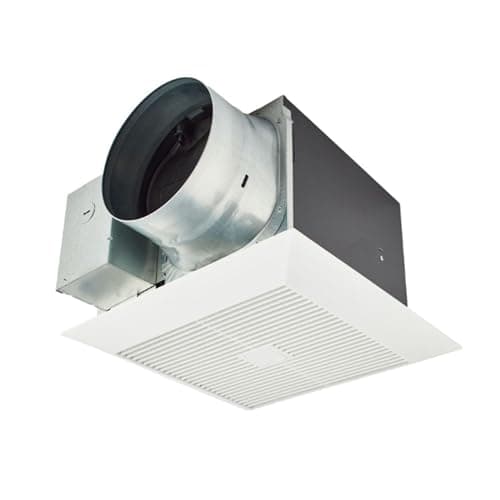 Best for actually leaving on Panasonic WhisperGreen Select FV-0511VK3 Ventilation Fan 110 / 80 / 50 CFM at 16.7 / 18.4 / 14.7 CFM per watt and 0.1 sones, with a published time delay built into the fan rather than bolted onto the switch. | Anyone who intends to follow the 20-minute rule — the most efficient certified fan on this site, at a noise level you will forget is running | |
| 2 | Shortest run time Panasonic WhisperGreen Select Ventilation Fan 158.7 CFM at 0.25 inches water gauge — the most air of any certified fan here — which cuts the time to four air changes by a third against a 110 CFM fan. | A big bathroom, or anybody who would rather run a fan hard for eight minutes than quietly for twenty | |
| 3 | 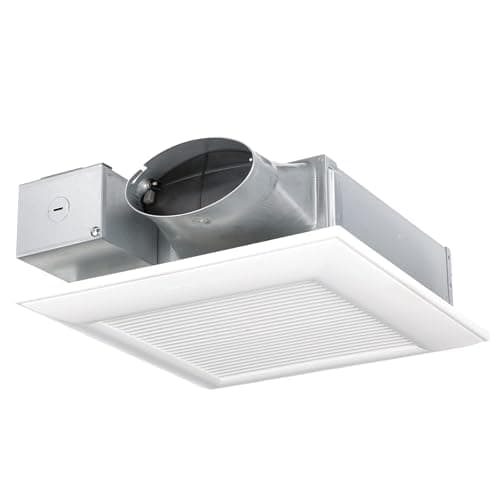 Best for continuous running Panasonic WhisperValue DC FV-0510VSC1 Ventilation Fan The only fan here that gets more efficient as it slows: 12 CFM per watt at 50 CFM on low, against 8.2 at 100 CFM on high. | Giving up on timing entirely — a shallow ceiling, a 4-inch duct, and a fan left on low all winter | |
| — | 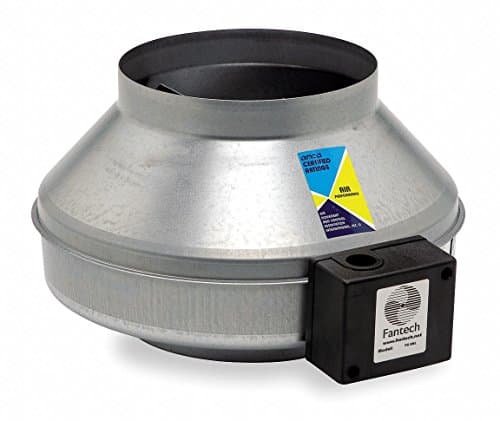 The wrong tool for this job Fantech FG 8 Series In-Line Fan 390 CFM at 4.0 CFM per watt, mounted in the duct rather than in the ceiling. Enormous airflow bought with four times the electricity per cubic foot. | A long duct run or several grilles on one fan — not a single bathroom where the question is how long to leave it on |
Nearly every answer to this question online is somebody’s preference. There is a published one, from the body whose sizing table the entire category uses, and it is specific.
The published answer
Twenty minutes, minimum, after each use
The Home Ventilating Institute’s own words: “A timer or other control that ensures ventilation continues for a minimum of 20 minutes after each use of the bathroom should be installed in each bathroom.”
Two things in that sentence get skipped. It says after each use, not after each shower — and it says the control should be installed, which means the recommendation assumes you are not going to stand there watching the clock. If your fan is on a plain wall switch, the guidance is already telling you the hardware is wrong.
The EPA comes at the same problem from the health side: “Run the bathroom fan or open the window when showering”, and “It is important to dry water-damaged areas and items within 24-48 hours to prevent mold growth.” A bathroom that never dries between showers is a surface that is wet indefinitely, which is the condition that guidance is written against.
The arithmetic
What 20 minutes actually moves
A fan’s rating is cubic feet per minute, so 20 minutes of running is simply CFM × 20 cubic feet of air. Divide that by the volume of the room and you get air changes — how many times over the fan replaced everything in the bathroom.
The table below assumes an 8-foot ceiling, so volume is floor area × 8. The arithmetic is ours; the CFM figures are certified.
| Bathroom | Volume | 50 CFM | 80 CFM | 110 CFM | 130 CFM |
|---|---|---|---|---|---|
| 40 sq ft | 320 cu ft | 3.1 | 5.0 | 6.9 | |
| 60 sq ft | 480 cu ft | 2.1 | 3.3 | 4.6 | |
| 80 sq ft | 640 cu ft | 1.6 | 2.5 | 3.4 | |
| 100 sq ft | 800 cu ft | 1.3 | 2.0 | 2.8 | |
| 140 sq ft | 1,120 cu ft | 0.9 | 1.4 | 2.0 |
Complete air changes achieved in a 20-minute run, at an 8-foot ceiling. Our arithmetic: (CFM × 20) ÷ (floor area × 8). A fan’s installed airflow is lower than its rating on a restrictive duct, so treat these as the best case.
The pattern in that table is the useful part. A 50 CFM fan in a 100 sq ft bathroom manages 1.3 air changes in 20 minutes — it has barely replaced the room’s air once. The same 20 minutes in a small 40 sq ft bathroom at 110 CFM is nearly seven changes, which is comfortably more than the job needs.
So the honest answer is not one number. It is: 20 minutes is the published floor, and whether that is enough depends on the fan and the room. In a large bathroom with a minimum-size fan, 30 to 40 minutes is what it takes to do what 20 minutes does in a small one.
The cost
It costs pennies, and that is the argument
Every reason given for turning a bathroom fan off early is implicitly about money. The numbers do not support it, and they are not close.
- 110 CFM at 16.7 CFM per watt is 6.6 watts. Twenty minutes twice a day for a month is 20 hours, or 2.4¢ at 18.34¢/kWh.
- Leaving it on low, permanently. 50 CFM at 14.7 CFM per watt is 3.4 watts: 46¢ a month, $5.46 a year, never touched.
- A cheap fan, run properly. At 5.8 CFM per watt, 70 CFM is 12.1 watts — 4.4¢ a month for the same twice-daily 20 minutes. Still not money.
- An in-line fan. 390 CFM at 4.0 CFM per watt is 97.5 watts: 36¢ a month. This is the only row where the electricity is worth a thought.
Against that, a fan left off is condensation on the glass and in the cold corners, which is the condition the EPA names directly: “Mold is frequently found on walls in cold corners behind furniture where condensation forms.” The fan is the cheapest line item in the house.
This one is not a DIY job
In winter the fan is also throwing out air you paid to heat. That is a real cost and it is not in the numbers above — a 110 CFM fan running 40 minutes a day moves about 4,400 cubic feet of warmed air outside. It is still the right trade, because the alternative is leaving the moisture in the building fabric. But it is the honest reason to size the fan properly and run it hard for a short time rather than weakly for an hour.
Controls
What to put on the wall
- A humidity sensor. Runs to a measured condition instead of a guessed time, which is the only control that adapts to a long shower. The sensing fans, and the finding that the sensor is free.
- A countdown timer. The simplest thing that satisfies the published guidance. Set it to 20 minutes minimum, longer in a big bathroom with a small fan.
- Nothing, and leave it on low. Legitimate and underrated: 20 CFM continuous is published as an alternative to an intermittent 50 CFM fan, and a multi-speed fan’s low speed clears that easily for a few dollars a year.
- A plain switch. The one the guidance is written against. It works only if the household is unusually disciplined, which households are not.
Placement
Where it is matters as much as how long
The published advice is that fans approved for wet locations “should be located over the shower or tub whenever possible”, and that an enclosed toilet should have its own exhaust fan rather than relying on the main one.
Both have the same logic. Twenty minutes of a fan pulling from the wrong end of the room is not 20 minutes of ventilation — it is 20 minutes of moving the air that was already dry while steam sits against the ceiling above the shower.
Say the unwelcome thing
Do not solve a bathroom moisture problem by running the fan longer on an undersized fan.
The table above shows why: a 50 CFM fan in a 100 sq ft bathroom needs roughly an hour to do what a 110 CFM fan does in 20 minutes, and during that hour the moisture is still migrating into the walls. The published sizing method is 1 CFM per square foot with a 50 CFM minimum below 100 sq ft, and fixture-by-fixture addition above it.
The other thing not to do is run the fan with the door shut and no gap under it. A fan can only exhaust what it can replace, and a sealed room starves it — the rated CFM on the box assumes make-up air is available.
In full
Every pick, and what is wrong with it
Published specifications only, each linked to the page it came from. Where a manufacturer publishes nothing, the row says so — we do not fill blanks in.
1. Best for actually leaving on
Panasonic WhisperGreen Select FV-0511VK3 Ventilation Fan
Panasonic · model FV-0511VK3
110 / 80 / 50 CFM at 16.7 / 18.4 / 14.7 CFM per watt and 0.1 sones, with a published time delay built into the fan rather than bolted onto the switch.
16.7 CFM per watt on high and 18.4 on medium, at 0.1 sones, on the ENERGY STAR Most Efficient list. That medium figure is the best certified efficacy of any ventilating fan in our registry.
Work the arithmetic the other way, because it is the point of this page. 110 CFM at 16.7 CFM per watt is 6.6 watts. Running it the full 20 minutes twice a day for a month — 20 hours — costs about 2.4¢ at 18.34¢/kWh. The reason people switch a bathroom fan off early has never been the electricity.
It is the noise, and 0.1 sones is the answer to it. Sones are a linear scale: 0.1 against the 2.0 of a budget sensing fan is a twentyfold difference in perceived loudness, not a twentieth of a decibel.
Low speed is 50 CFM at 14.7 CFM per watt, or 3.4 watts. If you give up on timing altogether and simply leave it running, that is 46¢ a month and $5.46 a year — and it clears the published 20 CFM continuous allowance two and a half times over.
What’s wrong with it
Certified on a 4-inch duct it falls to 11.4 CFM per watt on high — a 32 percent penalty for the pipe. It carries no light and no humidity sensor as shipped; the sensing parts are add-on modules.
Running cost
Panasonic does not publish a wattage for the FV-0511VK3, so we cannot calculate what it costs to run. We are not going to estimate one. If Panasonic publishes a nameplate figure, this block will show the arithmetic.
| Noise | 0.1 sones |
|---|---|
| Air delivery, high | 110 CFM at 0.25 in w.g. |
| Air delivery, medium | 80 CFM |
| Air delivery, low | 50 CFM |
| Efficacy, high | 16.7 CFM per watt |
| Efficacy, medium | 18.4 CFM per watt |
| Efficacy, low | 14.7 CFM per watt |
| Duct size | 6 in diameter |
| Speeds | 3 or more |
| Lighting | None |
| Power | Not published in the certified dataset |
| ENERGY STAR | Certified, and on the Most Efficient list |
Every figure above is from ENERGY STAR Certified Ventilating Fans dataset. Blanks are shown as “not published” rather than filled in.
2. Shortest run time
Panasonic WhisperGreen Select Ventilation Fan
Panasonic · model WhisperGreen Select
158.7 CFM at 0.25 inches water gauge — the most air of any certified fan here — which cuts the time to four air changes by a third against a 110 CFM fan.
158.7 CFM at 0.25 inches water gauge and 13.7 CFM per watt. Against a 110 CFM fan that is 44 percent more air a minute, and run time scales inversely: what takes 20 minutes at 110 CFM takes about 14 minutes at 158.7.
That is the real trade on this page. The published minimum is a time, but what it is really specifying is a volume of air moved — so a bigger fan buys you a shorter obligation.
It is also the fan for a room where the sizing rule demands more than 110 CFM in the first place. Above 100 square feet the published method adds 50 CFM per toilet, shower or bathtub and 100 for a jetted tub, so a three-fixture bathroom asks for 150 and almost nothing certified delivers it.
0.7 sones is the cost. Audible, not loud — but seven times the figure of the quiet picks, and loud enough that a 20-minute run-on is something you notice from the next room.
What’s wrong with it
0.7 sones, seven times the quietest fans on this page, and 13.7 CFM per watt against the FV-0511VK3's 16.7. More air per minute, more noise and more watts per cubic foot.
Running cost
Panasonic does not publish a wattage for the WhisperGreen Select, so we cannot calculate what it costs to run. We are not going to estimate one. If Panasonic publishes a nameplate figure, this block will show the arithmetic.
| Air delivery | 158.7 CFM at 0.25 in w.g. |
|---|---|
| Efficacy | 13.7 CFM per watt |
| Noise | 0.7 sones |
| Duct size | 6 in diameter |
| Unit type | Ceiling-mounted, bathroom/utility room |
| Power | Not published in the certified dataset |
| ENERGY STAR | Certified |
Every figure above is from ENERGY STAR Certified Ventilating Fans dataset. Blanks are shown as “not published” rather than filled in.
3. Best for continuous running
Panasonic WhisperValue DC FV-0510VSC1 Ventilation Fan
Panasonic · model FV-0510VSC1
The only fan here that gets more efficient as it slows: 12 CFM per watt at 50 CFM on low, against 8.2 at 100 CFM on high.
100 / 80 / 50 CFM at 8.2 / 9.9 / 12 CFM per watt, certified on a 4-inch duct in a housing slim enough for a ceiling with almost no cavity.
Read that efficacy row in the direction nobody expects. Most fans lose efficiency as they slow down. This one gains it — 12 CFM per watt on low is its best figure, which makes it the cheapest fan here to simply never turn off. 50 CFM at 12 CFM per watt is 4.2 watts, or 56¢ a month.
Continuous running also sidesteps the entire timing problem. The published guidance allows 20 CFM running continuously in place of an intermittent 50 CFM fan, and this fan’s lowest speed is more than double that. Nothing to remember, nothing to set, no run-on to sit through.
Its high speed is the weak figure, and the comparison is blunt: 8.2 CFM per watt against 16.7 for the FV-0511VK3 on a 6-inch duct. If you can run 6-inch duct, run it.
What’s wrong with it
8.2 CFM per watt on high is the worst of the three working picks, and 0.9 sones at the top of its range is nine times the quietest. Buy it for the slim housing and the low-speed figure, not for its high speed.
Running cost
Panasonic does not publish a wattage for the FV-0510VSC1, so we cannot calculate what it costs to run. We are not going to estimate one. If Panasonic publishes a nameplate figure, this block will show the arithmetic.
| Noise | 0.1 - 0.9 sones |
|---|---|
| Air delivery, high | 100 CFM at 0.25 in w.g. |
| Air delivery, medium | 80 CFM |
| Air delivery, low | 50 CFM |
| Efficacy, high | 8.2 CFM per watt |
| Efficacy, medium | 9.9 CFM per watt |
| Efficacy, low | 12 CFM per watt |
| Duct size | 4 in diameter |
| Speeds | 3 or more |
| Lighting | None |
| Sensing | Humidity -- the C suffix on Panasonic's condensation-sensing build. Not a field in the certified dataset |
| Power | Not published in the certified dataset |
| ENERGY STAR | Certified |
Every figure above is from ENERGY STAR Certified Ventilating Fans dataset. Blanks are shown as “not published” rather than filled in.
Skip this one
Fantech FG 8 Series In-Line Fan
Fantech · model FG 8 Series
390 CFM at 4.0 CFM per watt, mounted in the duct rather than in the ceiling. Enormous airflow bought with four times the electricity per cubic foot.
390 CFM at 4.0 CFM per watt, certified, mounted in the duct run instead of the ceiling. In-line fans exist for a real reason: a long or convoluted duct, or one fan serving two grilles.
They are the wrong answer to this question for two published reasons. The first is efficiency: 4.0 CFM per watt means 390 CFM costs 97.5 watts, so 20 minutes twice a day for a month runs 36¢ rather than 2.4¢.
The second is the one that actually decides it. No sone rating is published for in-line units in the certified dataset — the field is empty for the whole class. The entire difficulty with a 20-minute run-on is whether you can stand the noise, and for an in-line fan there is no number to check.
Moving the motor out of the ceiling does genuinely move the noise away from the room, which is why these get specified for quiet bathrooms. What in-line fans are properly for.
What’s wrong with it
4.0 CFM per watt is a quarter of the FV-0511VK3's 16.7, and no sone figure is published for in-line units at all — so the one thing that decides whether you tolerate a 20-minute run-on is unmeasured.
Running cost
Fantech does not publish a wattage for the FG 8 Series, so we cannot calculate what it costs to run. We are not going to estimate one. If Fantech publishes a nameplate figure, this block will show the arithmetic.
| Air delivery | 390 CFM |
|---|---|
| Efficacy | 4.0 CFM per watt |
| Duct size | 8 in diameter |
| Unit type | In-line (single-port), mounted in the duct run |
| Noise (sones) | Not published for in-line units |
| ENERGY STAR | Certified |
Every figure above is from ENERGY STAR Certified Ventilating Fans dataset. Blanks are shown as “not published” rather than filled in.
We are not linking a buy button for this one. If you want to look at it anyway, it is easy enough to find — but we would rather send you to something that fits your room.
Questions people actually ask
Frequently asked
How long should a bathroom fan run after a shower?
At least 20 minutes. The Home Ventilating Institute publishes that a timer or other control should ensure ventilation continues for a minimum of 20 minutes after each use of the bathroom. In a large bathroom with a minimum-size 50 CFM fan, 30 to 40 minutes is closer to what 20 minutes achieves in a small one.
Is it OK to leave a bathroom fan on all the time?
Yes, and it is a published alternative: continuous ventilation at a minimum of 20 CFM may be used in place of an intermittent 50 CFM fan. On an efficient fan it is also trivially cheap — 50 CFM at 14.7 CFM per watt is 3.4 watts, about $5 a year of electricity. Leaving a 100-watt in-line fan on is a different matter.
How much does it cost to run a bathroom fan?
Almost nothing on an efficient fan. 110 CFM at a certified 16.7 CFM per watt draws 6.6 watts, so 20 minutes twice a day for a month costs about 2 cents at the US average rate. A cheap 70 CFM fan at 5.8 CFM per watt draws 12.1 watts and still costs only a few cents a month. Bathroom fans on certified efficacy.
How many air changes should a bathroom fan give?
The published guidance specifies a run time and an airflow rather than air changes for bathrooms. Working it out: 20 minutes at 110 CFM in a 60 sq ft bathroom with an 8-foot ceiling is about 4.6 complete air changes, while the same 20 minutes at 50 CFM in a 100 sq ft bathroom is only 1.3 — which is why the fan size changes the answer.
Does running the bathroom fan longer waste heat in winter?
Yes, and it is the real cost rather than the electricity. A 110 CFM fan running 40 minutes a day moves roughly 4,400 cubic feet of heated air outdoors. It is still the right trade against leaving moisture in the walls — but it is the argument for a properly sized fan run hard for a short time rather than a small one run for an hour.
Should the bathroom fan be over the shower?
Where possible, yes. The published guidance is that fans approved for wet locations should be located over the shower or tub whenever possible, and that an enclosed toilet should have its own exhaust fan rather than sharing the main one. A fan at the far end of the room spends its run time moving air that was already dry.
Sources
Where these numbers came from
- Home Ventilating Institute, How much ventilation do I need? — the 20-minute post-use minimum, 1 CFM per sq ft with a 50 CFM floor, per-fixture addition above 100 sq ft, 20 CFM continuous alternative, wet-location placement and the enclosed-toilet rule
- ENERGY STAR Certified Ventilating Fans dataset — the certified CFM, sones and CFM per watt figures for every fan on this page
- EPA, A Brief Guide to Mold, Moisture and Your Home — run the bathroom fan or open the window when showering; dry wet areas within 24-48 hours
- EPA Mold Course, Chapter 2 — condensation as a sign of high humidity, and mold in cold corners where condensation forms
- EIA Electric Power Monthly, Table 5.3 — electricity rate
Read next
Where to go from here
Back to Whole-House Airflow, or read how we pick.