The picks
The best misting fans for a patio or deck
A misting fan is evaporative cooling with the water sprayed into the air instead of soaked into a pad. Same physics, same hard condition, much smaller machine.
By Sawyer V. · Published
The short answer
The Lasko Misto YF300 for a seating area: 276 CFM on 55–86 W, 41.6 inches tall, with a 10 ft cord and an in-line GFCI. The Misto 7050 moves more air (350 CFM) from a lower, pivoting body. Both connect to a garden hose — and both only work where the afternoon air is dry.
Fan & Frost earns a commission when you buy through our links, at no cost to you. It never changes a ranking, and we say so when the right answer is the cheaper unit or nothing at all. Full disclosure · How we pick.
At a glance
The picks, ranked
Tap any row to jump to the full reasoning. Prices are live from Amazon where we have them, and read “check price” where we don’t — never a number we cannot verify today.
| # | Product | Best for | Price |
|---|---|---|---|
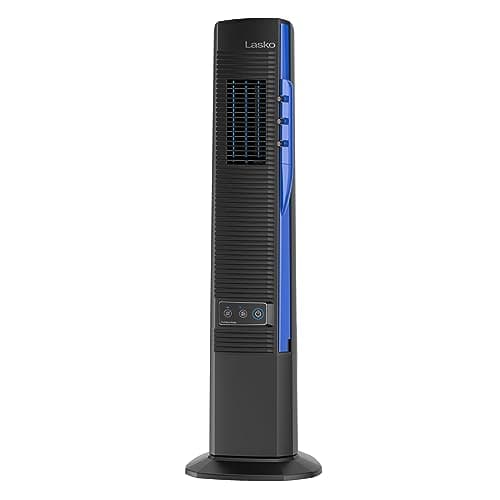
| 1 | Best for a seating area Lasko Misto 42" Outdoor Misting Tower Fan A 42-inch tower puts the mist at standing and seated height rather than at ankle level, and the 10 ft cord reaches where patios actually have outlets. | A patio or deck where people are sitting, in dry air | |
| 2 | 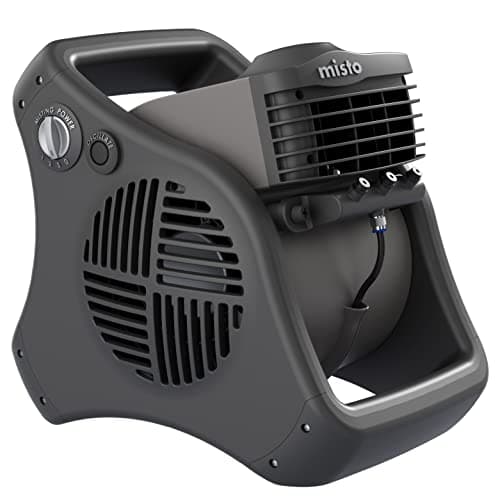 Most air Lasko Misto 15" Outdoor Misting Fan 350 CFM against the tower's 276, from a pivoting body you can aim at a specific group of people. | A larger or breezier outdoor space | |
| 3 | If you want real evaporative cooling outdoors Honeywell CO60PM Indoor/Outdoor Evaporative Cooler 2,697 CFM on 220 W with a 30 ft throw — an order of magnitude more air than a misting fan, cooled inside the machine. | A patio in a dry climate where you want more than a mist | |
| — | The one to skip with a hose attached Lasko Power Plus 20" Box Fan A weather-resistant motor is not a wet-rated one, and mist plus an unprotected box fan is the wrong combination. | A window, not a wet patio |
A misting fan is the same physics as an evaporative cooler, with one difference: the water is sprayed into the air stream instead of soaked into a pad inside the machine. Evaporation absorbs heat, the air gets cooler, and the machine is far smaller because it does not need a tank or a pad housing.
The condition
It only works where the air is dry
This is not a detail, it is the whole decision. Evaporation needs air with room to accept moisture, so a misting fan follows exactly the same humidity rule as any other evaporative device:
- Under 40% afternoon relative humidity — real, noticeable cooling.
- 40–60% — marginal. You feel damp before you feel cool.
- Over 60% — you are spraying water at people for no thermal benefit. In the humid Southeast this is the normal summer condition.
Check your local humidity at 3–5pm on a hot day, not in the morning — the two-minute check is here, and it applies to this page unchanged.
There is one genuine advantage misting fans hold over a full evaporative cooler in marginal humidity: you can turn the mist down. Both units here have an adjustable valve, so on a borderline day you can run them as ordinary outdoor fans and add mist only when it is dry enough to help.
The numbers
The two units, compared
| Misto YF300 (tower) | Misto 7050 (pivot) | |
|---|---|---|
| Air delivery | 276 CFM | Up to 350 CFM |
| Power | 55 – 86 W | 72 – 90 W |
| Speeds | 4 | 3 |
| Height | 41.59 in | 14.85 in |
| Weight | 15.11 lb | 13.23 lb |
| Water | Standard garden hose | 9 ft hose, adjustable valve |
| Electrical | 10 ft cord, in-line GFCI | In-line GFCI |
| Warranty | 2 years | 1 year |
| 30 × 8 hrs | $3.79 | $3.96 |
Specifications from Lasko’s product pages; costs are our arithmetic at 18.34¢/kWh.
Neither publishes a noise figure, which is a gap — though outdoors it matters less than it would beside a bed. And note that electricity is the small cost here: 13¢ for an eight-hour afternoon. Water use is the variable nobody publishes, and in the arid regions where these work it is the resource worth thinking about.
Say the unwelcome thing
Do not run a misting fan on a screened porch or under a solid roof with no airflow.
A misting fan adds water to the air continuously. In an enclosed or poorly ventilated space that moisture has nowhere to go, humidity climbs, evaporation slows, and the cooling stops — the same self-defeating loop an evaporative cooler hits in a closed room.
Worse, on a covered porch you end up with damp furniture and damp cushions rather than cool air. These want open sky and moving air.
Setup
Getting it right
- Upwind of where people sit, not aimed at them. You want the mist to evaporate on the way, not land on anyone. If people are getting wet, the mist is too heavy or the fan is too close.
- Dial the valve down first, then up. Start with almost no water and increase until you feel the difference. Most people start at full and conclude misting fans make you damp.
- Use the GFCI. Both units include one in-line. Do not bypass it, and do not run either on a non-GFCI outdoor circuit.
- Drain the hose before a freeze, and store the unit dry. Standing water in a mist line grows things.
- Watch for mineral deposits. In hard-water areas the nozzles scale up and the spray pattern degrades. Soaking the nozzles periodically is the maintenance this category actually needs.
If your climate fails the humidity test, the honest alternative outdoors is air movement without water — an air mover aimed at where people sit, or a permanently mounted outdoor-rated ceiling fan at around 20 W, which is quieter and better looking than anything on wheels.
In full
Every pick, and what is wrong with it
Published specifications only, each linked to the page it came from. Where a manufacturer publishes nothing, the row says so — we do not fill blanks in.
1. Best for a seating area
Lasko Misto 42" Outdoor Misting Tower Fan
Lasko · model YF300
A 42-inch tower puts the mist at standing and seated height rather than at ankle level, and the 10 ft cord reaches where patios actually have outlets.
55–86 W across four speeds, published, which works out to about $3.79 for thirty eight-hour afternoons at 18.34¢/kWh. The mist itself is free apart from the water.
The height is the argument. A tower puts the misted air across a seated person’s upper body, which is where the cooling actually happens — most of your exposed skin is above waist level. A pivoting floor unit aimed upward wastes some of that.
Two details that matter outdoors and nowhere else: a 10-foot cord with an in-line GFCI, and a standard garden hose fitting. Patios rarely have an outlet where you want the fan, and any outdoor electrical connection near water should be GFCI-protected. 15.11 lb, 2-year warranty.
Lasko’s own page claims it “helps it feel up to 20°F cooler”. Treat that as a best case in very dry air; the physics is the same evaporative cooling covered on the humidity page, and it degrades the same way.
What’s wrong with it
276 CFM is modest for outdoors, where there is no enclosure holding anything near you. Lasko publishes no noise figure and no oscillation range for it either.
Running cost — YF300
| Nameplate power | 55 W – 86 W | manufacturer's published figure |
|---|---|---|
| Energy, 8-hour night | 0.69 kWh | 86 ÷ 1000 × 8 |
| Cost per hour | 1.6¢ | at 18.34¢/kWh |
| Cost per 8-hour night | 13¢ | on the highest speed |
| Cost per 30 nights | $3.79 | 20.6 kWh |
| Same month, lowest speed | $2.42 | at 55 W |
Rate: 18.34¢/kWh, the US average residential price for June 2026 (EIA Electric Power Monthly, Table 5.3). Yours will differ — swap it in: (watts ÷ 1000) × hours × your rate.
| Power | 55 W - 86 W (0.49-0.73 A at 120 V) |
|---|---|
| Air delivery | 276 CFM |
| Speeds | 4 |
| Height | 41.59 in |
| Footprint | 12.78 x 12.78 in |
| Weight | 15.11 lb |
| Water connection | Standard garden hose |
| Cord | 10 ft, in-line GFCI, 3-prong grounded |
| Noise | Not published |
| Warranty | 2 years |
Every figure above is from Lasko product page, YF300. Blanks are shown as “not published” rather than filled in.
2. Most air
Lasko Misto 15" Outdoor Misting Fan
Lasko · model 7050
350 CFM against the tower's 276, from a pivoting body you can aim at a specific group of people.
Up to 350 CFM on 72–90 W, published. That is 27% more air than the tower for roughly the same power — $3.96 for thirty eight-hour sessions.
Outdoors, volume matters more than it does indoors because there is no enclosure keeping cooled air near you. Any breeze carries it away, and more air is the only counter.
The 9-foot hose with an adjustable valve is the practical advantage: you can dial the mist down to almost nothing on a humid evening, or up when it is genuinely dry. The pivoting head lets you aim it at the table rather than the lawn.
13.23 lb and in-line GFCI, same as the tower. 14.85 inches tall, so plan to put it on a table or aim it upward.
What’s wrong with it
72-90 W for less height, and a 1-year warranty against the tower's 2. Aimed from the floor it hits legs before faces unless you tilt it up.
Running cost — 7050
| Nameplate power | 72 W – 90 W | manufacturer's published figure |
|---|---|---|
| Energy, 8-hour night | 0.72 kWh | 90 ÷ 1000 × 8 |
| Cost per hour | 1.7¢ | at 18.34¢/kWh |
| Cost per 8-hour night | 13¢ | on the highest speed |
| Cost per 30 nights | $3.96 | 21.6 kWh |
| Same month, lowest speed | $3.17 | at 72 W |
Rate: 18.34¢/kWh, the US average residential price for June 2026 (EIA Electric Power Monthly, Table 5.3). Yours will differ — swap it in: (watts ÷ 1000) × hours × your rate.
| Power | 72 W - 90 W (0.8 A at 120 V) |
|---|---|
| Air delivery | Up to 350 CFM |
| Speeds | 3 |
| Dimensions | 14.85 H x 16.25 L x 12.3 W in |
| Weight | 13.23 lb |
| Water connection | 9 ft hose to a standard garden hose, adjustable valve |
| Cord | In-line GFCI |
| Noise | Not published |
| Warranty | 1 year |
Every figure above is from Lasko product page, 7050. Blanks are shown as “not published” rather than filled in.
3. If you want real evaporative cooling outdoors
Honeywell CO60PM Indoor/Outdoor Evaporative Cooler
Honeywell · model CO60PM
2,697 CFM on 220 W with a 30 ft throw — an order of magnitude more air than a misting fan, cooled inside the machine.
A misting fan sprays water into the air and lets it evaporate around you. An evaporative cooler evaporates the water inside the machine and delivers already-cooled air. The second is more effective and does not leave people damp.
2,697 CFM on 220 W is 12.3 CFM per watt and about ten times the airflow of the misting tower, for less power. The published 30 ft throw is the specification that matters outdoors.
The trade is size, noise and water management. The full patio comparison is here.
What’s wrong with it
61-65 dBA is conversational volume, which on a patio is the thing you are trying to protect. It also needs a 15.9 gallon tank filled or plumbed.
Running cost — CO60PM
| Nameplate power | 220 W | manufacturer's published figure |
|---|---|---|
| Energy, 8-hour night | 1.76 kWh | 220 ÷ 1000 × 8 |
| Cost per hour | 4.0¢ | at 18.34¢/kWh |
| Cost per 8-hour night | 32¢ | on the highest speed |
| Cost per 30 nights | $9.68 | 52.8 kWh |
Rate: 18.34¢/kWh, the US average residential price for June 2026 (EIA Electric Power Monthly, Table 5.3). Yours will differ — swap it in: (watts ÷ 1000) × hours × your rate.
| Air delivery | 2,697 CFM |
|---|---|
| Power | 220 W |
| Water tank | 15.9 gallons, continuous hookup |
| Air throw | 30 ft |
| Noise | 61-65 dBA |
| Speeds | 3, with oscillation |
| Pads | Triple-sided honeycomb |
| Dimensions | 27.6 W x 18.3 D x 40 H in |
| Weight | 39.2 lb |
| Manufacturer coverage claim | 1,643 sq ft |
| Warranty | 1 year |
Every figure above is from Honeywell Air Comfort product page, CO60PM. Blanks are shown as “not published” rather than filled in.
Skip this one
Lasko Power Plus 20" Box Fan
Lasko · model B20801
A weather-resistant motor is not a wet-rated one, and mist plus an unprotected box fan is the wrong combination.
This turns up because a box fan plus a $12 hose mister kit is the cheap version of a misting fan, and it is genuinely a bad idea.
Weather-resistant is not the same as wet-rated. Lasko’s weather-resistant motor is specified for a fan sitting in an open window, exposed to humidity and the occasional blown-in rain — not for continuous water spray at the intake.
The purpose-built units above ship with in-line GFCI cords for exactly this reason. A box fan on an ordinary outdoor extension lead with water in the air is a shock risk, and it is why every misting fan sold has that protection built in.
It is an excellent fan in a window. Keep the hose away from it.
What’s wrong with it
It has no GFCI cord, no misting system and no wet rating. People rig hose misters to box fans constantly; the fan is not built for the water and the circuit is not built for the risk.
Running cost — B20801
| Nameplate power | 73 W – 102 W | manufacturer's published figure |
|---|---|---|
| Energy, 8-hour night | 0.82 kWh | 102 ÷ 1000 × 8 |
| Cost per hour | 1.9¢ | at 18.34¢/kWh |
| Cost per 8-hour night | 15¢ | on the highest speed |
| Cost per 30 nights | $4.49 | 24.5 kWh |
| Same month, lowest speed | $3.21 | at 73 W |
Rate: 18.34¢/kWh, the US average residential price for June 2026 (EIA Electric Power Monthly, Table 5.3). Yours will differ — swap it in: (watts ÷ 1000) × hours × your rate.
| Power | 73 W - 102 W (0.6-0.9 A at 120 V) |
|---|---|
| Speeds | 3 |
| Dimensions | 21.25 H x 22.5 x 4.75 in |
| Weight | 10.1 lb |
| Motor | Weather-resistant |
| Air delivery (CFM) | Not published |
| Warranty | 2 years |
Every figure above is from Lasko product page, B20801. Blanks are shown as “not published” rather than filled in.
We are not linking a buy button for this one. If you want to look at it anyway, it is easy enough to find — but we would rather send you to something that fits your room.
Questions people actually ask
Frequently asked
Do misting fans actually work?
In dry air, yes — the water evaporating in the air stream absorbs real heat, the same mechanism an evaporative cooler uses. Above roughly 60 percent relative humidity there is little evaporation available, so you get damp air rather than cool air.
What is the difference between a misting fan and an evaporative cooler?
Where the water evaporates. A misting fan sprays it into the air around you; an evaporative cooler evaporates it inside the machine across a wet pad and delivers already-cooled air. The cooler is more effective and does not leave people damp, but it is far bigger and needs a tank.
How much electricity does a misting fan use?
Between about 55 and 90 W for the two Lasko Misto units. At 18.34¢/kWh that is roughly 13¢ for an eight-hour afternoon, or $3.79 across thirty of them. The electricity is the cheap part; water use is the variable nobody publishes.
Will a misting fan get my furniture wet?
It should not, if it is set up properly. Position it upwind rather than aimed at people, and start with the valve almost closed, increasing until you feel the cooling. Most complaints about dampness come from running the mist at full on a humid day, when the water cannot evaporate.
Can I use a misting fan on a covered porch?
Not well. A misting fan adds moisture continuously, so in an enclosed or poorly ventilated space the humidity climbs until evaporation slows and the cooling stops — and you are left with damp cushions. These want open sky and moving air.
Do I need a GFCI for a misting fan?
Yes, and both units here ship with one in-line. You are combining mains electricity with water spray outdoors, which is exactly what GFCI protection exists for. Never bypass it or run one on an unprotected outdoor circuit.
Sources
Where these numbers came from
Read next
Where to go from here
Back to Fans, or read how we pick.