Guide and picks
Air conditioner condensate and drainage
An air conditioner that produces no water is not cooling well. One producing it in the wrong place is a five-minute fix, usually.
By Sawyer V. · Published
The short answer
Condensate is water pulled out of your room air by the cold evaporator coil, and producing it is the machine dehumidifying correctly. A window unit drains it outside by sitting very slightly lower at the outdoor end — unless your manual specifies level, as several U-shaped models do. Most units then fling that water onto the condenser to improve efficiency. Water indoors almost always means the tilt or the drain path, not a fault.
Fan & Frost earns a commission when you buy through our links, at no cost to you. It never changes a ranking, and we say so when the right answer is the cheaper unit or nothing at all. Full disclosure · How we pick.

At a glance
The picks, ranked
Tap any row to jump to the full reasoning. Prices are live from Amazon where we have them, and read “check price” where we don’t — never a number we cannot verify today.
| # | Product | Best for | Price |
|---|---|---|---|
| 1 | 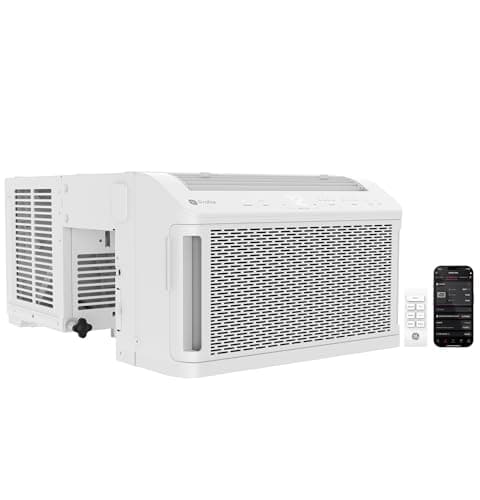 Modulating compressor, steadier drainage GE Profile ClearView Window Air Conditioner, 8,000 BTU CEER 16 and 375 kWh a year with a variable-speed compressor that runs low and long rather than cycling. | A humid room where you want long, moisture-removing runs | |
| 2 | 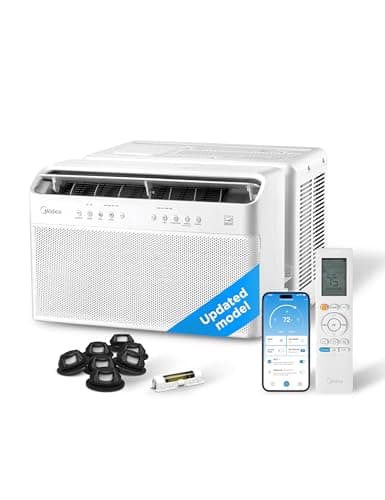 Check the manual before you tilt it Midea U-Shaped Window Air Conditioner, 8,000 BTU The U-shape changes the geometry, and several units in this family are designed to install level rather than tilted. | A bedroom, and a reminder that not every unit wants a slope | |
| — | The format with the most water to manage Whynter ARC-14S Dual Hose Portable Air Conditioner 71 pints a day of dehumidification, and nowhere for it to go except a tank, a pump or a hose you arrange. | A room with no usable window — where you also own the drainage problem | |
| — | Drainage set by the sleeve, not the unit Friedrich Through-the-Wall Air Conditioner, 10,100 BTU 10,100 BTU at CEER 14.2 and 533.5 kWh — the sleeve determines the drainage, so getting it right is a one-time job. | A permanent install where the pitch is built in |
Water coming off an air conditioner alarms people, and it should not. It is the visible product of the useful half of what the machine does.
Why it exists
The water is the dehumidification
Air holds water vapor, and how much it can hold depends on its temperature — warm air holds more, cold air less.
Room air passes over an evaporator coil that is well below room temperature. As that air cools it drops below the point where it can hold all its moisture, and the excess condenses onto the coil as liquid water, which runs down into a base pan.
So the air leaving the unit is cooler and drier, and the water in the pan is exactly the moisture that used to be in your room.
Two consequences worth holding onto:
- More water means more dehumidification. A unit producing a lot of condensate on a humid day is working properly.
- No water can mean a problem. An air conditioner producing nothing at all in humid weather is either barely running or not getting the coil cold — and humidity is a large part of why a room feels bad.
It also explains the oversizing problem. Moisture only condenses while the compressor runs. A unit that satisfies the thermostat in five minutes and stops has cooled the air and dried almost nothing, which is why an oversized machine leaves a room cold and clammy.
Where it goes
Tilt, and the slinger ring
In a window unit, gravity is the primary mechanism. The machine sits with its outdoor end very slightly lower than its indoor end, so water in the base pan runs away from the room.
Two important qualifications. Your manual specifies the drop, and it is small — a fraction of a degree, not a visible slope. And several units, including a number of U-shaped models, are designed to install dead level because their drainage is engineered differently. Applying general advice to one of those creates the fault.
Most units then do something cleverer with the water. A slinger ring on the condenser fan picks it up from the pan and throws it onto the hot condenser coil, where it evaporates.
That does two things at once:
- It disposes of the water without a drain, which is why a correctly installed window unit needs no plumbing.
- It improves efficiency. Evaporating water absorbs heat, so wetting the condenser helps it reject heat more effectively than dry air alone.
The slinger is also why a healthy unit makes an occasional ticking or splashing sound in humid weather. That noise is the machine working, not failing.
This one is not a DIY job
Do not drill a drain hole in the base pan. It is a common piece of internet advice and it removes the water the slinger ring uses to cool the condenser — so you lose efficiency to solve a problem you probably do not have.
If a unit is overflowing, the answer is the tilt or a blocked drain path, not a new hole.
Condensate is not clean water. It has passed over a coil that collects dust and biological growth. It is fine going into a drain or onto the ground; it is not something to collect for use without treatment.
Check where it lands. A window unit dripping onto a walkway, a neighbor’s window or a wooden sill is a nuisance and a maintenance problem. A simple drip deflector solves it.
Diagnosis
Water in the wrong place
| Symptom | Most likely cause |
|---|---|
| Dripping inside onto the sill | Unit level or tilted toward the room, or a blocked drain path in the pan |
| Dripping heavily outside | Normal in humid weather — that is the dehumidification |
| Ticking or splashing sounds | The slinger ring throwing water onto the condenser. Normal. |
| No water at all in humid weather | Barely running, or the coil is not getting cold — check airflow |
| Ice on the coil, then water when it thaws | Restricted airflow, almost always the filter |
| Water pooling in the base pan | Blocked drain path, or a slinger ring that has failed |
The icing case is worth expanding, because it produces water in a confusing way. Restricted airflow means less warm air over the coil, so the coil runs colder than designed and drops below freezing. Condensate then forms as ice instead of running away — and when you switch off, it all melts at once.
Switch to fan-only, let it thaw fully, then clean the filter and coil before restarting. The full diagnosis.
Maintenance
Keeping the drain path clear
The base pan collects condensate and everything the condensate carries with it — dust that got past the filter, and biological growth that thrives in a permanently wet tray.
- Clear the pan annually. Wipe out sludge and check the drain hole or slinger path is unobstructed. This is the single most common cause of water appearing indoors.
- Clean the filter every two to four weeks in season. It prevents the icing that produces the confusing version of this problem.
- Re-check the tilt each season. Units settle, foam gaskets compress, and brackets shift.
- Dry it before storage. A unit put away with water in the pan spends the off-season as a sealed damp box, which is where the smell in June comes from. Storage properly.
Say the unwelcome thing
Do not treat condensate as a fault to be eliminated.
People arrive at this topic wanting the water to stop, and stopping it would mean stopping the dehumidification — which is a large part of what makes a room comfortable.
A room at 78°F and low humidity feels better than one at 75°F and high humidity, because your body sheds heat by evaporating sweat and humid air will not accept it. The water in the pan is that humidity, removed.
So the goal is not less water. It is water going to the right place: correct tilt per your manual, a clear drain path, a clean pan, and a correctly sized unit that runs long enough to actually dehumidify.
In full
Every pick, and what is wrong with it
Published specifications only, each linked to the page it came from. Where a manufacturer publishes nothing, the row says so — we do not fill blanks in.
1. Modulating compressor, steadier drainage
GE Profile ClearView Window Air Conditioner, 8,000 BTU
GE Profile · model PWJV08W
CEER 16 and 375 kWh a year with a variable-speed compressor that runs low and long rather than cycling.
The variable-speed compressor matters for water more than people realize. Moisture only condenses out of the air while the compressor is running and the coil is cold.
A single-speed unit is either at full output or off, so in a room below its capacity it cycles — short runs, poor moisture removal, and condensate produced in bursts. A modulating compressor turns down instead, so the coil stays cold and drainage is steady.
375 kWh a year, about $69 for a season, at CEER 16 and 47% below the federal standard.
15.3 inches deep, which also makes setting the drainage tilt straightforward.
What’s wrong with it
46.2 lb and it occupies the window for the season, like any conventional unit.
Running cost — PWJV08W
| Annual energy use | 375 kWh | ENERGY STAR certified figure |
|---|---|---|
| Annual cost | $69 | 375 × 18.34¢/kWh |
| Per cooling month | $17 | spread over a four-month season |
The annual figure is the certified value from the ENERGY STAR Certified Room Air Conditioners dataset, which models a standard cooling season rather than your actual summer. It is more useful than a nameplate wattage here, because a variable-speed compressor spends most of its life well below nameplate.
Rate: 18.34¢/kWh, the US average residential price for June 2026 (EIA Electric Power Monthly, Table 5.3). Yours will differ — swap it in: (watts ÷ 1000) × hours × your rate.
| Cooling capacity | 8,000 BTU/h |
|---|---|
| CEER | 16 |
| Annual energy use | 375 kWh/yr |
| vs federal standard | 47% less energy |
| Dimensions | 12.6 H x 18.6 W x 15.3 D in |
| Weight | 46.2 lb |
| Refrigerant | R-32 |
| Installation | Does not straddle the windowsill |
| Compressor | Variable speed |
| ENERGY STAR | Certified, and on the Most Efficient list |
Every figure above is from ENERGY STAR Certified Room Air Conditioners dataset. Blanks are shown as “not published” rather than filled in.
2. Check the manual before you tilt it
Midea U-Shaped Window Air Conditioner, 8,000 BTU
Midea · model MAW08V1QWT-S
The U-shape changes the geometry, and several units in this family are designed to install level rather than tilted.
This is the exception that makes the general advice dangerous if applied blindly.
The sash closes through the middle of the machine rather than on top of it, so the whole geometry differs from a conventional unit — and several U-shaped models are engineered to install dead level, with the drainage handled internally.
Tilting one of those because a general guide said to is how you create the problem you were trying to avoid. Read the manual for your specific unit.
400 kWh a year, about $73 for a season, with the compressor outside a closed window.
What’s wrong with it
53.2 lb and 22 inches deep, vertical sash windows only, at CEER 15 and 400 kWh.
Running cost — MAW08V1QWT-S
| Annual energy use | 400 kWh | ENERGY STAR certified figure |
|---|---|---|
| Annual cost | $73 | 400 × 18.34¢/kWh |
| Per cooling month | $18 | spread over a four-month season |
The annual figure is the certified value from the ENERGY STAR Certified Room Air Conditioners dataset, which models a standard cooling season rather than your actual summer. It is more useful than a nameplate wattage here, because a variable-speed compressor spends most of its life well below nameplate.
Rate: 18.34¢/kWh, the US average residential price for June 2026 (EIA Electric Power Monthly, Table 5.3). Yours will differ — swap it in: (watts ÷ 1000) × hours × your rate.
| Cooling capacity | 8,000 BTU/h |
|---|---|
| CEER | 15 |
| Annual energy use | 400 kWh/yr |
| vs federal standard | 38% less energy |
| Dimensions | 13.5 H x 19.2 W x 22.0 D in |
| Weight | 53.2 lb |
| Refrigerant | R-32 |
| Installation | U-shape; sash closes through the middle of the unit |
| Compressor | Variable speed |
| ENERGY STAR | Certified |
Every figure above is from ENERGY STAR Certified Room Air Conditioners dataset. Blanks are shown as “not published” rather than filled in.
Skip this one
Whynter ARC-14S Dual Hose Portable Air Conditioner
Whynter · model ARC-14S
71 pints a day of dehumidification, and nowhere for it to go except a tank, a pump or a hose you arrange.
71 pints a day. That is the published dehumidification figure, and it is the clearest illustration on this page of how much water an air conditioner actually removes.
A window unit sends all of that outside automatically. A portable sits in the middle of your room, so the water has to go into a tank you empty, through a pump, or down a hose you route somewhere.
Many portables partially self-evaporate by flinging condensate onto the condenser and out of the exhaust hose — which works in moderate humidity and falls behind in high humidity, exactly when the unit produces most water.
1,300 W and 9,500 BTU SACC from a 14,000 BTU headline. If your window takes a unit, the window unit avoids this entirely.
What’s wrong with it
A portable produces the same condensate as any air conditioner with none of the built-in drainage a window unit has.
Running cost — ARC-14S
| Nameplate power | 1300 W | manufacturer's published figure |
|---|---|---|
| Energy, 8-hour night | 10.40 kWh | 1300 ÷ 1000 × 8 |
| Cost per hour | 24¢ | at 18.34¢/kWh |
| Cost per 8-hour night | $1.91 | on the highest speed |
| Cost per 30 nights | $57 | 312.0 kWh |
Rate: 18.34¢/kWh, the US average residential price for June 2026 (EIA Electric Power Monthly, Table 5.3). Yours will differ — swap it in: (watts ÷ 1000) × hours × your rate.
| Marketing capacity | 14,000 BTU (ASHRAE-128) |
|---|---|
| DOE-rated capacity | 9,500 BTU SACC |
| Hoses | Dual |
| Power | 1,300 W / 11.6 A at 115 V |
| Noise | Under 51 dBA low, under 56 dBA high |
| Dehumidification | 71 pints/day |
| Refrigerant | R-32 |
| Dimensions | 16 W x 19 D x 35.5 H in |
| Weight | 73 lb |
| Manufacturer coverage claim | 500 sq ft |
| Warranty | 1 year unit, 3 years compressor |
Every figure above is from Whynter product page, ARC-14S. Blanks are shown as “not published” rather than filled in.
We are not linking a buy button for this one. If you want to look at it anyway, it is easy enough to find — but we would rather send you to something that fits your room.
Skip this one
Friedrich Through-the-Wall Air Conditioner, 10,100 BTU
Friedrich · model WCVT10B10B
10,100 BTU at CEER 14.2 and 533.5 kWh — the sleeve determines the drainage, so getting it right is a one-time job.
Listed as a contrast rather than a recommendation. In a through-the-wall installation the drainage pitch belongs to the sleeve, which was set when the opening was made.
That is an advantage once it is right — nothing shifts, and there is no seasonal re-checking of a tilt. It is a real problem if it is wrong, because correcting it means pulling the chassis out.
Check the sleeve with a level before fitting anything. It should slope very slightly toward the outside. The install sequence.
533.5 kWh a year, about $98, and on the Most Efficient list.
What’s wrong with it
If the sleeve pitch is wrong, correcting it means removing the chassis. Check before fitting, not after.
Running cost — WCVT10B10B
| Annual energy use | 533.5 kWh | ENERGY STAR certified figure |
|---|---|---|
| Annual cost | $98 | 533.5 × 18.34¢/kWh |
| Per cooling month | $24 | spread over a four-month season |
The annual figure is the certified value from the ENERGY STAR Certified Room Air Conditioners dataset, which models a standard cooling season rather than your actual summer. It is more useful than a nameplate wattage here, because a variable-speed compressor spends most of its life well below nameplate.
Rate: 18.34¢/kWh, the US average residential price for June 2026 (EIA Electric Power Monthly, Table 5.3). Yours will differ — swap it in: (watts ÷ 1000) × hours × your rate.
| Cooling capacity | 10,100 BTU/h |
|---|---|
| CEER | 14.2 |
| Annual energy use | 533.5 kWh/yr |
| Weight | 110.0 lb |
| Refrigerant | R-32 |
| Installation | Through the wall (existing sleeve required) |
| Compressor | Variable speed |
| ENERGY STAR | Certified, and on the Most Efficient list |
Every figure above is from ENERGY STAR Certified Room Air Conditioners dataset. Blanks are shown as “not published” rather than filled in.
We are not linking a buy button for this one. If you want to look at it anyway, it is easy enough to find — but we would rather send you to something that fits your room.
Questions people actually ask
Frequently asked
Why does my air conditioner produce water?
It is the moisture from your room air, condensed onto the cold evaporator coil. Producing water is the machine dehumidifying correctly — and an air conditioner making no water in humid weather is either barely running or not getting the coil cold.
Why is my window air conditioner dripping inside?
Usually the tilt or a blocked drain path in the base pan. The unit should sit very slightly lower at the outdoor end, unless your manual specifies level — several U-shaped models are designed to install dead level.
Should a window air conditioner drip outside?
Yes, in humid weather. Most units also fling condensate onto the hot condenser with a slinger ring, which evaporates it and improves efficiency at the same time — so the occasional ticking or splashing is the machine working.
Should I drill a drain hole in my air conditioner?
No. The water in the base pan is used by the slinger ring to cool the condenser, so draining it away costs you efficiency. If the unit is overflowing, the cause is the tilt or a blocked drain path.
Why is there ice on my air conditioner coil?
Restricted airflow, almost always the filter. Less warm air over the coil means it runs colder than designed and drops below freezing, so condensate forms as ice instead of draining. Switch to fan-only, thaw fully, then clean the filter and coil. Full diagnosis.
Can I use air conditioner condensate water?
Not without treatment. It has passed over a coil that collects dust and biological growth, so it is fine going to a drain or onto the ground but is not clean water.
Sources
Where these numbers came from
Read next
Where to go from here
Back to Air Conditioners, or read how we pick.