Guide and picks
Where to put a fan
Most people who think their fan is too weak have put it in the wrong place. Position is free, and it changes more than the next size up does.
By Sawyer V. · Published
The short answer
It depends what you want. To cool a person, put the fan close, at or slightly above body height, aimed at exposed skin. To circulate a room, aim it at the far wall — not at people — and leave it fixed so the air column stays coherent. To actually lower the temperature, put it in a window and run it only once the outdoor air is cooler than the indoor air. Those are three different jobs and they want three different positions.
Fan & Frost earns a commission when you buy through our links, at no cost to you. It never changes a ranking, and we say so when the right answer is the cheaper unit or nothing at all. Full disclosure · How we pick.
At a glance
The picks, ranked
Tap any row to jump to the full reasoning. Prices are live from Amazon where we have them, and read “check price” where we don’t — never a number we cannot verify today.
| # | Product | Best for | Price |
|---|---|---|---|
| 1 | 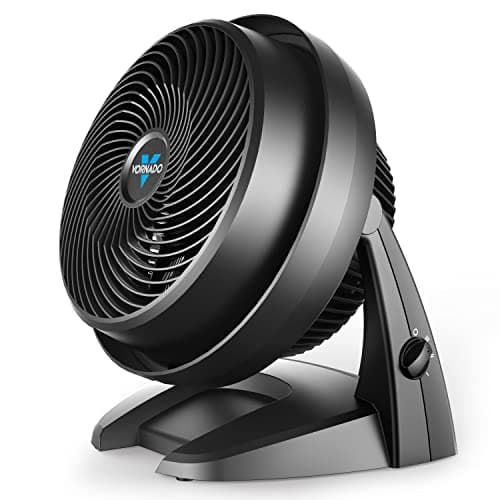 Best for the far-wall method Vornado 630 Medium Air Circulator Vornado states it moves air up to 70 feet — a coherent column that survives the trip to the far wall and comes back. | Circulating a whole room rather than aiming at anyone | |
| 2 | Best for the window job Lasko Twin Window Fan with Remote Up to 560 CFM on 22 to 31 W, with independent motors so one window can intake and exhaust at once. | Exchanging hot indoor air for cool outdoor air after dark | |
| 3 | 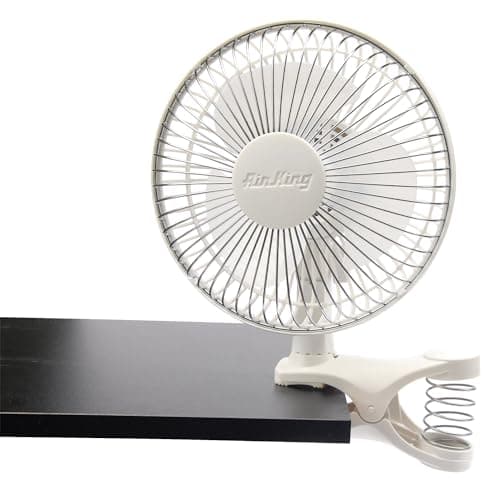 Best for personal placement Air King 6" Commercial Grade Clip-On Fan 34 dBA and 9 to 12 W, on a clip that mounts it off the desk and above the work surface. | Cooling one person at a desk or a chair without a floor unit | |
| — | The placement mistake in physical form Lasko Power Plus 20" Box Fan 73 to 102 W, sitting on the floor blowing across it, which is the least useful place a fan can be. | A window — where it belongs — rather than the middle of a floor |
A fan does not lower the temperature of a room. It moves air, and moving air does two useful things: it accelerates heat loss from skin, and it mixes air that would otherwise sit in layers.
Which of those you are trying to achieve determines where the fan goes, and the three answers are not compatible with each other.
Job one
Cooling a person
This is the mechanism most people actually want, and it is the one where placement matters least in principle and most in practice.
Airflow over skin accelerates evaporative and convective heat loss. The effect depends on air speed at the skin, and air speed falls off sharply with distance — a jet spreads and slows as it travels.
- Close beats big. A small fan two feet away delivers more air speed at your skin than a large fan across the room, on a fraction of the power. Nine watts versus fifty is a real difference in both directions.
- Aim at exposed skin. Arms, neck, face, feet. Air moving over a jumper does very little; the evaporation has to happen at the surface.
- At or slightly above body height. Angled gently down at a seated person, not up from the floor at their shins.
- Fixed, not oscillating, if you are the only person in the room. Oscillation shares the same airflow across an arc, so you get it intermittently instead of continuously.
The corollary is the most useful thing on this page: if nobody is in the room, turn the fan off. It is doing nothing except adding its motor heat to the space.
Job two
Circulating a room
Sometimes the problem is not that you are hot but that the room is uneven — a stuffy corner, a warm layer near the ceiling, an area the air conditioning never reaches.
That calls for the opposite placement: aim the fan away from people, at the far wall.
The air column travels, hits the wall, spreads along it and returns along the floor and ceiling. That circulation pattern turns the whole room over. Aiming at people instead produces a breeze on them and no pattern at all.
Three things this needs:
- A coherent column. A circulator with a deep shroud projects air a long way. A wide diffuse output dissipates in a few feet.
- No oscillation. A sweeping head never sustains flow in one direction long enough to establish the pattern.
- A clear path. Furniture, curtains and open doors in the wrong place absorb the column before it arrives.
This is also how you help an air conditioner reach a room it does not serve well — move the cooled air along rather than adding capacity. Common in a hot upstairs.
Job three
Actually lowering the temperature
A fan in a window is a different machine. It stops moving room air around and starts replacing it, which genuinely changes the temperature.
The rule that decides whether it works is timing.
| Condition | What to do |
|---|---|
| Outdoor cooler than indoor | Open up, run the fan, exchange the air |
| Outdoor warmer than indoor | Close everything, shade the glass, run a fan on people only |
| Roughly equal | Ventilate for air quality, expect no cooling |
In most climates that means the window fan runs from a couple of hours after sunset until shortly after dawn, and everything is shut through the afternoon.
Two openings beat one. Air needs an exit as well as an entrance. A fan exhausting from one window with another open across the room moves far more air than a fan pushing into a sealed space, because it is not fighting the pressure it creates.
If you only have one window, a twin window fan with independent motors solves it — intake on one side, exhaust on the other, through the same opening.
This one is not a DIY job
Which direction to face a single window fan. There is no universal answer, and the usual advice to always exhaust is wrong about half the time.
Exhaust (blowing out) when the room is hotter than the rest of the house — a west-facing bedroom in the evening. You are pulling cooler air in from the hallway behind you.
Intake (blowing in) when the outdoor air is the coolest air available and the room is the place you want it — overnight, with an interior door open for the air to leave through.
Test it rather than reasoning about it: run it one way for twenty minutes with a thermometer in the room, then the other. Buildings differ more than the rule of thumb allows for.
Two fans
The cross-ventilation setup
If you have two openings and two fans, the most effective arrangement in the whole category costs about 9.1¢ a night at 31 W each.
- One fan exhausting at the window on the warm side of the building, or the higher one if there is a height difference.
- One fan intaking at the window on the cool, shaded side — or leave that window simply open if you only have one fan.
- Interior doors open along the path between them, so the air has a route.
This works with the stack effect rather than against it: warm air already wants to leave high and cool air already wants to enter low, and the fans just increase the rate.
Say the unwelcome thing
Do not buy a bigger fan before trying a better position.
The most common upgrade path in this category is a fan that feels weak, replaced by a larger one that also feels weak, in the same spot.
Before spending anything, try three things. Move the fan closer — air speed at your skin is what matters and it falls off fast with distance. Turn oscillation off if you are the only person in the room. And raise it off the floor to at least seated height.
Those three changes cost nothing and routinely produce more improvement than the next size up. If the room is genuinely too hot rather than too still, no fan of any size is the answer.
In full
Every pick, and what is wrong with it
Published specifications only, each linked to the page it came from. Where a manufacturer publishes nothing, the row says so — we do not fill blanks in.
1. Best for the far-wall method
Vornado 630 Medium Air Circulator
Vornado · model 630
Vornado states it moves air up to 70 feet — a coherent column that survives the trip to the far wall and comes back.
The far-wall method depends on the fan producing a column rather than a spray. A column travels, strikes a surface, spreads along it and returns — setting the whole room turning over. A diffuse output dissipates before it gets anywhere.
Vornado states 70 feet of air movement, and the deep shrouded design behind that figure is what the technique needs. It deliberately does not oscillate, because sweeping breaks the column up.
Aim it at the wall furthest from where people sit, at a slight upward angle. You should feel a gentle general movement everywhere rather than a breeze anywhere.
The honest gap: no published wattage, CFM, dimensions or weight. The 70-foot figure is the manufacturer’s own claim. Five-year warranty.
What’s wrong with it
Vornado publishes no wattage, no CFM and no dimensions, which is a real gap for a site that runs on numbers.
Running cost
Vornado does not publish a wattage for the 630, so we cannot calculate what it costs to run. We are not going to estimate one. If Vornado publishes a nameplate figure, this block will show the arithmetic.
| Power | Not published |
|---|---|
| Airflow reach | Moves air up to 70 ft |
| Speeds | 3 |
| Air delivery (CFM) | Not published |
| Dimensions | Not published |
| Weight | Not published |
| Warranty | 5 years |
Every figure above is from Vornado product page, 630. Blanks are shown as “not published” rather than filled in.
2. Best for the window job
Lasko Twin Window Fan with Remote
Lasko · model W09550
Up to 560 CFM on 22 to 31 W, with independent motors so one window can intake and exhaust at once.
Placement in a window is the only position where a fan lowers the air temperature rather than just making you feel cooler. Everything else on this page is about perceived comfort; this is about the thermometer.
Two independent motors is the feature that makes single-window placement work. One side pulls cool air in while the other pushes warm air out, so you get an exchange even when there is only one opening in the room.
22 to 31 W for up to 560 CFM — about 4.5¢ for an eight-hour night — and an adjustable thermostat so it stops once the room is cool rather than over-cooling it by dawn.
What’s wrong with it
It fits 24 to 32 inch windows and does nothing at all once the window is closed.
Running cost — W09550
| Nameplate power | 22 W – 31 W | manufacturer's published figure |
|---|---|---|
| Energy, 8-hour night | 0.25 kWh | 31 ÷ 1000 × 8 |
| Cost per hour | 0.6¢ | at 18.34¢/kWh |
| Cost per 8-hour night | 4.5¢ | on the highest speed |
| Cost per 30 nights | $1.36 | 7.4 kWh |
| Same month, lowest speed | 97¢ | at 22 W |
Rate: 18.34¢/kWh, the US average residential price for June 2026 (EIA Electric Power Monthly, Table 5.3). Yours will differ — swap it in: (watts ÷ 1000) × hours × your rate.
| Power | 22 W - 31 W at 120 V |
|---|---|
| Air delivery | Up to 560 CFM |
| Window fit | 24 - 32 in wide |
| Modes | Intake, exhaust or exchange (independent motors) |
| Thermostat | Adjustable |
| Speeds | 3 |
| Dimensions | 12.9 H x 24.0 W x 4.9 D in |
| Weight | 8.0 lb |
| Warranty | 1 year |
Every figure above is from Lasko product page, W09550. Blanks are shown as “not published” rather than filled in.
3. Best for personal placement
Air King 6" Commercial Grade Clip-On Fan
Air King · model 9145
34 dBA and 9 to 12 W, on a clip that mounts it off the desk and above the work surface.
The most efficient placement of all is the closest one. Cooling works by moving air over skin, so a small fan two feet away beats a large fan across the room, on both effect and power.
9 to 12 W — 1.8¢ for an eight-hour day — against 41 to 52 W for a large tower fan trying to reach the same person from a corner.
The clip is what makes the placement work. It mounts on a shelf edge, a monitor arm or a bed frame, so the fan sits above and behind rather than taking desk space — which also keeps airflow off a microphone.
34 to 37 dBA, a three-decibel spread across its whole range. More on desk placement for calls.
What’s wrong with it
190 CFM is personal airflow only — it will do nothing measurable for the room.
Running cost — 9145
| Nameplate power | 9 W – 12 W | manufacturer's published figure |
|---|---|---|
| Energy, 8-hour night | 0.10 kWh | 12 ÷ 1000 × 8 |
| Cost per hour | 0.2¢ | at 18.34¢/kWh |
| Cost per 8-hour night | 1.8¢ | on the highest speed |
| Cost per 30 nights | 53¢ | 2.9 kWh |
| Same month, lowest speed | 40¢ | at 9 W |
Rate: 18.34¢/kWh, the US average residential price for June 2026 (EIA Electric Power Monthly, Table 5.3). Yours will differ — swap it in: (watts ÷ 1000) × hours × your rate.
| Power | 9 W - 12 W (0.1-0.2 A at 120 V) |
|---|---|
| Air delivery | Up to 190 CFM |
| Noise | 34 dBA low, 37 dBA high |
| Speeds | 2 |
| Mounting | Spring-loaded clip, non-marking |
| Dimensions | 10.38 H x 6.25 L x 8.13 W in |
| Weight | 2.22 lb |
| Cord | 6 ft, 3-conductor |
| Listing | ETL listed, OSHA compliant |
| Warranty | 1 year |
Every figure above is from Air King product page, 9145 (via Lasko). Blanks are shown as “not published” rather than filled in.
Skip this one
Lasko Power Plus 20" Box Fan
Lasko · model B20801
73 to 102 W, sitting on the floor blowing across it, which is the least useful place a fan can be.
Listed here because the classic box fan placement — on the floor, in the middle of the room, pointed vaguely at a sofa — is the single most common placement error.
Floor level is the worst height for a room fan. Cool air is denser and already collects there, so the fan is moving the air that needs it least. Furniture legs, rugs and sofa bases break up whatever column it produces within a few feet.
And it costs the same in either place: 73 to 102 W, or 15¢ for an eight-hour night, whether that power does useful work or not.
In a window it makes sense. Elsewhere in the room, almost anything else is better.
What’s wrong with it
Floor level is where the coolest air already is, and where furniture blocks it. The wattage is the same wherever you put it.
Running cost — B20801
| Nameplate power | 73 W – 102 W | manufacturer's published figure |
|---|---|---|
| Energy, 8-hour night | 0.82 kWh | 102 ÷ 1000 × 8 |
| Cost per hour | 1.9¢ | at 18.34¢/kWh |
| Cost per 8-hour night | 15¢ | on the highest speed |
| Cost per 30 nights | $4.49 | 24.5 kWh |
| Same month, lowest speed | $3.21 | at 73 W |
Rate: 18.34¢/kWh, the US average residential price for June 2026 (EIA Electric Power Monthly, Table 5.3). Yours will differ — swap it in: (watts ÷ 1000) × hours × your rate.
| Power | 73 W - 102 W (0.6-0.9 A at 120 V) |
|---|---|
| Speeds | 3 |
| Dimensions | 21.25 H x 22.5 x 4.75 in |
| Weight | 10.1 lb |
| Motor | Weather-resistant |
| Air delivery (CFM) | Not published |
| Warranty | 2 years |
Every figure above is from Lasko product page, B20801. Blanks are shown as “not published” rather than filled in.
We are not linking a buy button for this one. If you want to look at it anyway, it is easy enough to find — but we would rather send you to something that fits your room.
Questions people actually ask
Frequently asked
Where is the best place to put a fan in a room?
It depends on the goal. To cool yourself, close and aimed at exposed skin at body height. To even out a stuffy room, aimed at the far wall and away from people so a circulation pattern can form. To lower the temperature, in a window once the outdoor air is cooler.
Should a fan point at you or away from you?
At you if you want to feel cooler — that is the only mechanism a fan has for a person. Away from you, at the far wall, if you want the room mixed rather than one person cooled. The two goals want opposite placements.
Should a window fan blow in or out?
Exhaust when the room is hotter than the rest of the house, so you draw cooler indoor air in behind you. Intake when the outdoor air is the coolest available and you want it in that room. Test both with a thermometer — buildings vary more than the rule of thumb allows.
Does a fan cool an empty room?
No. A fan lowers the temperature you feel by moving air over skin; it does not lower the air temperature. In an empty room it achieves nothing and adds its own motor heat, so turning it off is strictly better.
Is a fan on the floor a bad idea?
For cooling a room, generally yes. Cool air is denser and already collects at floor level, so a fan there moves the air that needs it least, and furniture breaks up the column within a few feet. Raise it to at least seated height.
Do two fans work better than one?
In cross-ventilation, considerably. One exhausting at the warm or higher window and one intaking at the cool or lower one, with the doors between them open, works with the stack effect rather than against it and moves far more air than one fan alone. Cooling a room for nothing.
Sources
Where these numbers came from
Read next
Where to go from here
Back to Fans, or read how we pick.