Head to head
Misting fan vs evaporative cooler
Same physics, opposite execution: one evaporates the water before it reaches you, the other after.
By Sawyer V. · Published
The short answer
The cooler evaporates first, the misting fan evaporates last. An evaporative cooler pulls air through a saturated pad and delivers cooled air — 3,100 CFM on 250 W on one published machine. A misting fan sprays droplets into a smaller airstream — 276 CFM on 55 to 86 W — and relies on them evaporating in flight. In dry air both work; in humid air the mist lands on you.
Fan & Frost earns a commission when you buy through our links, at no cost to you. It never changes a ranking, and we say so when the right answer is the cheaper unit or nothing at all. Full disclosure · How we pick.

At a glance
The picks, ranked
Tap any row to jump to the full reasoning. Prices are live from Amazon where we have them, and read “check price” where we don’t — never a number we cannot verify today.
| # | Product | Best for | Price |
|---|---|---|---|
| 1 | 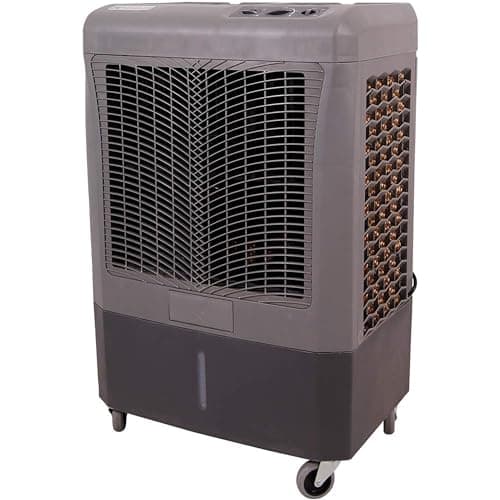 The evaporative cooler case Hessaire MC37M Mobile Evaporative Cooler 3,100 CFM on 250 W through a saturated pad, with a 10.3 gallon tank and a hose connection for continuous fill. | A patio, garage bay or workshop you want genuinely cooler air in | |
| 2 | 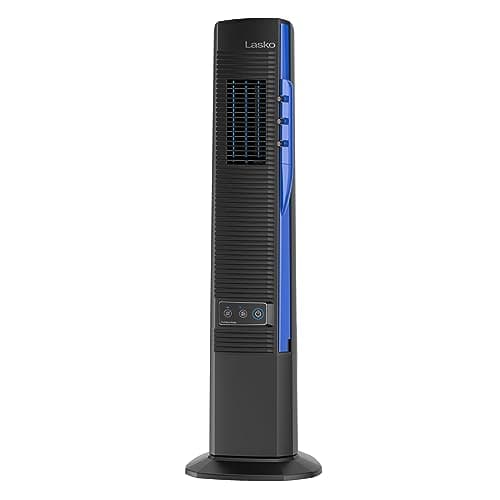 The misting fan case Lasko Misto 42" Outdoor Misting Tower Fan 276 CFM on 55 to 86 W with a garden-hose misting kit — light, cheap to run, and aimed at people rather than spaces. | One or two people on a small deck, in dry air |
Same physics
Both are evaporation, at different points
Evaporating a pound of water absorbs roughly 1,050 BTU, and that energy comes out of the air it evaporates into. Both machines exploit exactly that. The difference is where it happens.
- Evaporative cooler: evaporation happens on the pad, inside the machine, before the air reaches you. You feel cooled air.
- Misting fan: evaporation happens in the air between the nozzle and you, and on your skin. You feel cooled air plus whatever water has not evaporated yet.
Both therefore fail in the same weather, for the same reason. When the air is already close to saturated there is little evaporative cooling available — the ceiling is set by the dew point, as covered in whether evaporative coolers work in humidity. The misting fan fails more visibly, because the unevaporated water has to go somewhere.
This one is not a DIY job
Side by side
What each publishes
| Misting fan | Evaporative cooler | |
|---|---|---|
| Published airflow | 276 CFM | 3,100 CFM |
| Published power | 55 - 86 W | 250 W |
| Five-hour evening | 7.9¢ | 23¢ |
| Water supply | Garden hose, always | 10.3 gal tank or hose |
| What reaches you | Cooled air and droplets | Cooled air |
| Scale | One or two people | A seating area |
| Storage | Packs away easily | 40 lb plus water |
| Consumables | Nozzles, filters | Pads |
The airflow row is an eleven-fold difference, and it is the one that decides most purchases. A patio table with four people around it is an area, and areas need airflow; a single chair on a balcony is a person, and people need a breeze.
Outdoors
Why both belong outside
Indoors, everything either machine evaporates stays in the room, raising humidity until the cooling fades. Outdoors that moisture disperses continuously, which is why this whole category is happiest on a patio — the argument in do evaporative coolers work outdoors.
Practical notes that apply to both: run them from a GFCI-protected outdoor circuit, place them upwind of the seating so a breeze carries the output toward people, and drain them before freezing weather.
Verdict
Which to buy
- Misting fan for a small, dry-climate balcony, a single work station, or anywhere storage space decides the purchase. The picks are in misting fans, ranked.
- Evaporative cooler for a patio, a deck, a garage with the door open, or any space where several people need to feel it. The picks are in evaporative coolers for a patio.
- Neither above roughly 60% relative humidity. Shade plus a large ordinary fan is more comfortable and does not wet anything.
Say the unwelcome thing
Do not buy a misting fan for a humid climate patio.
The format depends on droplets evaporating before they land. In Gulf Coast or Southeast summer air they do not, so the fan becomes a sprinkler aimed at your furniture, and the cooling you feel is mostly water on skin rather than a lower air temperature.
Check your afternoon humidity first. Below about 50% this whole category is excellent value, and 3,100 CFM on 250 watts cools an area rather than a seat. Above it, buy shade and airflow instead.
In full
Every pick, and what is wrong with it
Published specifications only, each linked to the page it came from. Where a manufacturer publishes nothing, the row says so — we do not fill blanks in.
1. The evaporative cooler case
Hessaire MC37M Mobile Evaporative Cooler
Hessaire · model MC37M
3,100 CFM on 250 W through a saturated pad, with a 10.3 gallon tank and a hose connection for continuous fill.
A cooler does the evaporation inside the machine. Air is pulled through a wet pad, gives up heat to evaporate that water, and leaves cooler and damper than it arrived. What reaches you is air, not water.
That is why the airflow figure matters here and why this format scales: 3,100 CFM is enough to cool a seating area rather than a seat. Running it costs 23¢ for a five-hour evening at 18.34¢/kWh.
The 10.3 gallon tank with a continuous hose connection is the practical difference outdoors. A misting fan needs a hose anyway; this one can take the same hose and stop being refilled at all.
What’s wrong with it
40 lb of machine plus water, pads that scale up in hard water, and it puts more moisture into the air than a misting fan does.
Running cost — MC37M
| Nameplate power | 250 W | manufacturer's published figure |
|---|---|---|
| Energy, 8-hour night | 2.00 kWh | 250 ÷ 1000 × 8 |
| Cost per hour | 4.6¢ | at 18.34¢/kWh |
| Cost per 8-hour night | 37¢ | on the highest speed |
| Cost per 30 nights | $11 | 60.0 kWh |
Rate: 18.34¢/kWh, the US average residential price for June 2026 (EIA Electric Power Monthly, Table 5.3). Yours will differ — swap it in: (watts ÷ 1000) × hours × your rate.
| Air delivery | 3,100 CFM |
|---|---|
| Power | 250 W / 2.4 A |
| Water tank | 10.3 gallons, continuous hookup capable |
| Dimensions | 24 L x 16 W x 38 H in |
| Weight | 40 lb |
| Pads | Industrial-grade cooling pads |
| Coverage claim | Not published on the product page |
Every figure above is from Hessaire product page, MC37M. Blanks are shown as “not published” rather than filled in.
2. The misting fan case
Lasko Misto 42" Outdoor Misting Tower Fan
Lasko · model YF300
276 CFM on 55 to 86 W with a garden-hose misting kit — light, cheap to run, and aimed at people rather than spaces.
A misting fan is a conventional fan with a water line and nozzles. The droplets evaporate in the airstream and in the air around you, which cools both — and any droplet that does not evaporate lands on whatever is downwind.
276 CFM is a personal-scale figure, not a patio-scale one, and the draw is modest: 55 to 86 W, about 7.9¢ for a five-hour evening.
It is also the format that packs away. A tower on a stand with a hose fitting stores in a garage corner; a 40 lb cooler with a tank does not. For a small balcony used occasionally, that is a real advantage.
What’s wrong with it
276 CFM covers people, not areas; in humid air the mist wets furniture instead of evaporating; and it needs a hose running to it the whole time.
Running cost — YF300
| Nameplate power | 55 W – 86 W | manufacturer's published figure |
|---|---|---|
| Energy, 8-hour night | 0.69 kWh | 86 ÷ 1000 × 8 |
| Cost per hour | 1.6¢ | at 18.34¢/kWh |
| Cost per 8-hour night | 13¢ | on the highest speed |
| Cost per 30 nights | $3.79 | 20.6 kWh |
| Same month, lowest speed | $2.42 | at 55 W |
Rate: 18.34¢/kWh, the US average residential price for June 2026 (EIA Electric Power Monthly, Table 5.3). Yours will differ — swap it in: (watts ÷ 1000) × hours × your rate.
| Power | 55 W - 86 W (0.49-0.73 A at 120 V) |
|---|---|
| Air delivery | 276 CFM |
| Speeds | 4 |
| Height | 41.59 in |
| Footprint | 12.78 x 12.78 in |
| Weight | 15.11 lb |
| Water connection | Standard garden hose |
| Cord | 10 ft, in-line GFCI, 3-prong grounded |
| Noise | Not published |
| Warranty | 2 years |
Every figure above is from Lasko product page, YF300. Blanks are shown as “not published” rather than filled in.
Questions people actually ask
Frequently asked
Is a misting fan or an evaporative cooler better?
For a seating area, the cooler: 3,100 CFM against 276 on the machines compared here, and it delivers cooled air rather than droplets. For one or two people on a small balcony, the misting fan is lighter, cheaper to run and easier to store.
Do misting fans make everything wet?
In dry air, no — the droplets evaporate in flight, which is where the cooling comes from. In humid air they do not fully evaporate, and the water lands on furniture, floors and people. Damp cushions after an hour is the signal to stop using one.
How much does each cost to run?
At the national average rate, a five-hour evening is about 8 cents for an 86-watt misting fan and 23 cents for a 250-watt evaporative cooler. Water is extra for both and is usually a few dollars a month at most. Running cost in full.
Can you use either one indoors?
Only with a window or door open. Both add moisture to the air, and in a closed room humidity climbs until the cooling effect fades. Outdoors that moisture disperses, which is why the whole category suits patios. The moisture they add.
Do misting fans need a hose the whole time?
Most do — they mist from mains pressure rather than a reservoir, so the hose stays connected while it runs. Evaporative coolers carry a tank, and the larger ones accept a hose with a float valve so they can also run unattended.
Sources
Where these numbers came from
Read next
Where to go from here
Back to Evaporative Coolers, or read how we pick.