The picks
The best ceiling fans for a bedroom
A bedroom fan spends its whole life on its lowest setting, which makes it the one room where the low-speed figure is the specification that matters.
By Sawyer V. · Published
The short answer
Buy on certified efficiency, then check the low-speed draw. The best in the 42 to 56 inch band reach 377.0 CFM per watt against a band median of 189.2 — and note that the fan with the lowest low-speed draw in the band, at 1.0 W, is rated only 219.7 CFM per watt. Low watts and high efficiency are different questions.
Fan & Frost earns a commission when you buy through our links, at no cost to you. It never changes a ranking, and we say so when the right answer is the cheaper unit or nothing at all. Full disclosure · How we pick.
At a glance
The picks, ranked
Tap any row to jump to the full reasoning. Prices are live from Amazon where we have them, and read “check price” where we don’t — never a number we cannot verify today.
| # | Product | Best for | Price |
|---|---|---|---|
| 1 | Best overall Aeratron AE+2 50" Ceiling Fan 377.0 CFM per watt at 50 inches — the efficiency ceiling of the bedroom span band, at 14.0 W on high and 2.7 W on low. | A bedroom with 9 ft ceilings and no need for a light kit | |
| 2 | 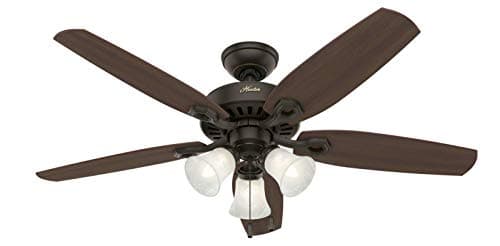 Best low-speed draw Hunter Vespucci 52" Ceiling Fan 366.7 CFM per watt with 1.8 W on low — near the top of the band on both figures at once, which is rare. | A bedroom where the fan runs all night, every night | |
| 3 | 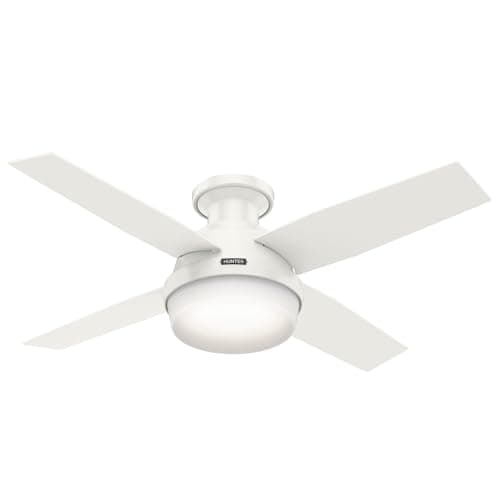 Best for a small bedroom Hunter Martindale 44" Ceiling Fan 304.5 CFM per watt at 44 inches, 1.1 W on low and 10.1 W on high — the lowest high-speed draw of any fan here. | A box room, a child's room, or anywhere 52 inches would dominate | |
| — | 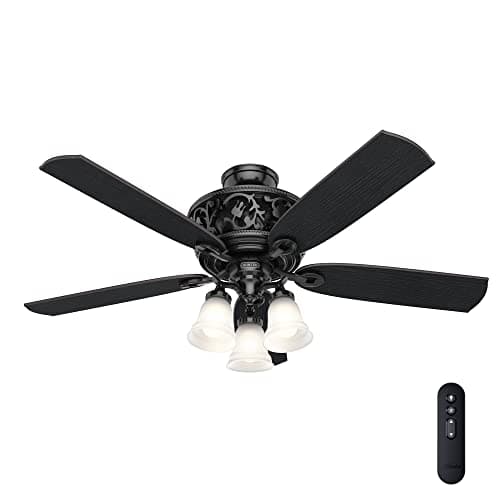 The number that misleads Hunter Promenade 54" Ceiling Fan 1.0 W on low — the lowest low-speed draw in the whole 42 to 56 inch band — on a fan rated just 219.7 CFM per watt. | Illustrating why low-speed watts is the wrong single filter |
A bedroom fan is an unusual appliance. It runs for eight hours at a stretch, on its lowest setting, in the room where noise matters most, while the person it is serving is unconscious and cannot adjust it.
That combination means the specifications that matter here are not the ones that matter in a living room.
The finding
Low-speed watts and efficiency do not track
Filtering the certified ceiling fan dataset to the 42 to 56 inch band gives 920 fans that publish a low-speed figure. Sorting them two different ways gives two different answers.
| Fan | Low | CFM/W | High | Most Efficient |
|---|---|---|---|---|
| Hunter Promenade 54 in | 1.0 W | 219.7 | 29.5 W | No |
| Hunter Martindale 44 in | 1.1 W | 304.5 | 10.1 W | Yes |
| Hunter Vespucci 52 in | 1.8 W | 366.7 | 13.9 W | Yes |
| Aeratron AE+2 50 in | 2.7 W | 377.0 | 14.0 W | Yes |
| Band median | — | 189.2 | — | — |
Read the first two rows against each other. A difference of 0.1 W on low separates them — and one is rated 304.5 CFM per watt and holds the Most Efficient badge while the other is rated 219.7 and does not.
The explanation is that low-speed wattage measures how slowly a fan can be made to turn, not how much air it produces per watt. A fan can post a very low figure by simply turning very slowly and moving very little air.
The practical rule: use CFM per watt to choose the fan, and the low-speed figure to check it. A fan with both high efficiency and low low-speed draw, like the 366.7 / 1.8 W pick above, is the genuinely good outcome.
Band
Bedroom-size fans are structurally less efficient
Worth knowing before you compare a bedroom fan to a living-room one and feel short-changed.
Median certified efficiency in the 42 to 56 inch band is 189.2 CFM per watt. In the largest span band it is 306.0. Airflow scales with swept area while drag scales sharply with tip speed, so a big fan turning slowly beats a small one turning fast.
Which means two things for a bedroom. First, a bedroom fan will never post living-room numbers, and that is geometry rather than a bad purchase. Second, the variation within the band is much larger than the band’s disadvantage — 189.2 median against a 377.0 best is a factor of two, so choosing well inside the band matters more than the band itself does.
This one is not a DIY job
Fit the largest span the room can take without the blades coming within about 18 inches of a wall, and hang it so the blades clear head height comfortably. A fan too close to the ceiling recirculates air against the plaster instead of pushing it down — downrod and mounting.
Noise
What we can and cannot tell you about noise
This is the specification people most want for a bedroom, and nobody publishes it.
The ENERGY STAR certified ceiling fan dataset covers airflow, wattage at each speed, standby power, span, warranty and light-kit details. It contains no sones or dBA field at all. There is no certified noise figure for any ceiling fan, from us or anyone else.
What is defensible is the physical reasoning. Ceiling fan noise comes mostly from blade tip speed and from air turbulence, both of which rise sharply with rotation speed. A fan that produces enough airflow at its lowest setting is quieter than one that needs its middle setting to match it.
That makes high CFM per watt a reasonable proxy for quiet operation, which is the best we can honestly offer — what fan noise figures actually mean. Mechanical noise — a wobble, a hum, a click — is a separate matter and usually a mounting problem — fixing a wobbling fan.
Standby
The watt that runs all year
A bedroom fan with a remote draws standby power continuously, whether it is turning or not, for all 8,760 hours of the year.
The figures on this page run from 0.3 W to 0.8 W. At 18.34¢/kWh that is 48¢ against $1.29 a year — small in absolute terms, and worth noticing because it is one of the few loads in a bedroom that never stops.
Put in proportion: a fan on low for eight hours a night through a 120-night summer at 1.8 W uses roughly the same electricity as eight months of its own standby. Standby is a real share of a ceiling fan’s annual consumption, which is unusual among appliances.
Direction
Make sure it is turning the right way
The cheapest improvement available, and a surprising number of fans are set wrong year-round.
In summer a ceiling fan should turn so it pushes air downward, creating the draft that speeds sweat evaporation. In winter the reverse setting pulls air up and pushes warm ceiling air gently down the walls without a draft.
If your fan is running all night and you feel nothing, check the direction switch before concluding it is underpowered — which way in summer and which way in winter.
Say the unwelcome thing
Do not buy the fan with the lowest low-speed wattage.
It is the most plausible-looking filter for a bedroom and it selects for the wrong thing. The lowest low-speed draw in the entire 42 to 56 inch band is 1.0 W, on a fan rated 219.7 CFM per watt that is not on the Most Efficient list and draws 29.5 W on high.
A low figure can mean the fan is efficient, or it can mean the fan is barely turning. The certified efficiency figure tells you which, and the low-speed number on its own does not.
Sort by CFM per watt first, then look at the low-speed column among the leaders. 366.7 CFM per watt at 1.8 W on low is what a fan that scores well on both actually looks like.
In full
Every pick, and what is wrong with it
Published specifications only, each linked to the page it came from. Where a manufacturer publishes nothing, the row says so — we do not fill blanks in.
1. Best overall
Aeratron AE+2 50" Ceiling Fan
Aeratron · model AE+2WI50
377.0 CFM per watt at 50 inches — the efficiency ceiling of the bedroom span band, at 14.0 W on high and 2.7 W on low.
The most efficient fan in the 42 to 56 inch band, which means it achieves useful airflow at a speed slow enough that blade noise is not a factor.
377.0 CFM per watt against a band median of 189.2 — almost exactly double. That is the specification that determines how slowly you can run it and still feel it.
14.0 W on high and 2.7 W on low, with 0.5 W standby. An eight-hour night on low is 0.4¢ at 18.34¢/kWh.
Most Efficient certified, three-year component warranty. A light-kit version is certified to the same figures if you need the fan to replace a fitting — fans with lights compared.
What’s wrong with it
No light kit in the base model, and 2.7 W on low is not the lowest figure here.
Running cost — AE+2WI50
| Nameplate power | 2.7 W – 14 W | manufacturer's published figure |
|---|---|---|
| Energy, 8-hour night | 0.11 kWh | 14 ÷ 1000 × 8 |
| Cost per hour | 0.3¢ | at 18.34¢/kWh |
| Cost per 8-hour night | 2.1¢ | on the highest speed |
| Cost per 30 nights | 62¢ | 3.4 kWh |
| Same month, lowest speed | 12¢ | at 2.7 W |
Rate: 18.34¢/kWh, the US average residential price for June 2026 (EIA Electric Power Monthly, Table 5.3). Yours will differ — swap it in: (watts ÷ 1000) × hours × your rate.
| Blade span | 50 in |
|---|---|
| Efficiency | 377.0 CFM per watt |
| Power, high speed | 14.0 W |
| Power, low speed | 2.7 W |
| Standby power | 0.5 W |
| Type | Indoor, fan only (a light-kit version, AE+2WI50L, is certified to the same figures) |
| Warranty | 3 years, components |
| ENERGY STAR | Certified, and on the Most Efficient list |
Every figure above is from ENERGY STAR Certified Ceiling Fans dataset. Blanks are shown as “not published” rather than filled in.
2. Best low-speed draw
Hunter Vespucci 52" Ceiling Fan
Hunter · model Vespucci
366.7 CFM per watt with 1.8 W on low — near the top of the band on both figures at once, which is rare.
The best combination on this page of high efficiency and genuinely low low-speed power, which usually pull against each other.
1.8 W on low is 0.3¢ for an eight-hour night and about 32¢ for a whole summer of them at 18.34¢/kWh.
366.7 CFM per watt, certified, against the band median of 189.2. 13.9 W on high at a 52-inch span.
0.8 W standby is the honest cost — about $1.29 a year, drawn whether the fan is on or not. Twice the standby of several fans in this band, which over a decade is not nothing.
What’s wrong with it
0.8 W of standby is the highest here, drawn all 8,760 hours of the year.
Running cost — Vespucci
| Nameplate power | 1.8 W – 13.9 W | manufacturer's published figure |
|---|---|---|
| Energy, 8-hour night | 0.11 kWh | 13.9 ÷ 1000 × 8 |
| Cost per hour | 0.3¢ | at 18.34¢/kWh |
| Cost per 8-hour night | 2.0¢ | on the highest speed |
| Cost per 30 nights | 61¢ | 3.3 kWh |
| Same month, lowest speed | 7.9¢ | at 1.8 W |
Rate: 18.34¢/kWh, the US average residential price for June 2026 (EIA Electric Power Monthly, Table 5.3). Yours will differ — swap it in: (watts ÷ 1000) × hours × your rate.
| Blade span | 52 in |
|---|---|
| Efficiency | 366.7 CFM per watt |
| Power, high speed | 13.9 W |
| Power, low speed | 1.8 W |
| Standby power | 0.8 W |
| Type | Indoor, fan only (no light kit) |
| Warranty | 3 years, components |
| ENERGY STAR | Certified |
Every figure above is from ENERGY STAR Certified Ceiling Fans dataset. Blanks are shown as “not published” rather than filled in.
3. Best for a small bedroom
Hunter Martindale 44" Ceiling Fan
Hunter · model 44in Martindale
304.5 CFM per watt at 44 inches, 1.1 W on low and 10.1 W on high — the lowest high-speed draw of any fan here.
Span should fit the room, and a 52-inch fan in a small bedroom simply looks and feels wrong regardless of what the numbers say.
1.1 W on low and 10.1 W on high. That high figure is the lowest on this page — it draws less at full speed than the 50-inch leader does, because it is moving less air.
304.5 CFM per watt, Most Efficient certified, with 0.4 W standby. Well above the 189.2 band median despite the smaller span.
An eight-hour night on low is 0.2¢ at 18.34¢/kWh. The honest limit is reach: at 44 inches the airflow column is narrower, so the far side of a large room feels nothing — small-room fans compared.
What’s wrong with it
44 inches will not reach the corners of a large bedroom.
Running cost — 44in Martindale
| Nameplate power | 1.1 W – 10.1 W | manufacturer's published figure |
|---|---|---|
| Energy, 8-hour night | 0.08 kWh | 10.1 ÷ 1000 × 8 |
| Cost per hour | 0.2¢ | at 18.34¢/kWh |
| Cost per 8-hour night | 1.5¢ | on the highest speed |
| Cost per 30 nights | 44¢ | 2.4 kWh |
| Same month, lowest speed | 4.8¢ | at 1.1 W |
Rate: 18.34¢/kWh, the US average residential price for June 2026 (EIA Electric Power Monthly, Table 5.3). Yours will differ — swap it in: (watts ÷ 1000) × hours × your rate.
| Blade span | 44 in |
|---|---|
| Efficiency | 304.5 CFM per watt |
| Power, high speed | 10.1 W |
| Power, low speed | 1.1 W |
| Standby power | 0.4 W |
| Type | Indoor, fan only |
| Warranty | 3 years, components |
| ENERGY STAR | Certified |
Every figure above is from ENERGY STAR Certified Ceiling Fans dataset. Blanks are shown as “not published” rather than filled in.
Skip this one
Hunter Promenade 54" Ceiling Fan
Hunter · model 59545
1.0 W on low — the lowest low-speed draw in the whole 42 to 56 inch band — on a fan rated just 219.7 CFM per watt.
Included because “lowest watts on low” is a tempting filter and it picks the wrong fan.
1.0 W on low is genuinely the lowest figure in the band. If you sorted the certified dataset by that column, this fan would come first.
219.7 CFM per watt is why that is misleading. It is barely above the 189.2 band median, and well under the 377.0 leader. The fan draws 1.0 W on low because it is barely turning, not because it is efficient.
29.5 W on high — more than double the leaders for less airflow — and it is not on the Most Efficient list. If you ever need more than the lowest setting, you pay for it every time.
What’s wrong with it
29.5 W on high is more than double the leaders, for less air.
Running cost — 59545
| Nameplate power | 1 W – 29.5 W | manufacturer's published figure |
|---|---|---|
| Energy, 8-hour night | 0.24 kWh | 29.5 ÷ 1000 × 8 |
| Cost per hour | 0.5¢ | at 18.34¢/kWh |
| Cost per 8-hour night | 4.3¢ | on the highest speed |
| Cost per 30 nights | $1.30 | 7.1 kWh |
| Same month, lowest speed | 4.4¢ | at 1 W |
Rate: 18.34¢/kWh, the US average residential price for June 2026 (EIA Electric Power Monthly, Table 5.3). Yours will differ — swap it in: (watts ÷ 1000) × hours × your rate.
| Blade span | 54 in |
|---|---|
| Efficiency | 219.7 CFM per watt |
| Power, high speed | 29.5 W |
| Power, low speed | 1.0 W |
| Standby power | 0.3 W |
| Type | Indoor, fan only |
| Warranty | 3 years, components |
| ENERGY STAR | Certified; NOT on the Most Efficient list |
Every figure above is from ENERGY STAR Certified Ceiling Fans dataset. Blanks are shown as “not published” rather than filled in.
We are not linking a buy button for this one. If you want to look at it anyway, it is easy enough to find — but we would rather send you to something that fits your room.
Questions people actually ask
Frequently asked
What size ceiling fan is best for a bedroom?
The largest span the room takes without the blades coming within about 18 inches of a wall — typically 44 inches for a small bedroom and 50 to 52 for a normal one. Larger spans are more efficient, but the variation within the band matters more than the band itself.
What is the most efficient bedroom-size ceiling fan?
377.0 CFM per watt at 50 inches is the ceiling of the 42 to 56 inch band, against a band median of 189.2 — almost exactly double. Several fans in the band exceed 360 CFM per watt, so the efficient options are not a single product.
Is a ceiling fan with the lowest wattage on low the best choice?
No, and it is a misleading filter. The lowest low-speed draw in the bedroom span band is 1.0 W, on a fan rated only 219.7 CFM per watt that draws 29.5 W on high. A low figure can mean efficient, or it can mean barely turning.
How quiet is a bedroom ceiling fan?
Nobody publishes a certified figure — the ENERGY STAR ceiling fan dataset has no sones or dBA field at all. The defensible proxy is efficiency: a fan producing enough airflow on its lowest setting runs slower, and blade noise rises sharply with tip speed. What fan noise figures mean.
How much does a ceiling fan cost to run overnight?
At 1.8 W on low, about 0.3¢ for an eight-hour night at the current average residential rate, and roughly 32¢ for a whole summer of them. Standby draw of 0.3 to 0.8 W continues all year whether the fan runs or not. Fan running costs.
Why does my bedroom ceiling fan not seem to do anything?
Check the direction switch first. In summer the fan should push air downward to create the draft that speeds sweat evaporation; a fan left on its winter setting pulls air up and you will feel very little. It is the cheapest fix available. Which way in summer.
Sources
Where these numbers came from
- ENERGY STAR Certified Ceiling Fans dataset — CFM per watt, low and high speed wattage, standby power, span and Most Efficient status across 1,439 US records, of which 920 in the 42 to 56 inch band publish a low-speed figure
- EIA Electric Power Monthly, Table 5.3 — average residential electricity price
Read next
Where to go from here
Back to Whole-House Airflow, or read how we pick.