Guide and picks
What to set a dehumidifier to
The setting people choose is almost always lower than the setting they need, and the difference is paid for in hours of compressor running.
By Sawyer V. · Published
The short answer
Set it to the highest number that solves your problem, not the lowest the dial allows. Every point lower is more compressor hours, and below a certain point the machine simply never stops — which is how a $86-a-year appliance becomes a great deal more. Start moderate, wait a couple of days, and only lower it if condensation or musty smell persists.
Fan & Frost earns a commission when you buy through our links, at no cost to you. It never changes a ranking, and we say so when the right answer is the cheaper unit or nothing at all. Full disclosure · How we pick.
At a glance
The picks, ranked
Tap any row to jump to the full reasoning. Prices are live from Amazon where we have them, and read “check price” where we don’t — never a number we cannot verify today.
| # | Product | Best for | Price |
|---|---|---|---|
| 1 | Best for actually seeing the number Honeywell Smart Dehumidifier, 32 pints/day 32.46 pints a day at 343 kWh a year with connected control — one of only 35 certified portables you can monitor remotely. | Anyone who wants to know what the room is doing, not guess | |
| 2 | Best where the setting gets chased Waykar Dehumidifier, 49 pints/day 2.20 L/kWh and 471 kWh a year — the efficiency that limits the damage of an ambitious setting. | A basement, where a low target means continuous running | |
| 3 | Best for reaching setpoint and stopping Vissani Dehumidifier, 27 pints/day 26.87 pints a day at 283 kWh a year — small enough to hit the target and rest. | A room where a moderate target is genuinely achievable | |
| — | Continuous mode has a cost Midea Cube Dehumidifier with Built-in Pump, 50 pints/day 49.95 pints a day at 520 kWh — and continuous mode means the humidistat stops deciding anything. | Drying out after a genuine water event, not as a permanent setting |
The humidity setting is the only control on the machine that meaningfully changes what it costs, and it is the one people set by instinct.
The principle
Lower is not better, it is longer
A dehumidifier does not run harder to reach a lower target. It runs longer. The compressor draws the same power whether it is pulling the room from 70% to 60% or from 50% to 45%; the difference is how many hours it spends doing it.
Two things follow, and the second is the one that hurts.
- Every point lower costs run time. Linear-ish, and predictable.
- Below the room’s achievable floor, it never stops. If the space has a water source that replenishes faster than the machine removes, a low target converts the appliance into a permanent load. The certified annual figure assumes cycling, and continuous running blows straight through it.
That is why the instruction is the highest number that solves your problem. Comfort and condensation control do not require a very dry room; they require a room below the point where moisture condenses on surfaces and where the air can still absorb your sweat.
Method
How to find your number
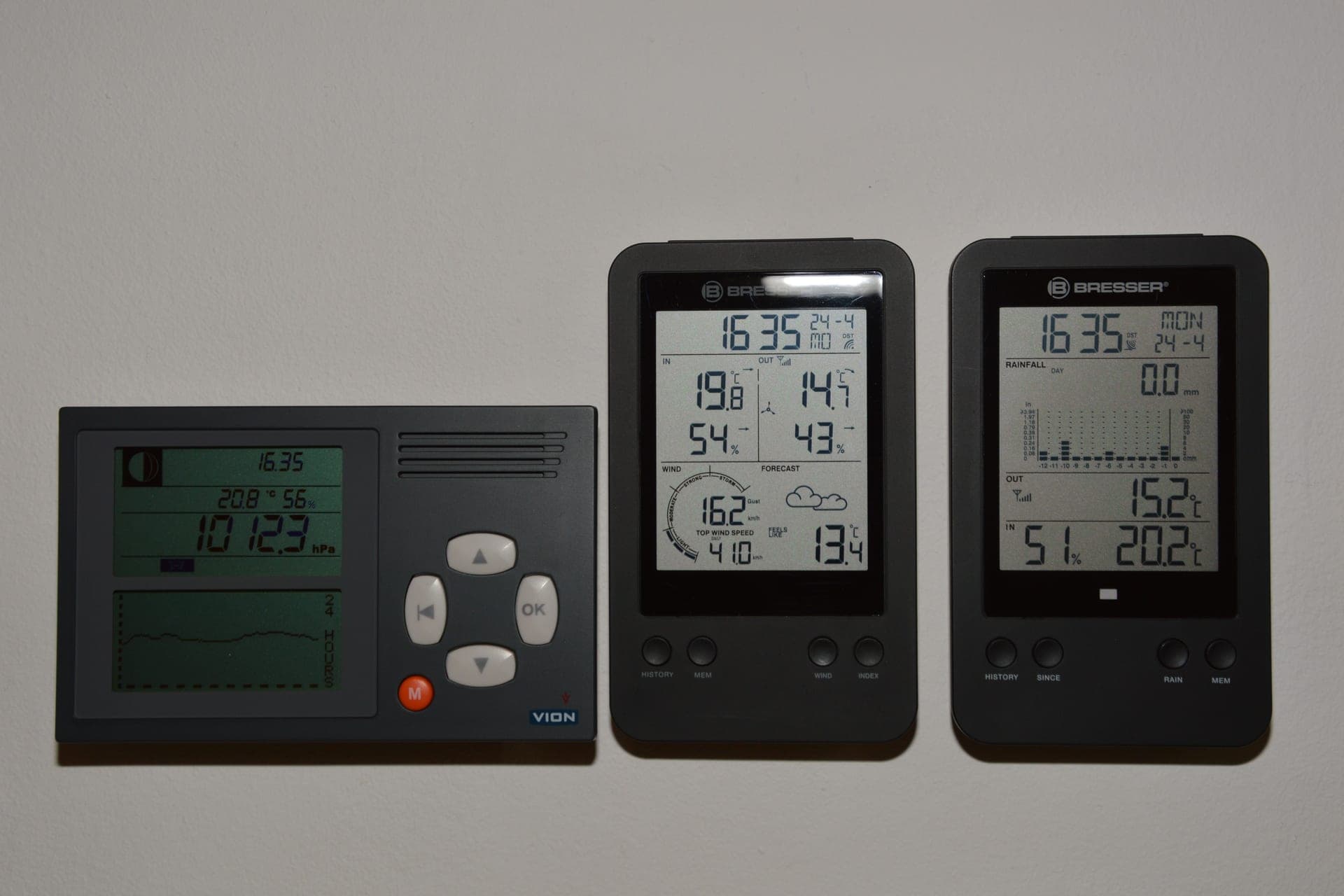
- Measure first. A separate thermometer-hygrometer, placed away from the machine, for a day. The unit’s own display reads the air at its intake, which is the driest air in the room.
- Start moderate. Somewhere in the middle of the dial rather than at the bottom.
- Wait two or three days. Humidity moves slowly, and materials in the room — carpet, cardboard, plaster — hold moisture that takes time to release.
- Check the symptom, not the number. Has the condensation gone? Has the musty smell gone? Is the room comfortable? Those are the targets; the percentage is just the dial.
- Lower by 5% only if the symptom persists, and wait again.
- Watch the duty cycle. If the compressor never stops, the target is below what the room can reach. Raise it.
The signal that you have gone too low is not discomfort — it is a machine that runs continuously. Diagnosing continuous running.
The cost
What the setting is worth in money
The certified annual figures assume a standard usage pattern. Your setting is the biggest thing that moves you away from it.
| Setting relative to the room | Compressor behavior | Cost versus the rating |
|---|---|---|
| Above what the room already is | Never runs | Near zero |
| Moderate and achievable | Cycles, mostly idle | At or below the rating |
| Low but achievable | Cycles, mostly running | Above the rating |
| Below the room's floor | Never stops | Well above the rating |
| Continuous mode | Never stops, by design | Well above the rating |
A certified 50-pint unit is rated at 471 to 530 kWh a year — $86 to $97 at 18.34¢/kWh. That assumes it cycles. A unit that never stops is not described by that figure at all, and the gap is larger than any difference between models.
Which is the useful reframing: the setting matters more than the machine. Choosing the efficiency leader over a mainstream unit saves about $11 a year. Choosing an unreachable target can cost multiples of that.
Continuous mode
What it is for, and what it is not
Nearly every unit has one, and it is widely misunderstood as a “maximum” setting.
Continuous mode disables the humidistat entirely. The compressor runs whenever the machine is on, with no target to reach and nothing to stop at. It is not more powerful; it simply never pauses.
It is the right choice for:
- Drying out after a leak or flood, for a few days.
- Drying a newly finished space where materials are releasing construction moisture.
- A space with no comfort requirement where you simply want maximum extraction and the machine is plumbed to drain.
It is the wrong choice as a permanent setting in an occupied room. You have removed the control that makes the appliance efficient, and left only the one that makes it run.
This one is not a DIY job
Specific humidity targets for health, mold prevention or building protection are outside this site’s scope. Recommended ranges vary by climate, construction, season and use, and they are the province of building science and public health bodies rather than a buying guide.
What we can tell you is the mechanics: a lower setting means more compressor hours, and a target below what the room can achieve means continuous running.
In cold weather, a very low indoor humidity target can be counterproductive in other ways, and a very high one causes condensation on cold surfaces. Both are building-specific.
If damp or mold is a health concern, that is a question for a medical professional and a qualified assessor.
Say the unwelcome thing
Do not set a dehumidifier to its lowest setting.
It is the instinctive move — drier must be better — and it is the single most expensive mistake you can make with one of these machines.
A lower target does not extract faster. It extracts for longer. And if the target is below what the room can actually reach, the compressor never stops at all — which means the certified annual figure stops describing your machine entirely.
The certified 50-pint units are rated $86 to $97 a year assuming they cycle. Continuous running exceeds that by far more than the difference between any two models.
Set the highest number that clears the condensation and the smell, wait a few days, and only then adjust. On a 2.20 L/kWh basement unit or a 283 kWh room unit, that setting is worth more than the specification.
In full
Every pick, and what is wrong with it
Published specifications only, each linked to the page it came from. Where a manufacturer publishes nothing, the row says so — we do not fill blanks in.
1. Best for actually seeing the number
Honeywell Smart Dehumidifier, 32 pints/day
Honeywell · model TPFIT32AWK
32.46 pints a day at 343 kWh a year with connected control — one of only 35 certified portables you can monitor remotely.
The setting only makes sense if you can see what it achieved, and most dehumidifiers show a reading that is not a calibrated instrument.
Connected capable — only 35 of 502 certified portables carry the flag. Being able to watch humidity over days is what tells you whether 50% was enough or 45% was necessary.
32.46 pints a day and 343 kWh a year, about $63 at 18.34¢/kWh, in the band with the best certified median efficiency (2.04).
Its onboard display is still the machine’s own sensor near its own intake. A separate hygrometer across the room is worth the few dollars.
What’s wrong with it
2.01 L/kWh is exactly median, and connectivity adds standby draw the data does not quantify.
Running cost — TPFIT32AWK
| Annual energy use | 343 kWh | ENERGY STAR certified figure |
|---|---|---|
| Annual cost | $63 | 343 × 18.34¢/kWh |
| Per cooling month | $16 | spread over a four-month season |
The annual figure is the certified value from the ENERGY STAR Certified Dehumidifiers dataset, which models a standard cooling season rather than your actual summer. It is more useful than a nameplate wattage here, because a variable-speed compressor spends most of its life well below nameplate.
Rate: 18.34¢/kWh, the US average residential price for June 2026 (EIA Electric Power Monthly, Table 5.3). Yours will differ — swap it in: (watts ÷ 1000) × hours × your rate.
| Water removal | 32.46 pints/day (DOE Appendix X1) |
|---|---|
| Efficiency (IEF) | 2.01 L/kWh |
| Annual energy use | 343 kWh/yr |
| Refrigerant | HFC-32 (GWP 675) |
| Connected | Yes |
| Noise | Not published in the certified dataset |
| ENERGY STAR | Certified |
Every figure above is from ENERGY STAR Certified Dehumidifiers dataset. Blanks are shown as “not published” rather than filled in.
2. Best where the setting gets chased
Waykar Dehumidifier, 49 pints/day
Waykar · model CTH150D
2.20 L/kWh and 471 kWh a year — the efficiency that limits the damage of an ambitious setting.
A basement is where an over-ambitious setting costs the most, because the machine has a continuous water source to fight.
2.20 L/kWh against the 2.01 that every mainstream 50-pint unit manages — 471 kWh a year against 515 to 530 for the same water, or $11 a year at 18.34¢/kWh.
49.43 pints a day and Most Efficient certified.
But be clear about what efficiency does not do: if you set a target the room cannot reach, this machine runs continuously too. It just runs continuously slightly more cheaply.
What’s wrong with it
No efficiency figure saves you from a target the room cannot reach.
Running cost — CTH150D
| Annual energy use | 471 kWh | ENERGY STAR certified figure |
|---|---|---|
| Annual cost | $86 | 471 × 18.34¢/kWh |
| Per cooling month | $22 | spread over a four-month season |
The annual figure is the certified value from the ENERGY STAR Certified Dehumidifiers dataset, which models a standard cooling season rather than your actual summer. It is more useful than a nameplate wattage here, because a variable-speed compressor spends most of its life well below nameplate.
Rate: 18.34¢/kWh, the US average residential price for June 2026 (EIA Electric Power Monthly, Table 5.3). Yours will differ — swap it in: (watts ÷ 1000) × hours × your rate.
| Water removal | 49.43 pints/day (DOE Appendix X1) |
|---|---|
| Efficiency (IEF) | 2.20 L/kWh |
| Annual energy use | 471 kWh/yr |
| Refrigerant | HFC-32 (GWP 675) |
| Connected | No |
| Noise | Not published in the certified dataset |
| ENERGY STAR | Certified, and on the Most Efficient list |
Every figure above is from ENERGY STAR Certified Dehumidifiers dataset. Blanks are shown as “not published” rather than filled in.
3. Best for reaching setpoint and stopping
Vissani Dehumidifier, 27 pints/day
Vissani · model VAD25S1AWTS
26.87 pints a day at 283 kWh a year — small enough to hit the target and rest.
The behavior you actually want: reach the setpoint, stop, and cycle occasionally.
A correctly sized unit in a room with a realistic target spends most of its time idle. That is what produces the 283 kWh a year figure — about $52 at 18.34¢/kWh, the lowest of any certified unit we hold.
26.87 pints a day at 2.01 L/kWh, the category median.
The honest limit: put it somewhere with a real water source and it will never reach setpoint, which converts it from a cheap machine into an expensive one.
What’s wrong with it
27 pints will not hold a basement, where it will run flat out instead.
Running cost — VAD25S1AWTS
| Annual energy use | 283 kWh | ENERGY STAR certified figure |
|---|---|---|
| Annual cost | $52 | 283 × 18.34¢/kWh |
| Per cooling month | $13 | spread over a four-month season |
The annual figure is the certified value from the ENERGY STAR Certified Dehumidifiers dataset, which models a standard cooling season rather than your actual summer. It is more useful than a nameplate wattage here, because a variable-speed compressor spends most of its life well below nameplate.
Rate: 18.34¢/kWh, the US average residential price for June 2026 (EIA Electric Power Monthly, Table 5.3). Yours will differ — swap it in: (watts ÷ 1000) × hours × your rate.
| Water removal | 26.87 pints/day (DOE Appendix X1) |
|---|---|
| Efficiency (IEF) | 2.01 L/kWh |
| Annual energy use | 283 kWh/yr |
| Refrigerant | HFC-32 (GWP 675) |
| Connected | No |
| Noise | Not published in the certified dataset |
| ENERGY STAR | Certified |
Every figure above is from ENERGY STAR Certified Dehumidifiers dataset. Blanks are shown as “not published” rather than filled in.
Skip this one
Midea Cube Dehumidifier with Built-in Pump, 50 pints/day
Midea · model MAD50PS1BWT-C
49.95 pints a day at 520 kWh — and continuous mode means the humidistat stops deciding anything.
Flagged for the mode rather than the machine. Most units have a continuous setting, and it is widely used as a default.
Continuous mode disables the humidistat. The compressor runs whenever the unit is on, regardless of what the room has reached. There is no setpoint to stop at.
That is correct for a specific job — drying a space out after a leak or a flood, where you want maximum extraction for a few days. It is wrong as a permanent setting.
520 kWh a year is the certified figure, about $95 at 18.34¢/kWh — and that assumes normal cycling. Continuous running exceeds it.
What’s wrong with it
Left in continuous mode permanently, the compressor never gets to stop.
Running cost — MAD50PS1BWT-C
| Annual energy use | 520 kWh | ENERGY STAR certified figure |
|---|---|---|
| Annual cost | $95 | 520 × 18.34¢/kWh |
| Per cooling month | $24 | spread over a four-month season |
The annual figure is the certified value from the ENERGY STAR Certified Dehumidifiers dataset, which models a standard cooling season rather than your actual summer. It is more useful than a nameplate wattage here, because a variable-speed compressor spends most of its life well below nameplate.
Rate: 18.34¢/kWh, the US average residential price for June 2026 (EIA Electric Power Monthly, Table 5.3). Yours will differ — swap it in: (watts ÷ 1000) × hours × your rate.
| Water removal | 49.95 pints/day (DOE Appendix X1) |
|---|---|
| Efficiency (IEF) | 2.01 L/kWh |
| Annual energy use | 520 kWh/yr |
| Drainage | Built-in pump, plus gravity hose and tank |
| Refrigerant | HFC-32 (GWP 675) |
| Connected | Yes |
| Noise | Not published in the certified dataset |
| ENERGY STAR | Certified |
Every figure above is from ENERGY STAR Certified Dehumidifiers dataset. Blanks are shown as “not published” rather than filled in.
We are not linking a buy button for this one. If you want to look at it anyway, it is easy enough to find — but we would rather send you to something that fits your room.
Questions people actually ask
Frequently asked
What should I set my dehumidifier to?
The highest setting that clears your actual symptom — condensation on windows, a musty smell, a clammy feel. Start moderate, wait two or three days because humidity moves slowly, and lower by 5% only if the problem persists.
Does a lower setting make a dehumidifier work harder?
No, it makes it work longer. The compressor draws the same power either way; a lower target just means more hours of running. And below what the room can actually reach, it never stops at all.
Should I use continuous mode?
Only for a specific job — drying out after a leak, drying a newly finished space, or an unoccupied area plumbed to drain. Continuous mode disables the humidistat entirely, so there is no target to reach and nothing to stop at.
How long should it take to reach the setting?
Days, not hours. Humidity moves slowly, and materials in the room — carpet, cardboard, plaster — hold moisture that releases gradually. Judge it after two or three days rather than the first evening.
Can I trust the humidity reading on the dehumidifier?
Treat it as indicative. It reads the air at the machine's own intake, which is the driest air in the room. A separate thermometer-hygrometer placed away from the unit gives a much better picture of what the space is actually doing.
How much does the setting change my bill?
More than the model does. Certified 50-pint units are rated $86 to $97 a year assuming they cycle. A target the room cannot reach means continuous running, which exceeds the rating by more than the gap between any two units. What they cost to run.
Sources
Where these numbers came from
Read next
Where to go from here
Back to Dehumidifiers, or read how we pick.