The picks
Best ceiling fans with lights
The certification covers the fan. It has never once covered the light — and knowing that changes how you read the box.
By Sawyer V. · Published
The short answer
Not one of the 1,398 certified US ceiling fans ships with an ENERGY STAR lamp. The field records “No” on every record, so the blue label on a fan-with-light describes the fan and says nothing about the lighting. Buy on the certified fan figures — CFM per watt and wattage by speed — and treat the light as a separate fixture you are also buying. 1,393 of 1,398 support dimming, so that part is nearly universal.
Fan & Frost earns a commission when you buy through our links, at no cost to you. It never changes a ranking, and we say so when the right answer is the cheaper unit or nothing at all. Full disclosure · How we pick.
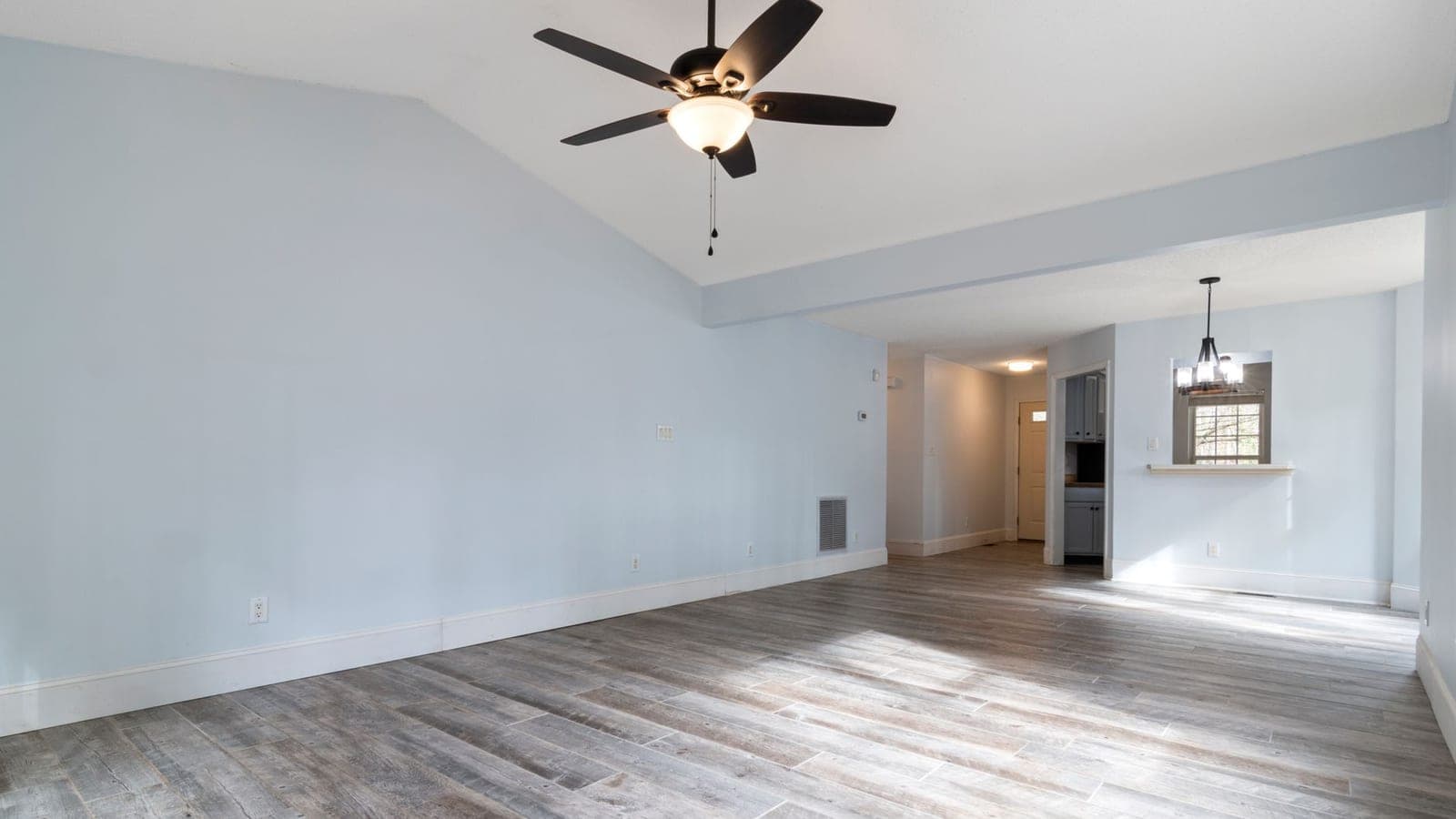
At a glance
The picks, ranked
Tap any row to jump to the full reasoning. Prices are live from Amazon where we have them, and read “check price” where we don’t — never a number we cannot verify today.
| # | Product | Best for | Price |
|---|---|---|---|
| 1 | Best fan half, with a light kit Visual Comfort Kingston 72" LED Ceiling Fan 385.0 CFM per watt on 27.8 W at 72 inches — strong certified fan performance in a fan-and-light fixture. | A large room needing one fixture to do both jobs | |
| 2 | 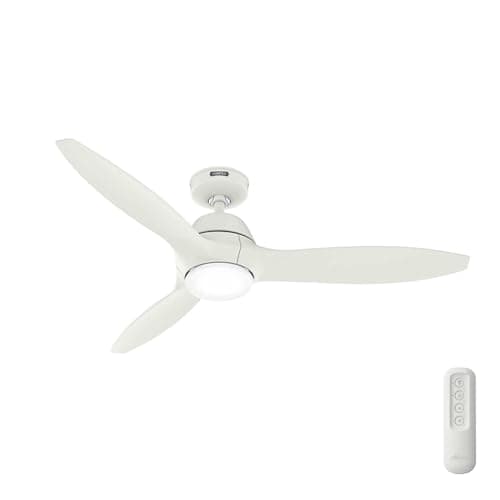 Best efficiency in a normal-sized fan-and-light Hunter Skyway 52" Ceiling Fan with Light Kit 363.8 CFM per watt on 16.3 W at 52 inches, with a light kit and a damp rating. | A standard room, or a damp indoor space like a sunroom | |
| 3 | Smallest fan-and-light worth having Maxim 42" Ceiling Fan with Light Kit 42 inches with an integrated light kit at 11.8 W — the practical answer when a small room needs both. | A small room where the fan is also the only ceiling fixture | |
| — | What you give up by insisting on a light Aeratron AE+2 60" Ceiling Fan 483.0 CFM per watt on 16.2 W, the highest certified figure of any ceiling fan. No light kit. | A room with separate lighting — where the fan can be just a fan |
A fan with a light is the default ceiling fixture in a lot of houses, and the certification data has something specific to say about them that is not on any box.
The finding
No certified ceiling fan has a certified lamp
The ENERGY STAR Certified Ceiling Fans dataset carries a field recording whether a fan ships with ENERGY STAR lamps.
We pulled every US-market record. All 1,398 read “No”.
That is worth being precise about, because it is easy to over-read. It does not mean the lights are bad, or inefficient, or that the fans are mis-labeled. Modern integrated LED modules are generally efficient regardless.
What it means is narrower and more useful: when you see the ENERGY STAR mark on a fan-with-light, it describes the fan. The lighting is outside what was tested and outside what the label covers.
So the light has to be judged the way you would judge any light fixture — lumens, color temperature, color rendering, dimming behavior, and whether the module is replaceable — from the manufacturer’s own figures rather than from the certification.
What is recorded
Dimmability, and connectivity
Two related fields the dataset does populate:
| Field | Across 1,398 US records |
|---|---|
| Ships with ENERGY STAR lamp | No — on every single record |
| Light kit dimmability | Yes on 1,393, No on 5 |
| Connected functionality | Yes on 53 (3.8%) |
ENERGY STAR Certified Ceiling Fans dataset, counted by us.
Dimmability is effectively universal — 1,393 of 1,398. It is not a differentiator, and paying extra for it would be paying for something every certified fan already has.
What varies is how a fixture dims and what it dims with. Integrated LED modules frequently want their own remote or a specific control rather than a standard wall dimmer, and putting an incompatible dimmer on one produces flicker or buzz. Check what the manufacturer specifies before rewiring anything.
This one is not a DIY job
Integrated LED modules are usually not lamp-replaceable. Most current fan-and-light fixtures use a sealed LED array rather than a socketed bulb. When the module fails, the options are a manufacturer replacement part or a new fixture — and parts availability for a discontinued model is a real risk.
If long service life matters more than the flush look, a fan taking a standard socketed lamp is easier to live with. Note that no certified fan ships an ENERGY STAR lamp in that socket either, so you would be choosing the bulb yourself regardless.
Wiring determines whether you can switch them separately. A single switched live to the ceiling means the fan and light share a switch, and you control them from a remote or pull chains. Independent wall switching needs two switched conductors, which is a wiring question rather than a fan question — worth settling before you choose the fixture.
The trade
What the light kit costs the fan
Comparing the fan-and-light fixtures on this page against fan-only models at similar spans:
| Fan | Span | Light | CFM/W | High |
|---|---|---|---|---|
| Aeratron AE+2 | 60 in | No | 483.0 | 16.2 W |
| Hunter 53606 | 60 in | No | 413.5 | 14.3 W |
| Visual Comfort Kingston | 72 in | Yes | 385.0 | 27.8 W |
| Hunter Vespucci | 52 in | No | 366.7 | 13.9 W |
| Hunter Skyway | 52 in | Yes | 363.8 | 16.3 W |
| Globe 27105 | 48 in | Yes | 270.7 | 21.6 W |
| Maxim 994403 | 42 in | Yes | 242.3 | 11.8 W |
The cleanest comparison is the two 52-inch Hunters: 366.7 CFM per watt fan-only against 363.8 with a light, and 13.9 W against 16.3 W. Under a one percent efficiency difference, and about 2.4 W more at full speed.
So the light kit is not a large penalty on the fan itself. The larger effect is on what is available: the highest-performing fans in the certified data tend to be fan-only, so insisting on a light narrows the field before you start.
Say the unwelcome thing
Do not read the ENERGY STAR label on a fan-and-light as covering the light.
It is the single most reasonable misreading in this category, and the dataset settles it: zero of 1,398 certified fans ship an ENERGY STAR lamp.
The certification tells you the fan moves a verified amount of air per watt. It tells you nothing about the lamp’s efficacy, its color rendering, its lifetime, or whether the module can be replaced when it fails.
Read those from the manufacturer’s own lighting specification, and read the certified figures for the fan. They are two purchases in one housing, and only one of them has been independently tested.
If the room has other lighting, a fan-only fixture gets you the better fan.
In full
Every pick, and what is wrong with it
Published specifications only, each linked to the page it came from. Where a manufacturer publishes nothing, the row says so — we do not fill blanks in.
1. Best fan half, with a light kit
Visual Comfort Kingston 72" LED Ceiling Fan
Visual Comfort & Co. · model Kingston 72 LED
385.0 CFM per watt on 27.8 W at 72 inches — strong certified fan performance in a fan-and-light fixture.
385.0 CFM per watt at 72 inches is genuinely good — comfortably above the 287.0 median for the 72–83 inch band across the certified dataset.
27.8 W on high, about 3.1¢ for a six-hour evening, and 4.1 W on low.
The number worth noticing is 1.2 W standby. That is drawn continuously, all year, whether the fan runs or not — roughly $1.93 a year on its own. Small, but it is the only figure on the fan that never stops.
The light is not part of what ENERGY STAR tested here, as it is not on any certified fan.
What’s wrong with it
1.2 W standby is the highest of the fans here, and like every certified fan its lamp is not covered by the certification.
Running cost — Kingston 72 LED
| Nameplate power | 4.1 W – 27.8 W | manufacturer's published figure |
|---|---|---|
| Energy, 8-hour night | 0.22 kWh | 27.8 ÷ 1000 × 8 |
| Cost per hour | 0.5¢ | at 18.34¢/kWh |
| Cost per 8-hour night | 4.1¢ | on the highest speed |
| Cost per 30 nights | $1.22 | 6.7 kWh |
| Same month, lowest speed | 18¢ | at 4.1 W |
Rate: 18.34¢/kWh, the US average residential price for June 2026 (EIA Electric Power Monthly, Table 5.3). Yours will differ — swap it in: (watts ÷ 1000) × hours × your rate.
| Blade span | 72 in |
|---|---|
| Efficiency | 385.0 CFM per watt |
| Power, high speed | 27.8 W |
| Power, low speed | 4.1 W |
| Standby power | 1.2 W |
| Type | Indoor, with light kit |
| Warranty | 3 years, components |
| ENERGY STAR | Certified |
Every figure above is from ENERGY STAR Certified Ceiling Fans dataset. Blanks are shown as “not published” rather than filled in.
2. Best efficiency in a normal-sized fan-and-light
Hunter Skyway 52" Ceiling Fan with Light Kit
Hunter · model 52" Skyway (damp-rated)
363.8 CFM per watt on 16.3 W at 52 inches, with a light kit and a damp rating.
363.8 CFM per watt at 52 inches, against a median of 190.4 across the 747 certified fans in that band. That is close to double the typical figure for its size.
16.3 W on high, 2.1 W on low, and 0.4 W standby — a third of the Kingston’s.
The damp rating suits a bathroom, a laundry or a sunroom. It is not an outdoor fan; the damp-versus-wet distinction is covered here and the certified dataset does not record it.
What’s wrong with it
Damp-rated is not wet-rated — it handles humidity and condensation, not rain landing on it.
Running cost — 52" Skyway (damp-rated)
| Nameplate power | 2.1 W – 16.3 W | manufacturer's published figure |
|---|---|---|
| Energy, 8-hour night | 0.13 kWh | 16.3 ÷ 1000 × 8 |
| Cost per hour | 0.3¢ | at 18.34¢/kWh |
| Cost per 8-hour night | 2.4¢ | on the highest speed |
| Cost per 30 nights | 72¢ | 3.9 kWh |
| Same month, lowest speed | 9.2¢ | at 2.1 W |
Rate: 18.34¢/kWh, the US average residential price for June 2026 (EIA Electric Power Monthly, Table 5.3). Yours will differ — swap it in: (watts ÷ 1000) × hours × your rate.
| Blade span | 52 in |
|---|---|
| Efficiency | 363.8 CFM per watt |
| Power, high speed | 16.3 W |
| Power, low speed | 2.1 W |
| Standby power | 0.4 W |
| Type | Indoor, with light kit; damp-rated |
| Warranty | 3 years, components |
| ENERGY STAR | Certified |
Every figure above is from ENERGY STAR Certified Ceiling Fans dataset. Blanks are shown as “not published” rather than filled in.
3. Smallest fan-and-light worth having
Maxim 42" Ceiling Fan with Light Kit
Maxim · model 994403FTBK
42 inches with an integrated light kit at 11.8 W — the practical answer when a small room needs both.
The honest small option. In a bedroom or box room, the ceiling fixture is often the only light, so a fan without one creates a second problem.
11.8 W on high, 3.7 W on low — about 1.7¢ for an eight-hour night at full.
242.3 CFM per watt is the weak point, and it is characteristic rather than a defect: the median for fans of 43 inches or less is 148.6, so this is well above typical for its size and well below what a larger fan manages.
What’s wrong with it
242.3 CFM per watt is well below what larger fans achieve, and 3.7 W on low is high for its size.
Running cost — 994403FTBK
| Nameplate power | 3.7 W – 11.8 W | manufacturer's published figure |
|---|---|---|
| Energy, 8-hour night | 0.09 kWh | 11.8 ÷ 1000 × 8 |
| Cost per hour | 0.2¢ | at 18.34¢/kWh |
| Cost per 8-hour night | 1.7¢ | on the highest speed |
| Cost per 30 nights | 52¢ | 2.8 kWh |
| Same month, lowest speed | 16¢ | at 3.7 W |
Rate: 18.34¢/kWh, the US average residential price for June 2026 (EIA Electric Power Monthly, Table 5.3). Yours will differ — swap it in: (watts ÷ 1000) × hours × your rate.
| Blade span | 42 in |
|---|---|
| Efficiency | 242.3 CFM per watt |
| Power, high speed | 11.8 W |
| Power, low speed | 3.7 W |
| Type | Indoor, with light kit |
| ENERGY STAR | Certified |
Every figure above is from ENERGY STAR Certified Ceiling Fans dataset. Blanks are shown as “not published” rather than filled in.
Skip this one
Aeratron AE+2 60" Ceiling Fan
Aeratron · model AE+2WI60
483.0 CFM per watt on 16.2 W, the highest certified figure of any ceiling fan. No light kit.
Listed as a skip purely on the brief, and it makes the cost of that brief visible.
483.0 CFM per watt on 16.2 W — the highest figure across all 1,398 certified US records. Against the best fan-and-light on this page, that is roughly 25% more air per watt on 40% less power.
The reason is not mysterious. A light kit shares the housing with the motor, adds mass below the blade disc, and constrains the aerodynamics of the whole fixture.
If the room has other lighting — or could — a separate light and a fan-only fixture gives you a better fan, a free choice of light, and independent switching.
What’s wrong with it
It is a skip only because it has no light. On every fan specification it is the best on this page by a wide margin.
Running cost — AE+2WI60
| Nameplate power | 2.9 W – 16.2 W | manufacturer's published figure |
|---|---|---|
| Energy, 8-hour night | 0.13 kWh | 16.2 ÷ 1000 × 8 |
| Cost per hour | 0.3¢ | at 18.34¢/kWh |
| Cost per 8-hour night | 2.4¢ | on the highest speed |
| Cost per 30 nights | 71¢ | 3.9 kWh |
| Same month, lowest speed | 13¢ | at 2.9 W |
Rate: 18.34¢/kWh, the US average residential price for June 2026 (EIA Electric Power Monthly, Table 5.3). Yours will differ — swap it in: (watts ÷ 1000) × hours × your rate.
| Blade span | 60 in |
|---|---|
| Efficiency | 483.0 CFM per watt |
| Power, high speed | 16.2 W |
| Power, low speed | 2.9 W |
| Type | Indoor |
| Light kit | No ENERGY STAR lamp shipped |
| Warranty | 3 years, components |
| ENERGY STAR | Certified, and on the Most Efficient list |
Every figure above is from ENERGY STAR Certified Ceiling Fans dataset. Blanks are shown as “not published” rather than filled in.
We are not linking a buy button for this one. If you want to look at it anyway, it is easy enough to find — but we would rather send you to something that fits your room.
Questions people actually ask
Frequently asked
Are ceiling fan lights ENERGY STAR certified?
No. All 1,398 US-market certified ceiling fans record 'No' for shipping with ENERGY STAR lamps. The blue label on a fan-with-light describes the fan — the lighting is outside what was tested.
Does a light kit make a ceiling fan less efficient?
Barely. Comparing two 52-inch Hunters, fan-only manages 366.7 CFM per watt and the version with a light 363.8 — under one percent. The bigger effect is on selection: the highest-performing certified fans tend to be fan-only.
Can you dim a ceiling fan light?
Almost always — 1,393 of 1,398 certified fans record dimmable light kits. What varies is how: integrated LED modules often want their own remote or a specific control rather than a standard wall dimmer, and a mismatched dimmer causes flicker or buzz.
Can you replace the bulb in a ceiling fan light?
Often not. Most current fixtures use a sealed integrated LED array rather than a socketed bulb, so a failed module means a manufacturer replacement part or a new fixture. Parts availability for a discontinued model is a real risk.
Should I buy a fan with a light or separate fixtures?
Separate, if the room allows it. You get a better fan — the top certified performers are fan-only — plus a free choice of light and independent switching. Buy the combination when the ceiling fixture has to do both jobs.
Can I switch the fan and light independently?
Only if the wiring supports it. A single switched live to the ceiling means they share a switch and you separate them with a remote or pull chains. Independent wall switching needs two switched conductors — a wiring question to settle before choosing the fixture.
Sources
Where these numbers came from
Read next
Where to go from here
Back to Whole-House Airflow, or read how we pick.