Guide and picks
How to clean a swamp cooler
The smell is not the pad. It is the six to sixteen gallons of warm standing water underneath it, and the clean has to start there.
By Sawyer V. · Published
The short answer
Unplug it, drain the tank, and work upward: tank, pump, distributor, then media. The tank is the source of the smell — these units hold 6.6 to 15.9 gallons of warm standing water. Scrub it with a mild solution, clear the pump inlet screen, flush the distributor tubes that have scaled shut, and rinse rigid media from the clean side outward. Then dry everything fully before it goes back together.
Fan & Frost earns a commission when you buy through our links, at no cost to you. It never changes a ranking, and we say so when the right answer is the cheaper unit or nothing at all. Full disclosure · How we pick.
At a glance
The picks, ranked
Tap any row to jump to the full reasoning. Prices are live from Amazon where we have them, and read “check price” where we don’t — never a number we cannot verify today.
| # | Product | Best for | Price |
|---|---|---|---|
| 1 | Easiest to actually clean Honeywell CL25AE Indoor Evaporative Cooler 25.4 lb and a 6.6 gallon tank — small enough to carry to a hose and tip out, which is the whole job made easy. | Anyone who wants maintenance to take ten minutes, not an hour | |
| 2 | Biggest tank, most to clean, best design Honeywell CO60PM Indoor/Outdoor Evaporative Cooler 15.9 gallons with a continuous hookup, and triple-sided honeycomb media that is designed to be rinsed. | A patio or garage where refill frequency matters more than weight | |
| 3 | 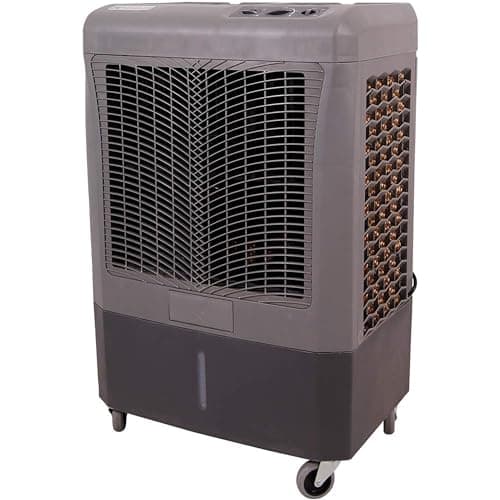 Best case for a continuous hookup Hessaire MC37M Mobile Evaporative Cooler 3,100 CFM on 250 W with a 10.3 gallon tank and a continuous hookup option that changes the maintenance picture. | A workshop or garage where the unit runs all day | |
| — | 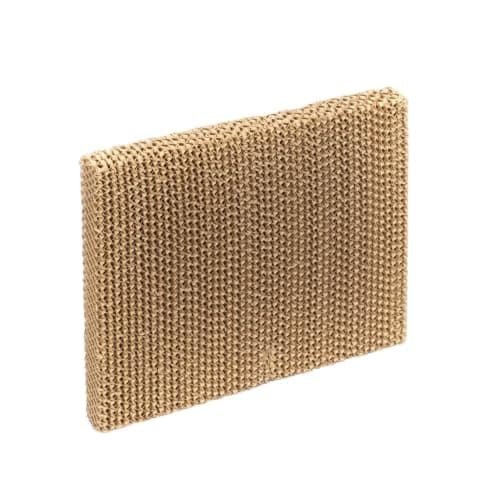 Have this ready before you start Hessaire CP370 Media Pad Set Not something to buy speculatively — but know the part number before you open the machine up. | The moment the rinse does not fix it |
Almost everyone who cleans a swamp cooler starts at the pad, because the pad is what they can see and what smells. That is the wrong end.
The pad smells because the water reaching it came out of a tank holding 6.6 to 15.9 gallons — the published capacities of the units on this page — that has been sitting warm and still. Clean the pad and put it back above the same tank and the smell returns within a day.
This one is not a DIY job
Unplug the unit before you open it. There is a submersible pump in a tank of water and a motor a few inches above it. This is not a job to do with the cord in the wall “just to check if the pump still runs”.
Wear gloves. What is on a neglected pad is biological growth, and rinsing it aerosolizes some of that — do this outdoors if you possibly can.
Do not use bleach on rigid honeycomb media unless the manufacturer explicitly permits it. It degrades the binder that holds the corrugations rigid, and a delaminated pad is a bypass gap.
Order of work
Bottom to top, and why
Work upward through the water path, in the direction water travels: tank, pump, distributor, media. Each stage feeds the next, so cleaning out of order means recontaminating what you just did.
- Drain the tank completely. Use the drain plug if there is one, and tip the unit if it is light enough — a 25 lb machine you can carry, a full 15.9 gallon tank is over 130 lb of water and you drain it in place.
- Scrub the tank. A soft brush and warm water with a mild detergent, or a dilute white vinegar solution for mineral film. Get into the corners, which is where sediment collects and where growth starts. Rinse and drain again.
- Clear the pump. Lift the pump out. It has an inlet screen or cage, and it will be clogged with sediment and scale. Rinse it, brush the screen, and soak the pump body in dilute vinegar if it is visibly furred. A pump running at half flow is the most common cause of a pad that only wets in patches.
- Flush the distributor. This is the tube or manifold that carries water from the pump to the top of the media. Its outlet holes scale shut, one at a time, and the failure is gradual enough that people never notice. Detach it, flush it through, and clear individual holes with a pin.
- Remove and rinse the media. For rigid honeycomb, rinse with a hose from the clean side outward, so debris goes out the way it came in rather than being driven deeper. For aspen fiber, do not bother rinsing — it compacts when handled wet. Replace it.
- Clean the housing and grille. Dust on the intake grille and blades reduces airflow, and lower airflow means less evaporation and less cooling. Same principle as a dusty fan, with water added.
- Dry everything fully before reassembly. This is the step people skip, and it is the one that determines whether the smell comes back. Leave the parts in air, or in sun if you have it, until they are genuinely dry rather than damp.
Diagnosis
What each symptom actually means
| Symptom | Where the fault usually is |
|---|---|
| Musty smell in the air stream | Standing water in the tank and biological growth in permanently-damp media |
| Pad wet in a stripe, dry either side | Distributor holes scaled shut, or a pump running at reduced flow |
| Cooling has faded gradually over a season | Mineral crust closing the pores of the media |
| Airflow noticeably weaker | Dust on the intake grille and blades, or collapsed media blocking the path |
| White dust settling on nearby surfaces | Minerals carried out of a heavily scaled pad in the air stream |
| Pump runs but no water reaches the pad | Blocked inlet screen, or an airlock in the distributor line |
Note how few of those are the pad itself. The pad is where the symptom shows; the pump, the distributor and the tank are where the cause tends to live.
Prevention
The habit that removes most of this
One change makes more difference than any cleaning schedule: run the fan with the pump switched off for the last ten to fifteen minutes of every session.
Airflow through wet media with no water feed dries the pad before the machine sits idle. Dry media does not grow anything, and it does not hold the concentrated mineral solution that turns into crust. Most coolers with a pump switch let you do this trivially; some have a dedicated dry-out mode.
Two more worth adopting:
- Drain the tank whenever the unit will be idle for more than a day. Warm standing water is the origin of essentially every swamp cooler smell.
- Do a full clean before storage, not after. A cooler put away dirty spends the off-season as a sealed, damp, dark box. The spring smell is created in October.
Say the unwelcome thing
Do not clean a cooler that is wrong for your climate and expect it to improve.
A thorough clean restores an evaporative cooler to its actual capability. If that capability was never enough, the clean will disappoint you.
These machines cool by evaporating water into the air. Where the air is already humid, there is little evaporative capacity available, so the cooler adds moisture and drops temperature barely at all — and a freshly cleaned pad evaporates more, making the humidity side worse.
If your cooler has always underperformed rather than declined over time, read the humidity question before you spend an afternoon on it. The comparison against an air conditioner covers what to do instead.
After
Putting it back
Reassemble dry, fill with clean water, and run the pump for two minutes with the fan off. Look at the media face: it should darken evenly, edge to edge, within that time.
If it does not, the distributor is still partly blocked — go back to step four. If it wets evenly and the cooler still underperforms, the media itself is finished and no cleaning will recover it. The pad guide covers what to buy and how to size it.
In full
Every pick, and what is wrong with it
Published specifications only, each linked to the page it came from. Where a manufacturer publishes nothing, the row says so — we do not fill blanks in.
1. Easiest to actually clean
Honeywell CL25AE Indoor Evaporative Cooler
Honeywell · model CL25AE
25.4 lb and a 6.6 gallon tank — small enough to carry to a hose and tip out, which is the whole job made easy.
Cleaning difficulty is almost entirely a function of two numbers: how heavy the machine is, and how big the tank is.
At 25.4 lb with a 6.6 gallon tank, this one you pick up and carry to a hose. Everything about the procedure below gets easier when you can work on the unit outside, tip it, and rinse it freely rather than sponging out a tank in place.
The trade-off is real and you should know it: 235 W to move 764 CFM, against the CO60PM’s 220 W for 2,697 CFM. You are paying in efficiency for the small size.
What’s wrong with it
764 CFM on 235 W is poor air-per-watt against the larger units, and the small tank needs refilling far more often.
Running cost — CL25AE
| Nameplate power | 235 W | manufacturer's published figure |
|---|---|---|
| Energy, 8-hour night | 1.88 kWh | 235 ÷ 1000 × 8 |
| Cost per hour | 4.3¢ | at 18.34¢/kWh |
| Cost per 8-hour night | 34¢ | on the highest speed |
| Cost per 30 nights | $10 | 56.4 kWh |
Rate: 18.34¢/kWh, the US average residential price for June 2026 (EIA Electric Power Monthly, Table 5.3). Yours will differ — swap it in: (watts ÷ 1000) × hours × your rate.
| Air delivery | 764 CFM |
|---|---|
| Power | 235 W |
| Water tank | 6.6 gallons |
| Air throw | 33 ft |
| Noise | 52-60 dBA |
| Speeds | 3, oscillating louvers |
| Timer | Up to 7.5 hours |
| Dimensions | 18.9 x 14.6 x 33.3 in |
| Weight | 25.4 lb |
| Manufacturer coverage claim | 466 sq ft |
| Warranty | 1 year |
Every figure above is from Honeywell Air Comfort product page, CL25AE. Blanks are shown as “not published” rather than filled in.
2. Biggest tank, most to clean, best design
Honeywell CO60PM Indoor/Outdoor Evaporative Cooler
Honeywell · model CO60PM
15.9 gallons with a continuous hookup, and triple-sided honeycomb media that is designed to be rinsed.
The largest tank here, and the clearest illustration of the trade. A 15.9 gallon reservoir with continuous hookup means you are not refilling it hourly. It also means the most standing water of any unit on this page, and standing water is what the clean is fundamentally about.
In its favor: triple-sided honeycomb media, which is rigid and rinsable, unlike aspen fiber. Three faces to rinse, but all three survive being rinsed.
2,697 CFM on 220 W, and 61–65 dBA. More on its media architecture here.
What’s wrong with it
15.9 gallons is over 130 lb of water when full — you are cleaning this one where it stands, not carrying it anywhere.
Running cost — CO60PM
| Nameplate power | 220 W | manufacturer's published figure |
|---|---|---|
| Energy, 8-hour night | 1.76 kWh | 220 ÷ 1000 × 8 |
| Cost per hour | 4.0¢ | at 18.34¢/kWh |
| Cost per 8-hour night | 32¢ | on the highest speed |
| Cost per 30 nights | $9.68 | 52.8 kWh |
Rate: 18.34¢/kWh, the US average residential price for June 2026 (EIA Electric Power Monthly, Table 5.3). Yours will differ — swap it in: (watts ÷ 1000) × hours × your rate.
| Air delivery | 2,697 CFM |
|---|---|
| Power | 220 W |
| Water tank | 15.9 gallons, continuous hookup |
| Air throw | 30 ft |
| Noise | 61-65 dBA |
| Speeds | 3, with oscillation |
| Pads | Triple-sided honeycomb |
| Dimensions | 27.6 W x 18.3 D x 40 H in |
| Weight | 39.2 lb |
| Manufacturer coverage claim | 1,643 sq ft |
| Warranty | 1 year |
Every figure above is from Honeywell Air Comfort product page, CO60PM. Blanks are shown as “not published” rather than filled in.
3. Best case for a continuous hookup
Hessaire MC37M Mobile Evaporative Cooler
Hessaire · model MC37M
3,100 CFM on 250 W with a 10.3 gallon tank and a continuous hookup option that changes the maintenance picture.
Worth understanding on a cleaning page because the continuous hookup is a maintenance feature as much as a convenience one.
A cooler on a float valve keeps water moving and the level constant. A cooler on a tank you fill by hand goes through a cycle of full, concentrated, nearly empty, refilled — and the concentrated phase is when minerals precipitate onto the pump and the distributor.
3,100 CFM on 250 W from a 10.3 gallon tank. The CP370 media set is the replacement pad, at 21 by 23 inches.
What’s wrong with it
40 lb, no published noise rating, and Hessaire publishes no pad replacement interval either. This is a shop machine, plainly.
Running cost — MC37M
| Nameplate power | 250 W | manufacturer's published figure |
|---|---|---|
| Energy, 8-hour night | 2.00 kWh | 250 ÷ 1000 × 8 |
| Cost per hour | 4.6¢ | at 18.34¢/kWh |
| Cost per 8-hour night | 37¢ | on the highest speed |
| Cost per 30 nights | $11 | 60.0 kWh |
Rate: 18.34¢/kWh, the US average residential price for June 2026 (EIA Electric Power Monthly, Table 5.3). Yours will differ — swap it in: (watts ÷ 1000) × hours × your rate.
| Air delivery | 3,100 CFM |
|---|---|
| Power | 250 W / 2.4 A |
| Water tank | 10.3 gallons, continuous hookup capable |
| Dimensions | 24 L x 16 W x 38 H in |
| Weight | 40 lb |
| Pads | Industrial-grade cooling pads |
| Coverage claim | Not published on the product page |
Every figure above is from Hessaire product page, MC37M. Blanks are shown as “not published” rather than filled in.
Skip this one
Hessaire CP370 Media Pad Set
Hessaire · model CP370
Not something to buy speculatively — but know the part number before you open the machine up.
Listed here as a contingency rather than a recommendation. Half the time a thorough clean restores a cooler completely and you need no parts at all.
The other half, you get the media out, look at it, and find crust that will not rinse or a pad that has delaminated. At that point the clean is pointless without a replacement.
Look up your part number before you start, so you are not reassembling a cooler you know is finished. For Hessaire 3,100 CFM units it is CP370, 21 by 23 inches. How to judge whether a pad is done.
What’s wrong with it
It only fits the 3,100 CFM Hessaire chassis, and no manufacturer replacement interval exists to tell you whether you need it yet.
Running cost
Hessaire does not publish a wattage for the CP370, so we cannot calculate what it costs to run. We are not going to estimate one. If Hessaire publishes a nameplate figure, this block will show the arithmetic.
| Fits | MC37, M150 and MFC3600 (3,100 CFM) coolers |
|---|---|
| Pad size | 21 x 23 in |
| Type | Replacement media pad set |
| Replacement interval | Not published by the manufacturer |
Every figure above is from Hessaire parts page, CP370 media pad set. Blanks are shown as “not published” rather than filled in.
We are not linking a buy button for this one. If you want to look at it anyway, it is easy enough to find — but we would rather send you to something that fits your room.
Questions people actually ask
Frequently asked
Why does my swamp cooler smell?
Almost always the tank, not the pad. These units hold 6.6 to 15.9 gallons of water that sits warm and still between runs, and that is where biological growth starts. Cleaning the pad alone leaves the source in place and the smell returns within a day.
What order should you clean a swamp cooler in?
Follow the water: tank, pump, distributor, then media, then the housing and grille. Each stage feeds the next, so cleaning the pad before the tank and distributor just recontaminates it.
Can you use bleach in a swamp cooler?
Not on rigid honeycomb media unless the manufacturer explicitly allows it — bleach degrades the binder holding the corrugations rigid, and delaminated media lets air bypass it. A mild detergent or dilute white vinegar handles the tank and the mineral film.
Why is only part of my cooler pad getting wet?
The distributor holes have scaled shut, or the pump inlet screen is clogged and flow has dropped. Air then takes the dry part of the pad because it offers less resistance, so the cooler moves plenty of air and cools very little.
How do you stop a swamp cooler smelling in the first place?
Run the fan with the pump off for the last ten to fifteen minutes of every session so the media dries before the machine sits, and drain the tank whenever it will be idle more than a day. Clean it before storage rather than after.
How often should you clean a swamp cooler?
At minimum, once before the season and once before storage. In hard water, or with daily use, monthly attention to the pump inlet screen and distributor is worth it — those two components degrade gradually enough that the loss of cooling is never obvious.
Sources
Where these numbers came from
Read next
Where to go from here
Back to Evaporative Coolers, or read how we pick.