Guide and picks
How many amps does a box fan use?
The number is smaller than almost everyone expects, which is why the interesting question is not the fan but everything else on the circuit.
By Sawyer V. · Published
The short answer
0.6 to 0.9 amps at 120 volts for a 20-inch box fan — Lasko publishes 73 to 102 W across its three speeds, and watts divided by volts gives amps. Across the whole fan category the published range runs from 0.06 A for a DC tower fan on low to 1.53 A for an air mover. A 15-amp circuit could carry a dozen box fans; what it cannot carry is one box fan and a hair dryer.
Fan & Frost earns a commission when you buy through our links, at no cost to you. It never changes a ranking, and we say so when the right answer is the cheaper unit or nothing at all. Full disclosure · How we pick.

At a glance
The picks, ranked
Tap any row to jump to the full reasoning. Prices are live from Amazon where we have them, and read “check price” where we don’t — never a number we cannot verify today.
| # | Product | Best for | Price |
|---|---|---|---|
| 1 | The fan this question is usually about Lasko Power Plus 20" Box Fan 73 to 102 W, published as 0.6 to 0.9 A at 120 V — the reference figure for a full-size 20-inch box fan. | A room, a doorway or a window, on any circuit in the house | |
| 2 | 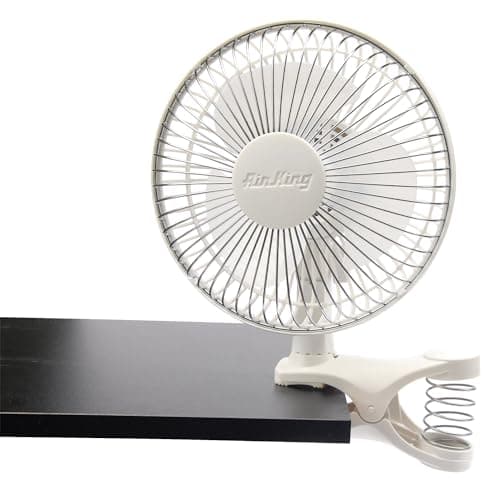 Lowest draw in the catalog Air King 6" Commercial Grade Clip-On Fan 9 to 12 W, published as 0.1 to 0.2 A — roughly a seventh of a box fan's current for one person's worth of air. | A desk, a bunk or anywhere a circuit is already loaded | |
| 3 | 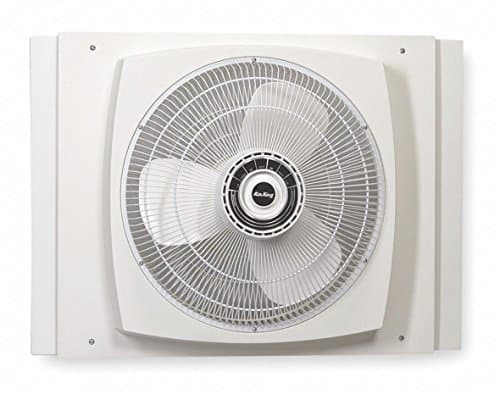 The one that publishes amps at every speed Air King 16" Whole House Window Fan 52 to 90 W, published as 0.5 to 0.8 A, while moving 1,360 to 2,470 CFM — less current than a box fan for far more air. | A window, where you want real air exchange without a big current draw |
The figures
Published amps by fan format
Every number below comes from the manufacturer’s own product page. Where a maker publishes watts but not amps, the amp column is our arithmetic at 120 V and is marked as such.
| Fan | Published watts | Amps at 120 V | 8-hour night |
|---|---|---|---|
| DC tower fan, low | 2.9 W | 0.06 A | 0.4¢ |
| 6 in clip-on fan | 9 - 12 W | 0.1 - 0.2 A | 1.8¢ |
| DC tower fan, high | 19 W | 0.303 A | 2.8¢ |
| 16 in window fan | 52 - 90 W | 0.5 - 0.8 A | 13¢ |
| 20 in box fan | 73 - 102 W | 0.6 - 0.9 A | 15¢ |
| 20 in window fan | 115 - 170 W | 1.0 - 1.4 A | 25¢ |
| 15 in air mover | 160 - 178 W | 1.35 - 1.53 A | 26¢ |
| Evaporative cooler | 250 W | 2.4 A | 37¢ |
The spread from top to bottom is a factor of forty, and almost all of it is format rather than brand. A DC motor on a low setting and an air mover built for drying floors are not doing the same job, and their current draw says so.
The arithmetic
Watts to amps, and back
US household outlets are nominally 120 V, so:
Amps = watts ÷ 120. A 102 W box fan is 0.85 A. A 12 W clip-on is 0.1 A. A 178 W air mover is 1.48 A.
Two details worth knowing before you trust a label:
- Nameplate amps are often higher than running amps. The plate states a maximum the motor can draw under load, not what it pulls sitting in a room. Where a manufacturer publishes both, as Lasko does, the published range is the useful figure.
- Startup current is brief and small. An AC induction motor draws a surge for a fraction of a second when it starts. On a fan drawing under an amp, that surge is not what trips breakers — unlike an air conditioner compressor, where it is exactly what does, as covered in will my circuit handle this air conditioner.
This one is not a DIY job
Circuits
How many fans can share one circuit?
A 15-amp household circuit is loaded to no more than 12 amps continuously, which is the US convention for anything running three hours or more. On that budget:
- Box fans at 0.9 A: thirteen of them, arithmetically.
- 20-inch window fans at 1.4 A: eight.
- Air movers at 1.53 A: seven, which is the realistic limit on a restoration job before someone reaches for a second circuit.
Nobody runs thirteen box fans in one room, so the practical answer is different: fans are never the problem on a circuit. The problem is the 1,500 W space heater, the 1,800 W hair dryer or the 1,200 W microwave sharing it. Add a fan to any of those and the fan is a rounding error; add a second heater and the breaker goes.
Off-grid
Generators, inverters and batteries
This is where amp figures earn their keep, because generator and inverter capacity is the one place a household actually runs out of current.
- Generators are sized in watts. A 20-inch box fan needs about 102 W running, so even a small recreational generator carries several, and the fan’s brief startup surge is negligible next to a refrigerator’s.
- Inverters follow the same arithmetic. A 300 W inverter runs one box fan comfortably; a 1,000 W unit runs several, subject to its own continuous rating rather than its peak.
- Battery runtime is watt-hours divided by watts. A 100 Ah 12 V battery holds about 1,200 Wh, of which perhaps half is usable on a lead-acid chemistry. At 102 W that is roughly six hours of box fan, before inverter losses. The same battery runs a 12 W clip-on fan for days.
- DC fans skip the inverter entirely. A fan that runs natively on 12 V or a battery pack avoids the conversion loss, which is why they dominate rechargeable fans and RV cooling.
The broader outage strategy, including what not to try to run, is in cooling during a power outage.
Cords
Extension cords, and where fans differ from air conditioners
Room air conditioners come with a blanket prohibition on extension cords, and it is not caution: at 5 to 15 amps, cord resistance causes a voltage drop, the motor compensates by drawing more current, and the plug melts.
A fan at under one amp is a different proposition, and manufacturers do not ban cords outright. The sensible rules still apply:
- Use a cord rated above the fan’s draw, with a three-prong grounded plug where the fan has one.
- Heavier gauge for longer runs. 16 AWG is fine for short household lengths; 14 AWG for 50 feet or a fan running all season.
- No daisy-chaining, and no coiled cord under a rug. Coiled cords under insulation get warm even at modest current.
- Outdoors, use an outdoor-rated cord on a GFCI, which matters for patio fans and misting fans in particular.
The cheaper question
What those amps cost
Current is what a circuit cares about; watt-hours are what the bill cares about. At 18.34¢/kWh a box fan on high costs 15¢ a night and $4.49 across a month of nights — against 1.8¢ a night for the clip-on and 0.4¢ for a DC tower on low.
The full watts-to-dollars method, for whatever fan you already own, is in how much electricity a fan uses.
Say the unwelcome thing
Do not size a generator or inverter on nameplate amps.
The number stamped on a motor plate is a maximum under load, and sizing an inverter to a stack of nameplate figures buys capacity nobody will use. It is how people end up with a 2,000 W inverter to run three fans that draw 250 W between them.
Use published running watts, add them up, then add a margin for the one appliance with a compressor. For fans specifically, 0.1 to 0.2 amps and 0.6 to 0.9 amps are the two figures that cover almost every situation in a house.
In full
Every pick, and what is wrong with it
Published specifications only, each linked to the page it came from. Where a manufacturer publishes nothing, the row says so — we do not fill blanks in.
1. The fan this question is usually about
Lasko Power Plus 20" Box Fan
Lasko · model B20801
73 to 102 W, published as 0.6 to 0.9 A at 120 V — the reference figure for a full-size 20-inch box fan.
Lasko publishes the numbers most box fan makers do not: 73 W on low and 102 W on high, which the same page states as 0.6 to 0.9 amps at 120 volts. That is the figure to plan around for any full-size 20-inch box fan.
Running cost follows directly. At 18.34¢/kWh, an eight-hour night on high is 15¢, and thirty of them is $4.49.
The weather-resistant motor is the specification that matters if it is going to sit in an open window overnight, which is where box fans do their most useful work — the method is in how to cool a room with a box fan.
What’s wrong with it
Lasko publishes no CFM figure for it, so there is no efficiency number to compare against a window fan, and a box fan seals nothing in a window opening.
Running cost — B20801
| Nameplate power | 73 W – 102 W | manufacturer's published figure |
|---|---|---|
| Energy, 8-hour night | 0.82 kWh | 102 ÷ 1000 × 8 |
| Cost per hour | 1.9¢ | at 18.34¢/kWh |
| Cost per 8-hour night | 15¢ | on the highest speed |
| Cost per 30 nights | $4.49 | 24.5 kWh |
| Same month, lowest speed | $3.21 | at 73 W |
Rate: 18.34¢/kWh, the US average residential price for June 2026 (EIA Electric Power Monthly, Table 5.3). Yours will differ — swap it in: (watts ÷ 1000) × hours × your rate.
| Power | 73 W - 102 W (0.6-0.9 A at 120 V) |
|---|---|
| Speeds | 3 |
| Dimensions | 21.25 H x 22.5 x 4.75 in |
| Weight | 10.1 lb |
| Motor | Weather-resistant |
| Air delivery (CFM) | Not published |
| Warranty | 2 years |
Every figure above is from Lasko product page, B20801. Blanks are shown as “not published” rather than filled in.
2. Lowest draw in the catalog
Air King 6" Commercial Grade Clip-On Fan
Air King · model 9145
9 to 12 W, published as 0.1 to 0.2 A — roughly a seventh of a box fan's current for one person's worth of air.
When current is genuinely the constraint — an RV, a workshop on one extension run, a bedroom circuit already carrying a heater — the answer is usually a smaller fan rather than a cleverer one.
0.1 to 0.2 A is small enough that ten of these together still draw less than a single box fan. An eight-hour night costs 1.8¢ at 18.34¢/kWh.
It is a personal fan, not a room fan: up to 190 CFM aimed at whoever it is clipped next to. Within that limit it is the most circuit-friendly cooling in the house.
What’s wrong with it
190 CFM cools one person within a few feet and does nothing for a room, and it has to clamp to something solid.
Running cost — 9145
| Nameplate power | 9 W – 12 W | manufacturer's published figure |
|---|---|---|
| Energy, 8-hour night | 0.10 kWh | 12 ÷ 1000 × 8 |
| Cost per hour | 0.2¢ | at 18.34¢/kWh |
| Cost per 8-hour night | 1.8¢ | on the highest speed |
| Cost per 30 nights | 53¢ | 2.9 kWh |
| Same month, lowest speed | 40¢ | at 9 W |
Rate: 18.34¢/kWh, the US average residential price for June 2026 (EIA Electric Power Monthly, Table 5.3). Yours will differ — swap it in: (watts ÷ 1000) × hours × your rate.
| Power | 9 W - 12 W (0.1-0.2 A at 120 V) |
|---|---|
| Air delivery | Up to 190 CFM |
| Noise | 34 dBA low, 37 dBA high |
| Speeds | 2 |
| Mounting | Spring-loaded clip, non-marking |
| Dimensions | 10.38 H x 6.25 L x 8.13 W in |
| Weight | 2.22 lb |
| Cord | 6 ft, 3-conductor |
| Listing | ETL listed, OSHA compliant |
| Warranty | 1 year |
Every figure above is from Air King product page, 9145 (via Lasko). Blanks are shown as “not published” rather than filled in.
3. The one that publishes amps at every speed
Air King 16" Whole House Window Fan
Air King · model 9155
52 to 90 W, published as 0.5 to 0.8 A, while moving 1,360 to 2,470 CFM — less current than a box fan for far more air.
Air King publishes airflow and power at every speed, which makes this the most checkable fan in the catalog: 2,470 / 1,700 / 1,360 CFM on 90 / 65 / 52 W, stated as 0.8 / 0.6 / 0.5 A.
Read that against the box fan above and the case for a window fan gets easier: fewer amps than a box fan on high, with a documented 2,470 CFM behind it instead of no published figure at all.
The formats are not interchangeable — one seals a window opening and one goes anywhere — which is the subject of box fan versus window fan.
What’s wrong with it
It needs a 26.5-inch-wide opening at least 22 inches high, weighs 15 lb, and out of a window it is useless.
Running cost — 9155
| Nameplate power | 52 W – 90 W | manufacturer's published figure |
|---|---|---|
| Energy, 8-hour night | 0.72 kWh | 90 ÷ 1000 × 8 |
| Cost per hour | 1.7¢ | at 18.34¢/kWh |
| Cost per 8-hour night | 13¢ | on the highest speed |
| Cost per 30 nights | $3.96 | 21.6 kWh |
| Same month, lowest speed | $2.29 | at 52 W |
Rate: 18.34¢/kWh, the US average residential price for June 2026 (EIA Electric Power Monthly, Table 5.3). Yours will differ — swap it in: (watts ÷ 1000) × hours × your rate.
| Air delivery | 2,470 / 1,700 / 1,360 CFM (high / medium / low) |
|---|---|
| Power | 90 / 65 / 52 W (0.8 / 0.6 / 0.5 A) |
| Efficiency | 27.4 CFM per watt on high, 26.2 on low (our arithmetic) |
| Blade | 16 in |
| Speeds | 3 |
| Window required | 26.5 - 34.5 in wide x 22 in high |
| Dimensions | 26.5 W x 8.25 D x 22 H in |
| Weight | 15.0 lb |
| Storm Guard | Window can close behind the fan |
| Mounting | Hardware included |
| Noise | Not published |
| ENERGY STAR | No program exists for window fans |
Every figure above is from Air King whole house window fan product page, models 9155 and 9166F. Blanks are shown as “not published” rather than filled in.
Questions people actually ask
Frequently asked
How many amps does a box fan use?
About 0.6 to 0.9 amps at 120 volts for a 20-inch model. Lasko publishes 73 watts on low and 102 on high for its Power Plus box fan, and watts divided by volts gives the amps.
How many watts does a box fan use?
73 to 102 watts across three speeds on the published example here. Smaller fans use far less — a 6-inch clip-on is 9 to 12 watts — and a 15-inch air mover built for drying draws 160 to 178. Watts to dollars.
How many box fans can you run on a 15-amp circuit?
Thirteen, arithmetically, since a 15-amp circuit carries 12 amps continuously and a box fan draws up to 0.9. In practice fans are never the constraint — a hair dryer or space heater on the same circuit is.
Can a generator run a box fan?
Easily. A box fan needs about 102 watts running, so even a small recreational generator carries several, and a fan's brief startup surge is trivial next to a refrigerator's. Cooling without mains power.
How long will a battery run a box fan?
A 100 Ah 12-volt battery holds roughly 1,200 watt-hours, of which about half is usable on lead-acid, so at 102 watts expect around six hours before inverter losses. A 12-watt clip-on fan on the same battery runs for days.
Is it safe to use an extension cord with a box fan?
Unlike air conditioners, which prohibit them outright, a fan drawing under an amp is fine on a properly rated cord. Use 16 AWG for short runs and 14 AWG for long ones, do not daisy-chain, and never run a coiled cord under a rug.
Sources
Where these numbers came from
- Lasko product page, B20801 Power Plus box fan — 73 to 102 W, 0.6 to 0.9 A at 120 V, three speeds, weather-resistant motor
- Air King product page, 9145 clip-on fan — 9 to 12 W, 0.1 to 0.2 A at 120 V, up to 190 CFM
- Air King whole house window fan product page — 52/65/90 W at 0.5/0.6/0.8 A for the 16-inch 9155 and 115/145/170 W at 1.0/1.2/1.4 A for the 20-inch 9166F
- Lasko product page, T42710 EcoQuiet DC tower fan — 2.9 to 19 W, 0.06 to 0.303 A at 120 V
- Lasko product page, U15720 Max Performance air mover — 160 to 178 W, 1.35 to 1.53 A at 120 V
- EIA Electric Power Monthly, Table 5.3 — average residential electricity price
Read next
Where to go from here
Back to Fans, or read how we pick.