The picks
The quietest ceiling fans, by the numbers that exist
Nobody certifies ceiling fan noise, so every quiet claim in the category is a word. Two numbers are certified, and they are the ones to buy on.
By Sawyer V. · Published
The short answer
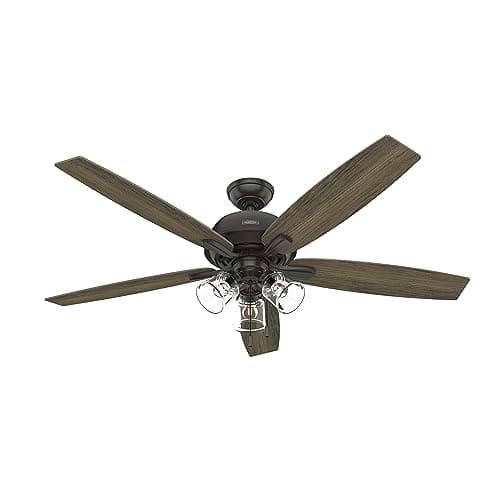
The Hunter 53606, at 1.0 W on low across a 60-inch span — the lowest certified low-speed draw of any fan we hold data for, which means the least motor work at the setting you actually sleep with. No ceiling fan manufacturer publishes a decibel figure and ENERGY STAR does not measure noise, so low-speed watts and certified CFM per watt are the only checkable proxies. The best of those is 483.0 CFM per watt.
Fan & Frost earns a commission when you buy through our links, at no cost to you. It never changes a ranking, and we say so when the right answer is the cheaper unit or nothing at all. Full disclosure · How we pick.
At a glance
The picks, ranked
Tap any row to jump to the full reasoning. Prices are live from Amazon where we have them, and read “check price” where we don’t — never a number we cannot verify today.
| # | Product | Best for | Price |
|---|---|---|---|
| 1 | Best overall Hunter 60" Ceiling Fan (53606) 1.0 W on low at a 60-inch span, certified at 413.5 CFM per watt and on the ENERGY STAR Most Efficient list. The least motor work at the setting that matters. | A bedroom or living room up to about 400 sq ft, run on low all night | |
| 2 | Least motor work of anything certified Aeratron AE+2 60" Ceiling Fan 483.0 CFM per watt — the highest certified efficiency in the entire US ceiling fan dataset, from a two-blade DC fan drawing 2.9 W on low. | A room where you want the most air for the least motor effort, at any price | |
| 3 | 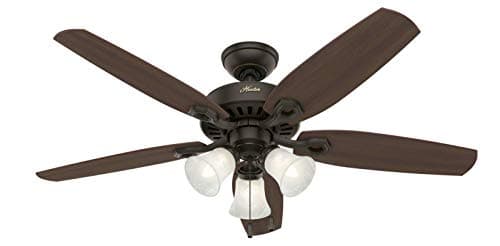 Best at 52 inches, with nothing to rattle Hunter Vespucci 52" Ceiling Fan 1.8 W on low and 366.7 CFM per watt at the span that fits most rooms, with no light kit — and a light kit is the most common source of ceiling fan noise. | A standard bedroom of 225 to 400 sq ft with a separate light | |
| 4 | 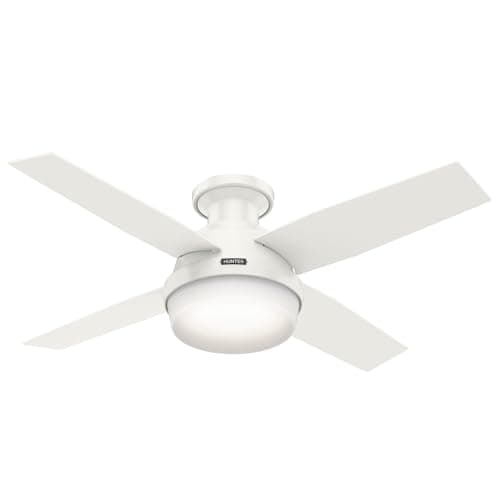 Best for a small room Hunter Martindale 44" Ceiling Fan 1.1 W on low — effectively tied for the lowest certified figure — in a 44-inch span that suits a room where a 52-inch fan would have no clearance. | A bedroom, nursery or office up to about 225 sq ft | |
| — | 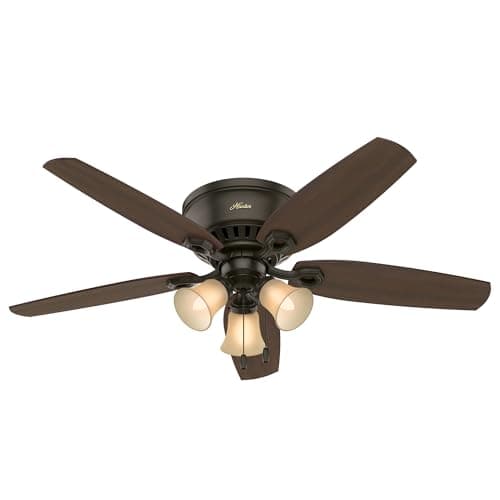 The mount to avoid if you have the height Hunter 52" Hugger Ceiling Fan 331.1 CFM per watt against 366.7 for the same brand's standard-mount 52-inch fan. That gap is the motor doing more work for the same air. | A ceiling under about eight feet, where a hugger is the only legal option |
There is no quiet ceiling fan rating. ENERGY STAR certifies ceiling fans on airflow and airflow efficiency and does not measure sound at all, and no manufacturer in our dataset publishes a decibel figure for a ceiling fan. Every “whisper quiet” in the category is a word.
That is worth stating plainly, because the same companies do publish noise figures elsewhere: bathroom exhaust fans are rated in sones by regulation, and portable fans from several brands publish dBA. The measurement capability exists. It is not applied here.
The method
Two certified numbers that stand in for a decibel figure
Ceiling fan noise comes from three places, and certified data covers two of them.
- Motor work, visible as low-speed watts. The setting you sleep with is low, and the fan that can do useful work on 1.0 W is a fan whose motor is barely engaged. This is the single most useful published number.
- Blade tip speed, visible as CFM per watt and span. Noise rises steeply with tip speed. A wide blade at high efficiency is moving a lot of air slowly; a narrow blade at low efficiency is moving less air faster.
- Mechanical rattle, not published anywhere. Balance, mount, box, light-kit shade. This is where most real-world ceiling fan noise actually comes from, and no specification will warn you.
The numbers
Certified data, ranked by low-speed draw
| Fan | Span | Watts, low | CFM per watt | Noise |
|---|---|---|---|---|
| Hunter 53606 | 60 in | 1.0 W | 413.5 | Not published |
| Hunter Martindale | 44 in | 1.1 W | 304.5 | Not published |
| Hunter Georgetown | 52 in | 1.5 W | 326.3 | Not published |
| Hunter Vespucci | 52 in | 1.8 W | 366.7 | Not published |
| Hunter 52 in hugger | 52 in | 1.9 W | 331.1 | Not published |
| Aeratron AE+2 | 60 in | 2.9 W | 483.0 | Not published |
| Fanimation MAD8531 | 84 in | 3.3 W | 420.0 | Not published |
Span, wattage and efficiency from the ENERGY STAR Certified Ceiling Fans dataset. The noise column is empty because ENERGY STAR does not measure sound and no manufacturer publishes a figure.
This one is not a DIY job
A ceiling fan you can hear is almost always a mounting problem, not a motor problem. Before replacing one, check that the electrical box is fan-rated and tight to a joist, that the downrod pin and set screws are seated, and that every light-kit screw is snug. A clicking or ticking fan is mechanical every time.
Buying
What to look for in a quiet ceiling fan
- Low-speed wattage under about 2 W. It is published in the ENERGY STAR data for most certified fans and it is the closest thing to a quietness rating in the category.
- A DC motor. Every fan at the top of the efficiency table uses one. They hold airflow at lower torque, and they do not produce the mains hum an AC motor with a capacitor speed control can. Why DC motors change the arithmetic.
- The widest span the room will take. A wide blade moving air slowly is quieter than a narrow blade moving the same air fast. 18 inches of clearance to every wall is the limit.
- No light kit, if you have another light. A glass shade is the most common rattle in a ceiling fan and it is entirely avoidable.
- A downrod rather than a hugger, whenever the ceiling height allows it.
Context
How this compares with fans that do publish figures
A certified ceiling fan on low is almost certainly the quietest thing in this house that moves air, and the absence of a number is frustrating rather than suspicious. For scale, among fans that do publish: a DC tower fan publishes 23 dBA on 2.9 W, a 6-inch clip-on publishes 34 dBA, and a 20-inch window fan publishes 50 dB on low. A 60-inch ceiling fan drawing 1.0 W is doing a third of the electrical work of the quietest of those.
The full decibel scale for cooling hardware.
Say the unwelcome thing
Do not buy a ceiling fan on a 'whisper quiet' claim.
It is not a measurement and no part of it is verified. ENERGY STAR certification covers airflow and efficiency only, so a fan can carry the label and the phrase simultaneously while nobody has ever measured its sound.
Buy on the certified numbers instead: low-speed watts, CFM per watt, and the widest span the room will take.
In full
Every pick, and what is wrong with it
Published specifications only, each linked to the page it came from. Where a manufacturer publishes nothing, the row says so — we do not fill blanks in.
1. Best overall
Hunter 60" Ceiling Fan (53606)
Hunter · model 53606
1.0 W on low at a 60-inch span, certified at 413.5 CFM per watt and on the ENERGY STAR Most Efficient list. The least motor work at the setting that matters.
1.0 W on low is the number. It is the lowest low-speed draw in our entire ceiling fan dataset, and low is where a bedroom fan spends its life.
Why that stands in for quiet: a motor consuming one watt is doing almost no work, and almost no work means almost no electrical hum, almost no bearing load and a blade turning slowly. Fan noise rises very steeply with blade tip speed, so the fan that can do useful work at the bottom of its range is the fan you will not hear.
413.5 CFM per watt certified, on the ENERGY STAR Most Efficient list, at 14.3 W on high. The 60-inch span is part of the quietness argument rather than separate from it: a wide blade moves its air slowly, and a narrow blade has to spin fast to move the same volume.
4.4¢ for a month of eight-hour nights on low. Even on high it is 63¢.
The honest gap: no dBA figure is published, by Hunter or by anyone. We are not going to invent one.
What’s wrong with it
Hunter publishes no noise figure for it, like everyone else, and 60 inches needs a room that can take it — 18 inches of clearance to every wall.
Running cost — 53606
| Nameplate power | 1 W – 14.3 W | manufacturer's published figure |
|---|---|---|
| Energy, 8-hour night | 0.11 kWh | 14.3 ÷ 1000 × 8 |
| Cost per hour | 0.3¢ | at 18.34¢/kWh |
| Cost per 8-hour night | 2.1¢ | on the highest speed |
| Cost per 30 nights | 63¢ | 3.4 kWh |
| Same month, lowest speed | 4.4¢ | at 1 W |
Rate: 18.34¢/kWh, the US average residential price for June 2026 (EIA Electric Power Monthly, Table 5.3). Yours will differ — swap it in: (watts ÷ 1000) × hours × your rate.
| Blade span | 60 in |
|---|---|
| Efficiency | 413.5 CFM per watt |
| Power, high speed | 14.3 W |
| Power, low speed | 1.0 W |
| Type | Indoor |
| Warranty | 3 years, components |
| ENERGY STAR | Certified, and on the Most Efficient list |
Every figure above is from ENERGY STAR Certified Ceiling Fans dataset. Blanks are shown as “not published” rather than filled in.
2. Least motor work of anything certified
Aeratron AE+2 60" Ceiling Fan
Aeratron · model AE+2WI60
483.0 CFM per watt — the highest certified efficiency in the entire US ceiling fan dataset, from a two-blade DC fan drawing 2.9 W on low.
483.0 CFM per watt is not a close-run figure. It is the best certified efficiency across all 1,398 US-market records we pulled, at any span.
Efficiency is the best single proxy for ceiling fan noise that exists in published data, because it measures exactly the thing noise comes from: how much electrical work the motor has to do to produce a given amount of air. A fan at 483 CFM per watt is converting almost everything it draws into air and almost nothing into heat, vibration and hum.
Two blades is how it gets there. Fewer blades means less drag, which lets a DC motor hold the same airflow at lower torque. It also means a very distinctive-looking fan.
2.9 W on low, 16.2 W on high, across a 60-inch span, with three years of component warranty. A month of nights on low is 13¢.
No light kit is certified with it, so if the room needs light from the fan, this is not the fan.
What’s wrong with it
No noise figure published, no ENERGY STAR lamp shipped if you want light, and a two-blade fan is a strong visual statement that not every room wants.
Running cost — AE+2WI60
| Nameplate power | 2.9 W – 16.2 W | manufacturer's published figure |
|---|---|---|
| Energy, 8-hour night | 0.13 kWh | 16.2 ÷ 1000 × 8 |
| Cost per hour | 0.3¢ | at 18.34¢/kWh |
| Cost per 8-hour night | 2.4¢ | on the highest speed |
| Cost per 30 nights | 71¢ | 3.9 kWh |
| Same month, lowest speed | 13¢ | at 2.9 W |
Rate: 18.34¢/kWh, the US average residential price for June 2026 (EIA Electric Power Monthly, Table 5.3). Yours will differ — swap it in: (watts ÷ 1000) × hours × your rate.
| Blade span | 60 in |
|---|---|
| Efficiency | 483.0 CFM per watt |
| Power, high speed | 16.2 W |
| Power, low speed | 2.9 W |
| Type | Indoor |
| Light kit | No ENERGY STAR lamp shipped |
| Warranty | 3 years, components |
| ENERGY STAR | Certified, and on the Most Efficient list |
Every figure above is from ENERGY STAR Certified Ceiling Fans dataset. Blanks are shown as “not published” rather than filled in.
3. Best at 52 inches, with nothing to rattle
Hunter Vespucci 52" Ceiling Fan
Hunter · model Vespucci
1.8 W on low and 366.7 CFM per watt at the span that fits most rooms, with no light kit — and a light kit is the most common source of ceiling fan noise.
1.8 W on low, 366.7 CFM per watt certified, at 52 inches — the span that fits the largest number of real bedrooms.
The quietness argument here is partly mechanical rather than electrical. No light kit means no glass shade, no retaining screws and no bulb socket, and a loose shade or a slightly unseated bulb is the single most common cause of a ceiling fan that rattles — more common than the motor by a distance.
7.9¢ for a month of nights on low, 61¢ if you run it on high.
0.8 W of standby runs every hour of the year, which is $1.29 annually before the blades move.
What’s wrong with it
No light. 13.9 W on high is more than the 60-inch fans above draw for more air, because a narrower blade works harder.
Running cost — Vespucci
| Nameplate power | 1.8 W – 13.9 W | manufacturer's published figure |
|---|---|---|
| Energy, 8-hour night | 0.11 kWh | 13.9 ÷ 1000 × 8 |
| Cost per hour | 0.3¢ | at 18.34¢/kWh |
| Cost per 8-hour night | 2.0¢ | on the highest speed |
| Cost per 30 nights | 61¢ | 3.3 kWh |
| Same month, lowest speed | 7.9¢ | at 1.8 W |
Rate: 18.34¢/kWh, the US average residential price for June 2026 (EIA Electric Power Monthly, Table 5.3). Yours will differ — swap it in: (watts ÷ 1000) × hours × your rate.
| Blade span | 52 in |
|---|---|
| Efficiency | 366.7 CFM per watt |
| Power, high speed | 13.9 W |
| Power, low speed | 1.8 W |
| Standby power | 0.8 W |
| Type | Indoor, fan only (no light kit) |
| Warranty | 3 years, components |
| ENERGY STAR | Certified |
Every figure above is from ENERGY STAR Certified Ceiling Fans dataset. Blanks are shown as “not published” rather than filled in.
4. Best for a small room
Hunter Martindale 44" Ceiling Fan
Hunter · model 44in Martindale
1.1 W on low — effectively tied for the lowest certified figure — in a 44-inch span that suits a room where a 52-inch fan would have no clearance.
1.1 W on low, within a tenth of a watt of the lowest figure in the dataset, at a span that actually fits a small room.
This is the pick that respects the clearance arithmetic. A 52-inch fan in a 12 by 12 room leaves under 18 inches to two walls, and a blade running close to a wall generates exactly the kind of turbulence noise you were trying to avoid. The span table.
10.1 W on high and 304.5 CFM per watt. The efficiency is lower than the 60-inch fans and that is physics, not a fault: a smaller blade must spin faster.
0.4 W of standby, among the lowest here. 4.8¢ for a month of nights on low.
What’s wrong with it
304.5 CFM per watt is well behind the 60-inch fans here, because a 44-inch blade has to turn faster for the same air. No light kit.
Running cost — 44in Martindale
| Nameplate power | 1.1 W – 10.1 W | manufacturer's published figure |
|---|---|---|
| Energy, 8-hour night | 0.08 kWh | 10.1 ÷ 1000 × 8 |
| Cost per hour | 0.2¢ | at 18.34¢/kWh |
| Cost per 8-hour night | 1.5¢ | on the highest speed |
| Cost per 30 nights | 44¢ | 2.4 kWh |
| Same month, lowest speed | 4.8¢ | at 1.1 W |
Rate: 18.34¢/kWh, the US average residential price for June 2026 (EIA Electric Power Monthly, Table 5.3). Yours will differ — swap it in: (watts ÷ 1000) × hours × your rate.
| Blade span | 44 in |
|---|---|
| Efficiency | 304.5 CFM per watt |
| Power, high speed | 10.1 W |
| Power, low speed | 1.1 W |
| Standby power | 0.4 W |
| Type | Indoor, fan only |
| Warranty | 3 years, components |
| ENERGY STAR | Certified |
Every figure above is from ENERGY STAR Certified Ceiling Fans dataset. Blanks are shown as “not published” rather than filled in.
Skip this one
Hunter 52" Hugger Ceiling Fan
Hunter · model 55130
331.1 CFM per watt against 366.7 for the same brand's standard-mount 52-inch fan. That gap is the motor doing more work for the same air.
This is a good fan, and it is the wrong choice if you are shopping specifically for quiet and you have the ceiling height to avoid it.
331.1 CFM per watt against 366.7 for the same brand’s standard-mount 52-inch fan, and 1.9 W on low against 1.8. The same pattern shows up at 44 inches: 295.9 against 304.5. A hugger consistently does more motor work for the same air.
The mechanism is blade-to-ceiling clearance. A fan mounted tight to the ceiling is drawing air through a restricted gap above the blade, which both reduces its efficiency and generates turbulence where a downrod-mounted fan has free air.
None of that means never buy a hugger. Under about eight feet of ceiling you have no choice, and 7 feet of floor clearance is a safety requirement rather than a preference. The flush-mount category, and the penalty measured.
What’s wrong with it
A flush mount runs the blade within a few inches of the ceiling, which costs certified efficiency and adds blade-to-ceiling turbulence. Choose it for clearance, never for quiet.
Running cost — 55130
| Nameplate power | 1.9 W – 14.5 W | manufacturer's published figure |
|---|---|---|
| Energy, 8-hour night | 0.12 kWh | 14.5 ÷ 1000 × 8 |
| Cost per hour | 0.3¢ | at 18.34¢/kWh |
| Cost per 8-hour night | 2.1¢ | on the highest speed |
| Cost per 30 nights | 64¢ | 3.5 kWh |
| Same month, lowest speed | 8.4¢ | at 1.9 W |
Rate: 18.34¢/kWh, the US average residential price for June 2026 (EIA Electric Power Monthly, Table 5.3). Yours will differ — swap it in: (watts ÷ 1000) × hours × your rate.
| Blade span | 52 in |
|---|---|
| Efficiency | 331.1 CFM per watt |
| Power, high speed | 14.5 W |
| Power, low speed | 1.9 W |
| Standby power | 0.5 W |
| Type | Indoor hugger (flush mount), fan only |
| Warranty | 3 years, components |
| ENERGY STAR | Certified, and on the Most Efficient list |
Every figure above is from ENERGY STAR Certified Ceiling Fans dataset. Blanks are shown as “not published” rather than filled in.
We are not linking a buy button for this one. If you want to look at it anyway, it is easy enough to find — but we would rather send you to something that fits your room.
Questions people actually ask
Frequently asked
What is the quietest ceiling fan?
No ceiling fan publishes a decibel figure, so there is no measured answer. On the certified data that does exist, the Hunter 53606 draws 1.0 W on low across a 60-inch span at 413.5 CFM per watt — the least motor work at the setting a bedroom fan actually runs on.
Do ceiling fans have a decibel rating?
No. ENERGY STAR certifies ceiling fans on airflow and airflow efficiency and does not measure sound, and no manufacturer in our dataset publishes a dBA figure. Bathroom exhaust fans are rated in sones by regulation; ceiling fans are not rated for noise at all.
Are DC ceiling fans quieter than AC ones?
The certified data supports it indirectly. Every fan at the top of the efficiency table uses a DC motor, and efficiency measures exactly how little electrical work the motor does for a given amount of air. DC motors also avoid the mains hum that an AC motor on a capacitor speed control can produce. DC versus AC fan motors.
Why is my ceiling fan noisy?
Almost always mechanical rather than electrical: a light-kit shade that has worked loose, a downrod pin or set screw that is not seated, an electrical box that is not fan-rated, or blade imbalance. A clicking or ticking fan is a mounting problem every time. Fixing a noisy fan.
Does a bigger ceiling fan run quieter?
Usually, yes. Fan noise rises steeply with blade tip speed, so a wide blade moving a given volume of air slowly is quieter than a narrow blade moving the same volume fast. That is visible in the certified data: the 60-inch fans here reach 413 to 483 CFM per watt while 44-inch fans reach about 300.
Are flush-mount ceiling fans noisier?
They do measurably more motor work for the same air. The certified efficiency of a 52-inch hugger is 331.1 CFM per watt against 366.7 for the same brand's standard-mount 52-inch fan, and at 44 inches it is 295.9 against 304.5. Choose a hugger for ceiling clearance, which is a safety requirement, not for quiet. Flush-mount fans.
Sources
Where these numbers came from
- ENERGY STAR Certified Ceiling Fans dataset — span, low-speed watts, high-speed watts and CFM per watt for every fan above
- ENERGY STAR Most Efficient 2026 — ceiling fans
- Lasko EcoQuiet T42710 DC tower fan — 23 dBA low, published, for scale
- Air King whole house window fan — 64/57/50 dB published, for scale
- EIA Electric Power Monthly, Table 5.3 — electricity rate
Read next
Where to go from here
Back to Whole-House Airflow, or read how we pick.