The picks
The best evaporative coolers, ranked on airflow per watt
Ranked on the two numbers manufacturers actually publish. We checked the coverage claims and they turn out to be arithmetic rather than measurement — the working is below.
By Sawyer V. · Published
The short answer
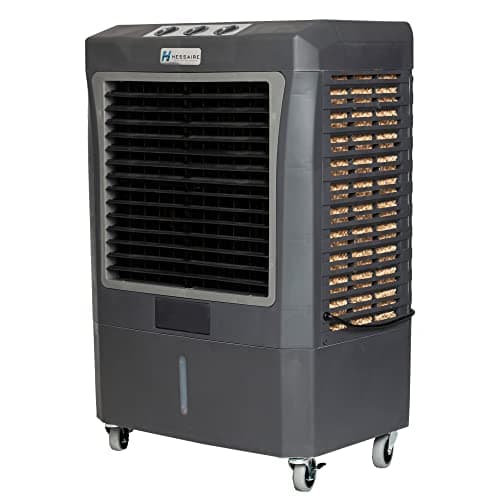
The Hessaire MC37M is the pick on the numbers: 3,100 CFM on 250 W, which is 12.4 CFM per watt, the best here. TheHoneywell CO60PM is a close second at 12.3. Both need dry air to work at all — below roughly 40% relative humidity — and both need a door or window open.
Fan & Frost earns a commission when you buy through our links, at no cost to you. It never changes a ranking, and we say so when the right answer is the cheaper unit or nothing at all. Full disclosure · How we pick.
At a glance
The picks, ranked
Tap any row to jump to the full reasoning. Prices are live from Amazon where we have them, and read “check price” where we don’t — never a number we cannot verify today.
| # | Product | Best for | Price |
|---|---|---|---|
| 1 | Best airflow per watt Hessaire MC37M Mobile Evaporative Cooler 3,100 CFM on 250 W is the best airflow-per-watt figure here, from the most complete spec sheet in the category. | A garage, workshop or covered patio in a dry climate | |
| 2 | Best documented Honeywell CO60PM Indoor/Outdoor Evaporative Cooler 12.3 CFM per watt, plus the noise figure, throw distance, speed count and pad configuration that Hessaire leaves out. | A patio or open garage where you want every spec published | |
| 3 | The only one that suits a room Honeywell CL25AE Indoor Evaporative Cooler 52-60 dBA and a 7.5-hour timer make it liveable indoors, at the cost of dramatically worse efficiency. | A single dry room with a window open |
An evaporative cooler pulls air through a wet pad. Evaporating water absorbs heat, so the air coming out is genuinely colder than the air going in. This is real cooling, not the perceived effect a fan produces, and it costs about a fifth of what refrigeration costs.
It also has one absolute condition, and we would rather lead with it than bury it.
Say the unwelcome thing
If your summers are humid, do not buy one of these.
The cooling comes from evaporation, and evaporation needs air with room to accept moisture. In Phoenix in June, at 15% relative humidity, that trade is excellent. In Houston, Miami, Atlanta or most of the eastern US in August, the air is already close to saturated — there is almost no evaporation available, so you get air that is barely cooler and noticeably damper. That feels worse, not better.
Roughly: below 40% relative humidity these work well; above 60% they are close to useless. The full threshold, and how to check your own climate, is here. Read that page before this one if you are not certain.
Our own analysis
The coverage claims are arithmetic, not measurement
Every evaporative cooler is sold with a square-footage figure, and those figures are what most buyers compare. So we checked them.
Take each Honeywell model’s published CFM and divide it by its published coverage claim:
| Model | CFM | Claimed sq ft | CFM ÷ sq ft |
|---|---|---|---|
| CO60PM | 2,697 | 1,643 | 1.64 |
| CO610PM | 2,669 | 1,626 | 1.64 |
| CO48PM | 1,702 | 1,037 | 1.64 |
| CL25AE | 764 | 466 | 1.64 |
| TC09PEU | 211 | 129 | 1.64 |
CFM and coverage figures from Honeywell’s own product pages. The division is ours, and you can reproduce it in a minute.
Every single model returns 1.64. From the 211 CFM desk unit to the 2,697 CFM outdoor one, across a thirteen-fold range of airflow, the ratio does not move.
That is not a coincidence and it is not a measurement. The “square feet” figure is the CFM figure divided by a constant. Which means:
- The coverage claim carries no information the CFM figure did not already carry. Comparing two units on square footage is the same as comparing them on airflow, with an extra step.
- It cannot account for humidity, which is the single variable that decides whether the unit works at all. The same machine in Phoenix and in Houston gets the same claimed coverage.
- It cannot account for ventilation, ceiling height, shade or heat load either.
So we rank on CFM per watt instead. It is the ratio that actually distinguishes these machines from one another, and both numbers in it are published.
The ranking
Airflow per watt, and what it costs
| Model | CFM | Watts | CFM/W | 30 × 8 hrs |
|---|---|---|---|---|
| Hessaire MC37M | 3,100 | 250 | 12.4 | $11 |
| Honeywell CO60PM | 2,697 | 220 | 12.3 | $9.68 |
| Honeywell CL25AE | 764 | 235 | 3.3 | $10 |
CFM and wattage from each manufacturer’s product page. CFM/W and cost are our arithmetic at 18.34¢/kWh.
The striking row is the last one. The small indoor unit draws more power than the large outdoor unit for a quarter of the airflow. If you assumed the compact model was the economical choice, it is not — you are paying a substantial efficiency penalty for the form factor.
For context, all three are cheap next to refrigeration. A 1,300 W portable air conditioner costs about $57 for the same thirty eight-hour periods, roughly five times the Hessaire. The full comparison is here.
Using one properly
Two rules that decide whether it works
One: leave something open. This is the rule people get wrong. An evaporative cooler continuously adds moisture to the air, so in a closed room the humidity climbs until evaporation slows and the cooling stops. It needs a route out — an open window, an open door, a garage door up. Airflow through the space, not around it.
That single requirement is why these are so well suited to a garage or a patio and so poorly suited to a sealed bedroom.
Two: keep the pads clean and wet. The pad is the machine. A dry pad cools nothing, and a scaled or moldy pad restricts airflow and smells. In hard-water areas mineral scale builds up noticeably over a season. Rinse the pads periodically, drain the tank when you store the unit, and budget for replacement pads as a consumable.
The ice compartments several of these units offer are worth almost nothing thermodynamically — the ice melts quickly and the amount of heat it absorbs is trivial next to the evaporation doing the real work. Not a reason to choose a unit.
In full
Every pick, and what is wrong with it
Published specifications only, each linked to the page it came from. Where a manufacturer publishes nothing, the row says so — we do not fill blanks in.
1. Best airflow per watt
Hessaire MC37M Mobile Evaporative Cooler
Hessaire · model MC37M
3,100 CFM on 250 W is the best airflow-per-watt figure here, from the most complete spec sheet in the category.
3,100 CFM at 250 W works out to 12.4 CFM per watt, the best ratio in this roundup. More airflow matters more here than in almost any other cooling category, because an evaporative cooler’s output is air that has already been cooled — moving more of it is moving more cooling.
The 10.3 gallon tank is the other reason this wins for a garage. At 250 W the running cost is about 37¢ for an eight-hour day, or $11 for a month of them — but the practical constraint on a swamp cooler is usually refilling it, not paying for it. A large tank plus a continuous water connection means you fill it once and forget it.
Notably, Hessaire publishes no coverage claim on the product page. Having done the arithmetic below on the coverage claims that do exist in this category, we think that is the more honest position, not a gap.
What’s wrong with it
Hessaire publishes no coverage claim, no noise figure and no speed count on the product page — and at 40 lb with a 10.3 gallon tank, a full unit is heavy to move despite the casters.
Running cost — MC37M
| Nameplate power | 250 W | manufacturer's published figure |
|---|---|---|
| Energy, 8-hour night | 2.00 kWh | 250 ÷ 1000 × 8 |
| Cost per hour | 4.6¢ | at 18.34¢/kWh |
| Cost per 8-hour night | 37¢ | on the highest speed |
| Cost per 30 nights | $11 | 60.0 kWh |
Rate: 18.34¢/kWh, the US average residential price for June 2026 (EIA Electric Power Monthly, Table 5.3). Yours will differ — swap it in: (watts ÷ 1000) × hours × your rate.
| Air delivery | 3,100 CFM |
|---|---|
| Power | 250 W / 2.4 A |
| Water tank | 10.3 gallons, continuous hookup capable |
| Dimensions | 24 L x 16 W x 38 H in |
| Weight | 40 lb |
| Pads | Industrial-grade cooling pads |
| Coverage claim | Not published on the product page |
Every figure above is from Hessaire product page, MC37M. Blanks are shown as “not published” rather than filled in.
2. Best documented
Honeywell CO60PM Indoor/Outdoor Evaporative Cooler
Honeywell · model CO60PM
12.3 CFM per watt, plus the noise figure, throw distance, speed count and pad configuration that Hessaire leaves out.
2,697 CFM on 220 W is 12.3 CFM per watt, within a rounding error of the Hessaire. What separates them is documentation: Honeywell publishes noise (61–65 dBA), throw distance (30 ft), speeds (3, with oscillation), pad configuration (triple-sided honeycomb), tank (15.9 gallons) and weight (39.2 lb). Hessaire publishes about half of that.
The 15.9 gallon tank is the largest here and the triple-sided pads matter more than they sound — three wet surfaces instead of one means more evaporative surface area for the same airflow, which is where the cooling actually happens.
About $9.68 for a month of eight-hour days at 18.34¢/kWh.
The noise figure is the reason this is a second pick rather than a first for indoor use. 61–65 dBA is conversational volume. In a garage with the door up, irrelevant. In a room, considerable.
What’s wrong with it
61-65 dBA is loud — normal conversation level — so this belongs outdoors or in a workshop, not anywhere near a room you sleep in. Its 1,643 sq ft coverage claim is also derived rather than measured (see below).
Running cost — CO60PM
| Nameplate power | 220 W | manufacturer's published figure |
|---|---|---|
| Energy, 8-hour night | 1.76 kWh | 220 ÷ 1000 × 8 |
| Cost per hour | 4.0¢ | at 18.34¢/kWh |
| Cost per 8-hour night | 32¢ | on the highest speed |
| Cost per 30 nights | $9.68 | 52.8 kWh |
Rate: 18.34¢/kWh, the US average residential price for June 2026 (EIA Electric Power Monthly, Table 5.3). Yours will differ — swap it in: (watts ÷ 1000) × hours × your rate.
| Air delivery | 2,697 CFM |
|---|---|
| Power | 220 W |
| Water tank | 15.9 gallons, continuous hookup |
| Air throw | 30 ft |
| Noise | 61-65 dBA |
| Speeds | 3, with oscillation |
| Pads | Triple-sided honeycomb |
| Dimensions | 27.6 W x 18.3 D x 40 H in |
| Weight | 39.2 lb |
| Manufacturer coverage claim | 1,643 sq ft |
| Warranty | 1 year |
Every figure above is from Honeywell Air Comfort product page, CO60PM. Blanks are shown as “not published” rather than filled in.
3. The only one that suits a room
Honeywell CL25AE Indoor Evaporative Cooler
Honeywell · model CL25AE
52-60 dBA and a 7.5-hour timer make it liveable indoors, at the cost of dramatically worse efficiency.
764 CFM on 235 W is 3.3 CFM per watt. Read that against the Hessaire’s 12.4 and the Honeywell CO60PM’s 12.3 and the oddity is obvious: this small indoor unit uses more electricity than the large outdoor one while moving roughly a quarter of the air.
That is not a defect so much as physics of scale — small fans and small motors are less efficient, and a compact cabinet restricts airflow. But it is worth knowing before you assume the small one is the frugal choice. It is not.
What you buy it for is liveability indoors: 52–60 dBA rather than 61–65, a 7.5-hour timer, a remote, oscillating louvers, and 25.4 lb rather than 40. In a dry-climate bedroom with a window cracked, it is the only unit here that makes sense.
$10 for a month of eight-hour nights.
What’s wrong with it
3.3 CFM per watt against the Hessaire's 12.4 — it draws MORE power than the big outdoor units for a quarter of the airflow. That is the price of the small form factor, and it is a steep one.
Running cost — CL25AE
| Nameplate power | 235 W | manufacturer's published figure |
|---|---|---|
| Energy, 8-hour night | 1.88 kWh | 235 ÷ 1000 × 8 |
| Cost per hour | 4.3¢ | at 18.34¢/kWh |
| Cost per 8-hour night | 34¢ | on the highest speed |
| Cost per 30 nights | $10 | 56.4 kWh |
Rate: 18.34¢/kWh, the US average residential price for June 2026 (EIA Electric Power Monthly, Table 5.3). Yours will differ — swap it in: (watts ÷ 1000) × hours × your rate.
| Air delivery | 764 CFM |
|---|---|
| Power | 235 W |
| Water tank | 6.6 gallons |
| Air throw | 33 ft |
| Noise | 52-60 dBA |
| Speeds | 3, oscillating louvers |
| Timer | Up to 7.5 hours |
| Dimensions | 18.9 x 14.6 x 33.3 in |
| Weight | 25.4 lb |
| Manufacturer coverage claim | 466 sq ft |
| Warranty | 1 year |
Every figure above is from Honeywell Air Comfort product page, CL25AE. Blanks are shown as “not published” rather than filled in.
Questions people actually ask
Frequently asked
What is the best evaporative cooler?
On published figures, the Hessaire MC37M: 3,100 CFM on 250 W, which is 12.4 CFM per watt, the best ratio we found. The Honeywell CO60PM is effectively tied at 12.3 and publishes more complete specifications, including noise and throw distance.
How do I compare evaporative coolers?
On CFM per watt, using the two figures manufacturers actually publish. Do not compare on the square-footage claim: every Honeywell model's claimed coverage is exactly its CFM divided by 1.64, so the figure is arithmetic rather than a measurement and adds nothing to the airflow number.
Do evaporative coolers work in humid weather?
No. The cooling comes from evaporating water into the air, so it needs air dry enough to accept moisture. Below about 40 percent relative humidity they work well; above about 60 percent you get air that is barely cooler and noticeably damper. The humidity threshold.
Can you use an evaporative cooler indoors?
Only with a window or door open. The unit continuously adds moisture, so in a closed room humidity climbs until evaporation slows and the cooling stops. The Honeywell CL25AE is the only unit here quiet enough for a room, at 52 to 60 dBA.
How much does an evaporative cooler cost to run?
Very little. At 18.34¢/kWh, a 250 W unit costs about 37¢ for an eight-hour day and $11 for thirty of them. A 1,300 W portable air conditioner costs roughly $57 over the same period.
Are the square footage claims on evaporative coolers accurate?
They are derived, not measured. Dividing each Honeywell model's published CFM by its coverage claim gives exactly 1.64 for every model in the range, from 211 CFM to 2,697 CFM. The claim is airflow divided by a constant, and it accounts for neither humidity nor ventilation.
Sources
Where these numbers came from
- Hessaire MC37M specifications — 3,100 CFM, 250 W, 10.3 gal
- Honeywell CO60PM specifications — 2,697 CFM, 220 W, 1,643 sq ft claim
- Honeywell CL25AE specifications — 764 CFM, 235 W, 466 sq ft claim
- Honeywell CO48PM — 1,702 CFM, 1,037 sq ft claim
- Honeywell CO610PM — 2,669 CFM, 1,626 sq ft claim
- EIA Electric Power Monthly, Table 5.3 — electricity rate
Read next
Where to go from here
Back to Evaporative Coolers, or read how we pick.